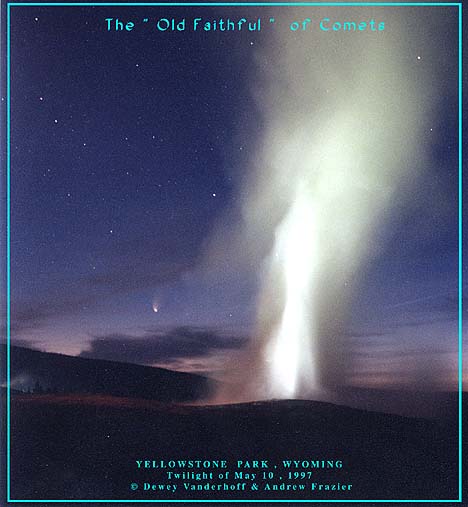
As Comet Hale-Bopp leaves our Northern Skies, it provides us with yet another burst of joy. On May 11th the fading comet was photographed behind the famous "Old Faithful" water geyser of Yellowstone National Park, Wyoming, USA, Planet Earth. Perhaps more familiar to Earth Dwellers than the dark geysers on Neptune's moon Triton, the gas geysers on Jupiter's moon Io, and the dirty water geysers hypothesized on Jupiter's moon Europa, Earth's Old Faithful is also reliable - every 60-80 minutes it gushes a plume of water and steam high into the air. Comet Hale-Bopp will continue to be visible to observers in the Southern Hemisphere as it moves away from the Sun towards the outer Solar System.
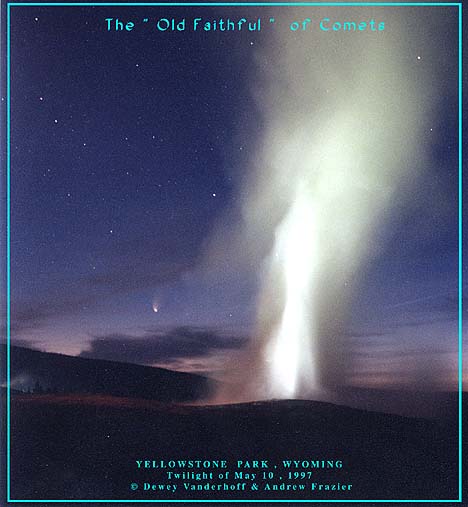
A medida que el cometa Hale-Bopp abandona nuestros cielos del hemisferio norte, nos brinda otro destello de alegría. El 11 de mayo, el cometa en declive fue fotografiado detrás del famoso géiser de agua "Old Faithful" del Parque Nacional Yellowstone, en Wyoming, EE. UU., planeta Tierra. Quizás más familiar para los habitantes de la Tierra que los géiseres oscuros de Tritón, luna de Neptuno, los géiseres de gas de Ío, luna de Júpiter, y los géiseres de agua sucia hipotetizados en Europa, luna de Júpiter, el Old Faithful terrestre es igualmente predecible: cada 60 a 80 minutos lanza un penacho de agua y vapor a gran altura en el aire. El cometa Hale-Bopp seguirá siendo visible para los observadores del hemisferio sur a medida que se aleja del Sol hacia las regiones exteriores del Sistema Solar.