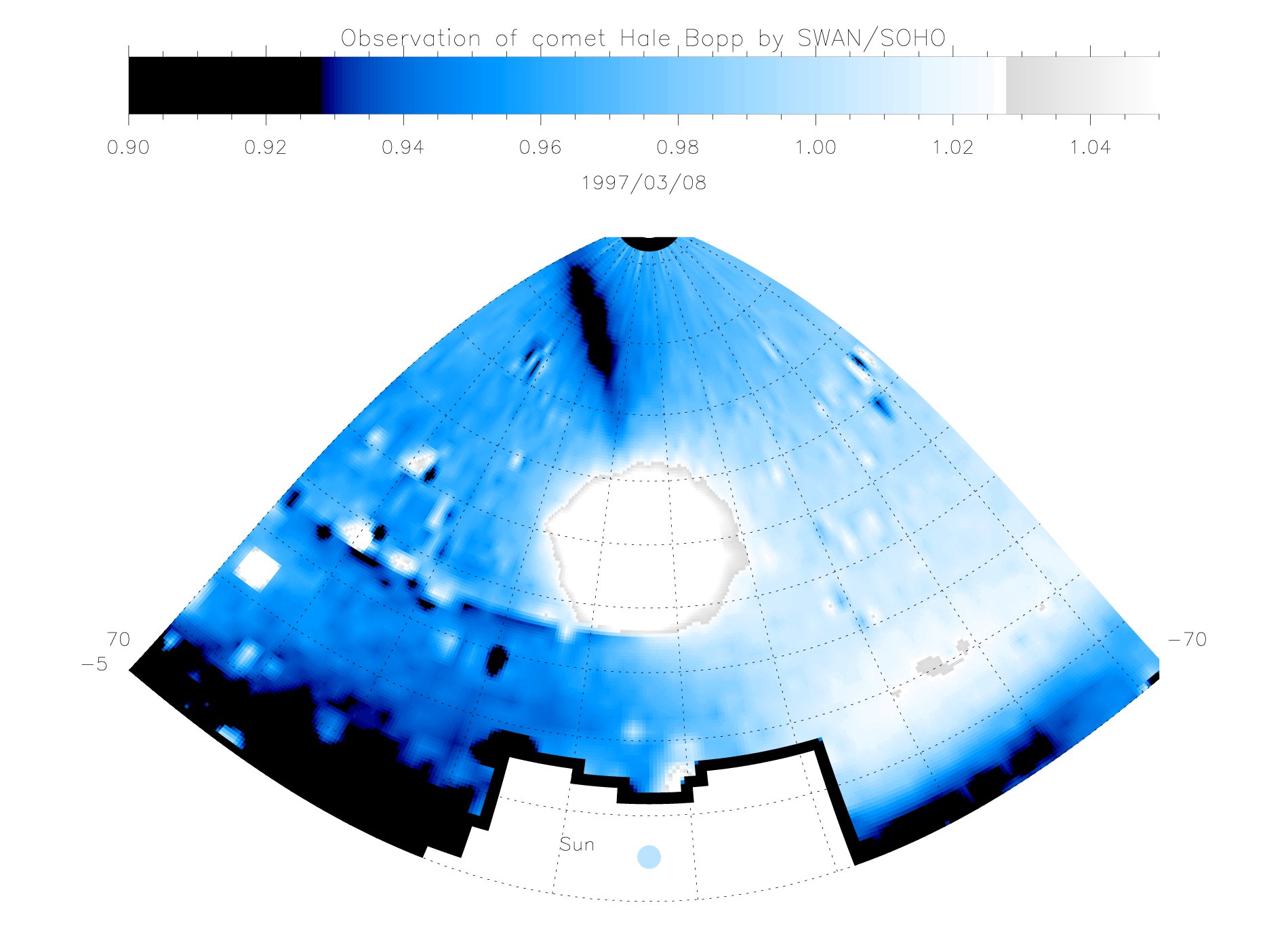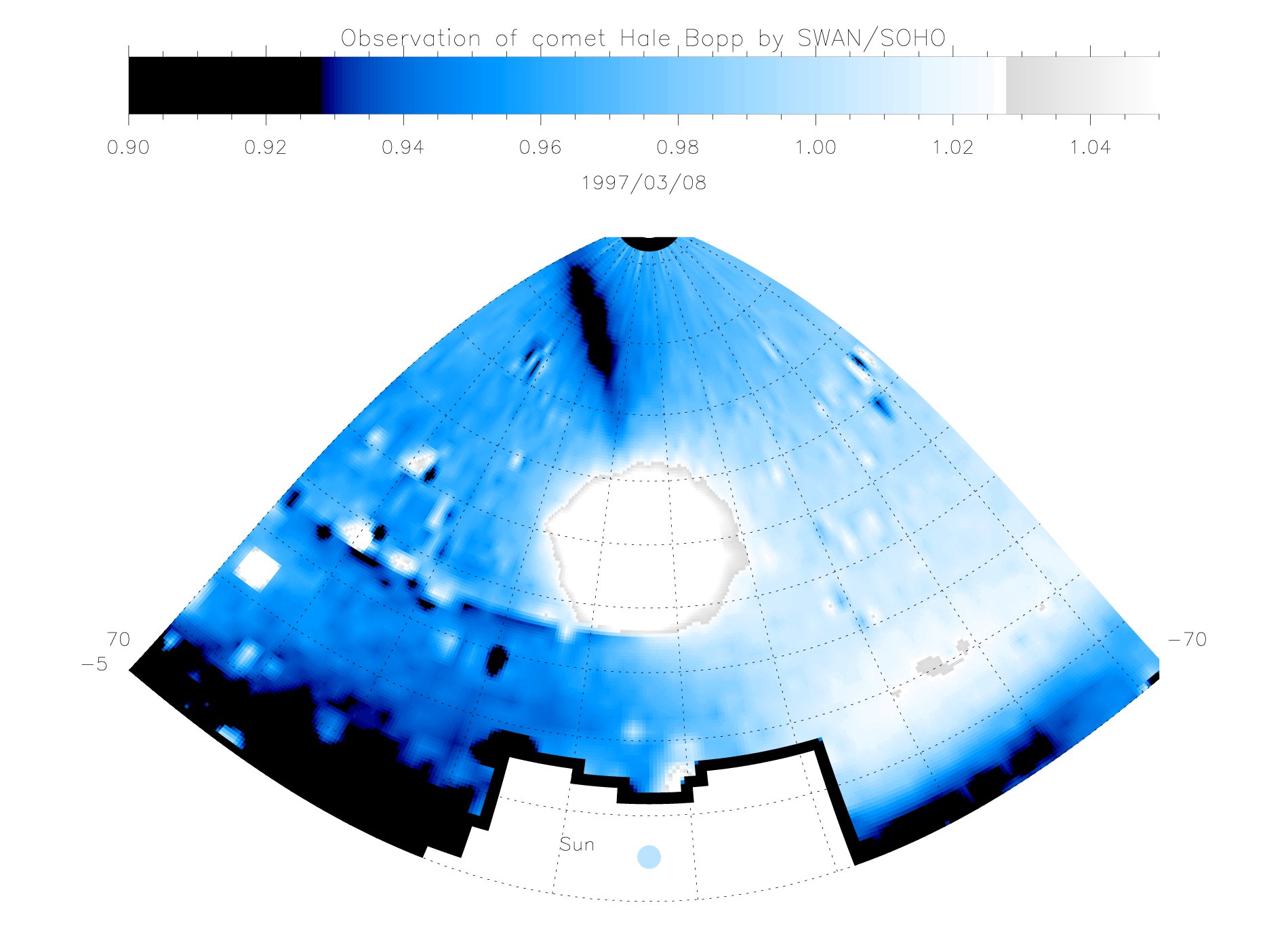
Hale-Bopp, the Great Comet of 1997, may have been the most viewed comet in history - visible even from bright metropolitan skies. Astronomers are now reporting that this magnificent comet also cast a shadow against the glare of the solar system's ultraviolet haze. This false-color image represents a slice of the sky viewed by the SWAN (Solar Wind ANisotropy) instrument aboard the space-based SOHO observatory. Recorded on March 8, 1997 it shows a general haze of solar ultraviolet light scattered by interstellar hydrogen. The sun itself is positioned below the bottom center of the cropped image and the large bright spot is ultraviolet sunlight scattered by the cloud of hydrogen gas surrounding Hale-Bopp's nucleus. Just above and to the left is a broad, diffuse, dark streak - the 150 million kilometer long shadow produced by the denser regions of this hydrogen envelope. Why are comets surrounded by hydrogen? The hydrogen comes from the breakup of water (H20) vapor released as the comet nucleus approaches the sun. These observations indicate that Hale-Bopp's nucleus was producing about 300 tons of water per second.
El cometa Hale-Bopp, el Gran Cometa de 1997, fue posiblemente el cometa más observado en la historia, visible incluso desde cielos urbanos con alta contaminación lumínica. Los astrónomos informan ahora que este magnífico cometa proyectó también una sombra contra el resplandor de la neblina ultravioleta del sistema solar. Esta imagen en falso color representa una porción del cielo observada por el instrumento SWAN (Solar Wind ANisotropy) a bordo del observatorio espacial SOHO. Registrada el 8 de marzo de 1997, muestra una neblina general de luz ultravioleta solar dispersada por hidrógeno interestelar. El Sol se encuentra por debajo del centro inferior de la imagen recortada, y la gran mancha brillante corresponde a la luz ultravioleta solar dispersada por la nube de gas hidrógeno que rodea el núcleo de Hale-Bopp. Justo arriba y a la izquierda se aprecia una franja oscura, amplia y difusa: la sombra de 150 millones de kilómetros de longitud producida por las regiones más densas de esta envoltura de hidrógeno. ¿Por qué están rodeados de hidrógeno los cometas? El hidrógeno proviene de la disociación del vapor de agua (H₂O) liberado cuando el núcleo del cometa se aproxima al Sol. Estas observaciones indican que el núcleo de Hale-Bopp producía aproximadamente 300 toneladas de agua por segundo.