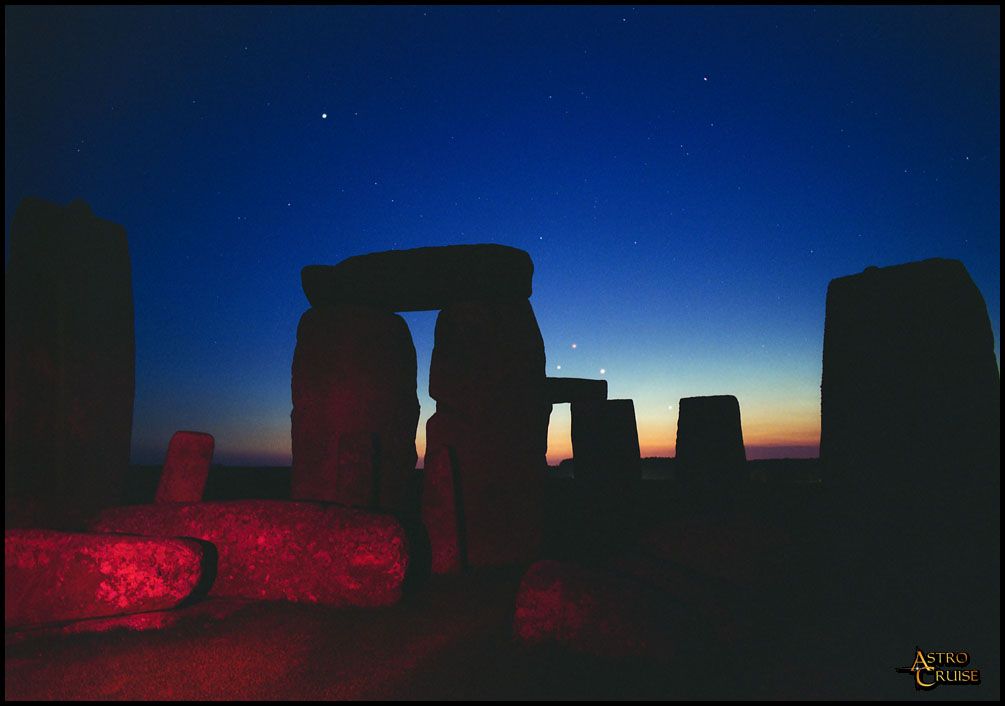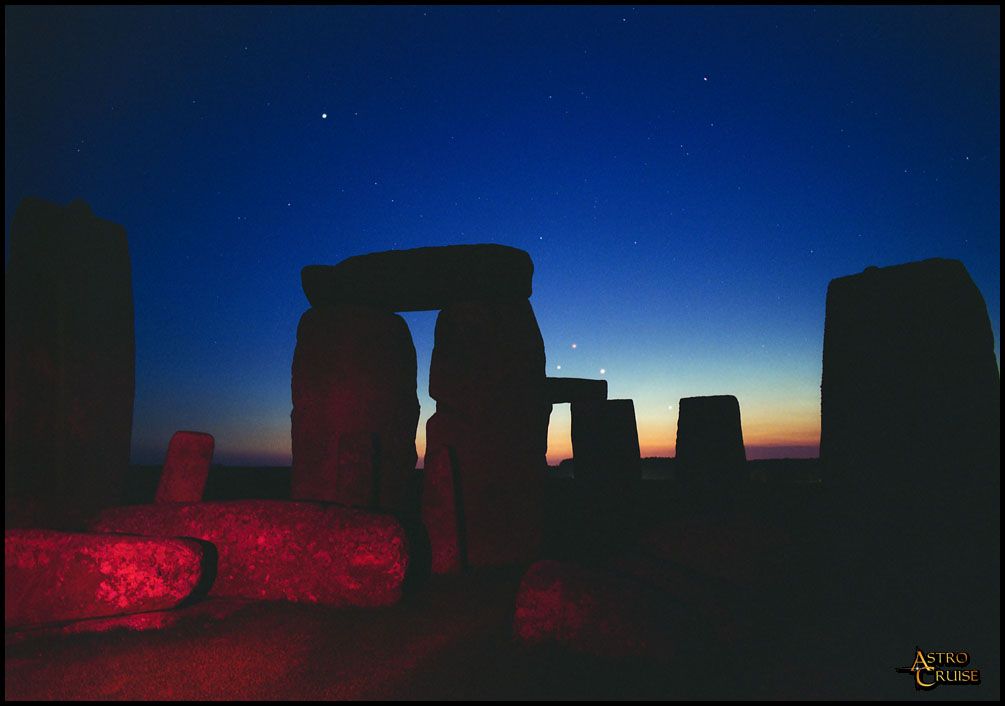
Stonehenge, four thousand year old monument to the Sun, provides an appropriate setting for this delightful snapshot of the Sun's children gathering in planet Earth's sky. While the massive stone structure dates from around 2000 B.C., this arrangement of the visible planets was recorded only a few days ago on the evening of May 4th, 2002 A.D. Bright Jupiter stands highest above the horizon at the upper left. A remarkable, almost equilateral triangle formed by Saturn (left), Mars (top), and Venus (right) is placed just above the stones near picture center. Fighting the glow of the setting sun, Mercury can be spotted closest to the horizon, below and right of the planetary triad. Still easy to enjoy for casual sky gazers, this photogenic and slowly shifting planetary grouping will be joined by a young crescent Moon beginning Monday, May 13.
Stonehenge, monumento de cuatro mil años de antigüedad dedicado al Sol, proporciona un escenario apropiado para esta encantadora instantánea de los hijos del Sol reuniéndose en el cielo del planeta Tierra. Aunque la estructura megalítica data de alrededor del año 2000 a.C., esta alineación de los planetas visibles fue registrada hace solo unos días en la tarde del 4 de mayo de 2002 d.C. Júpiter brillante se encuentra más alto sobre el horizonte en la parte superior izquierda. Un triángulo notable, casi equilátero, formado por Saturno (izquierda), Marte (arriba) y Venus (derecha) se sitúa justo encima de las piedras cerca del centro de la imagen. Compitiendo contra el brillo del sol poniente, Mercurio puede ser detectado más cerca del horizonte, debajo y a la derecha de la tríada planetaria. Todavía fácil de disfrutar para los astrónomos aficionados, este grupo planetario fotogénico y de lento desplazamiento será acompañado por una joven luna creciente a partir del lunes 13 de mayo.