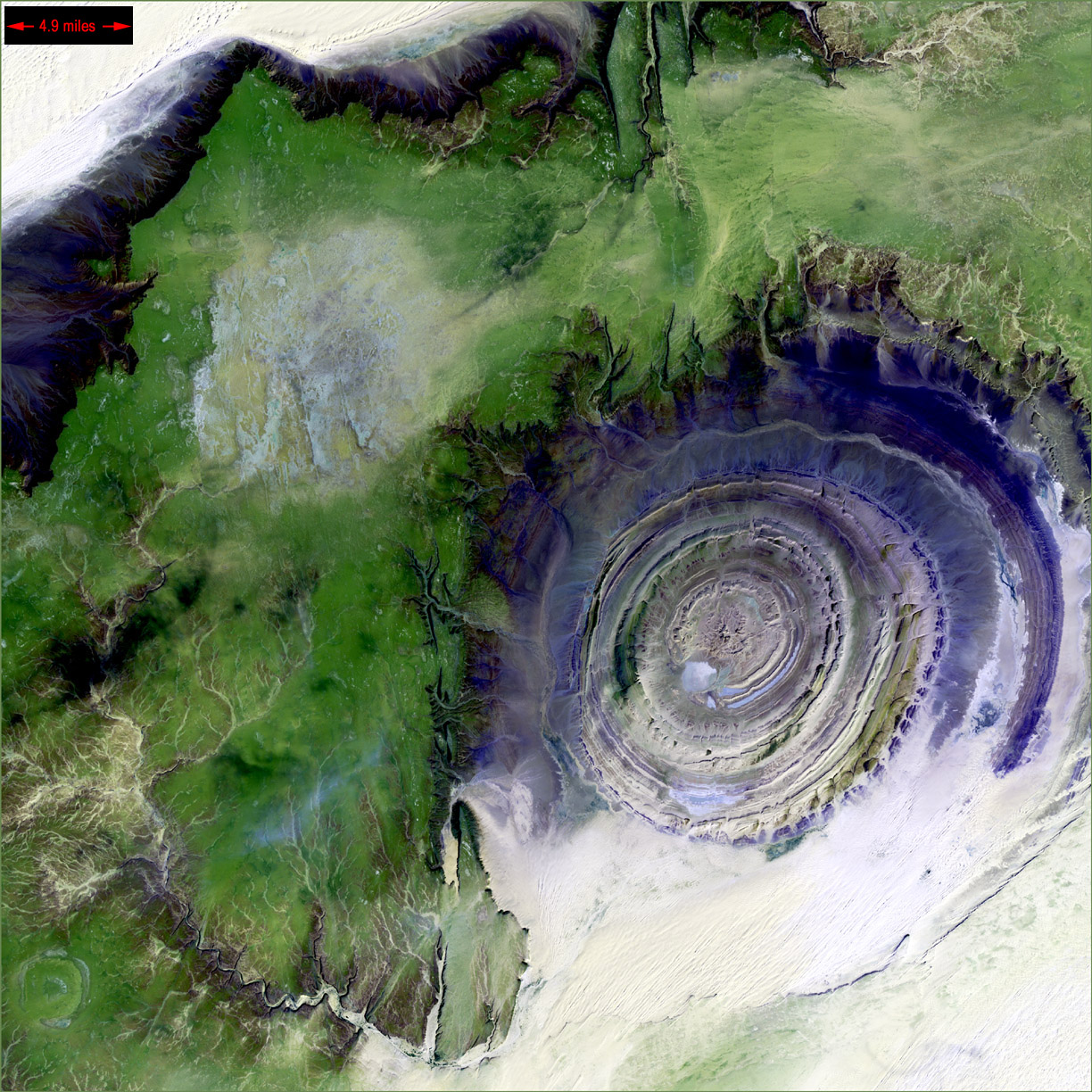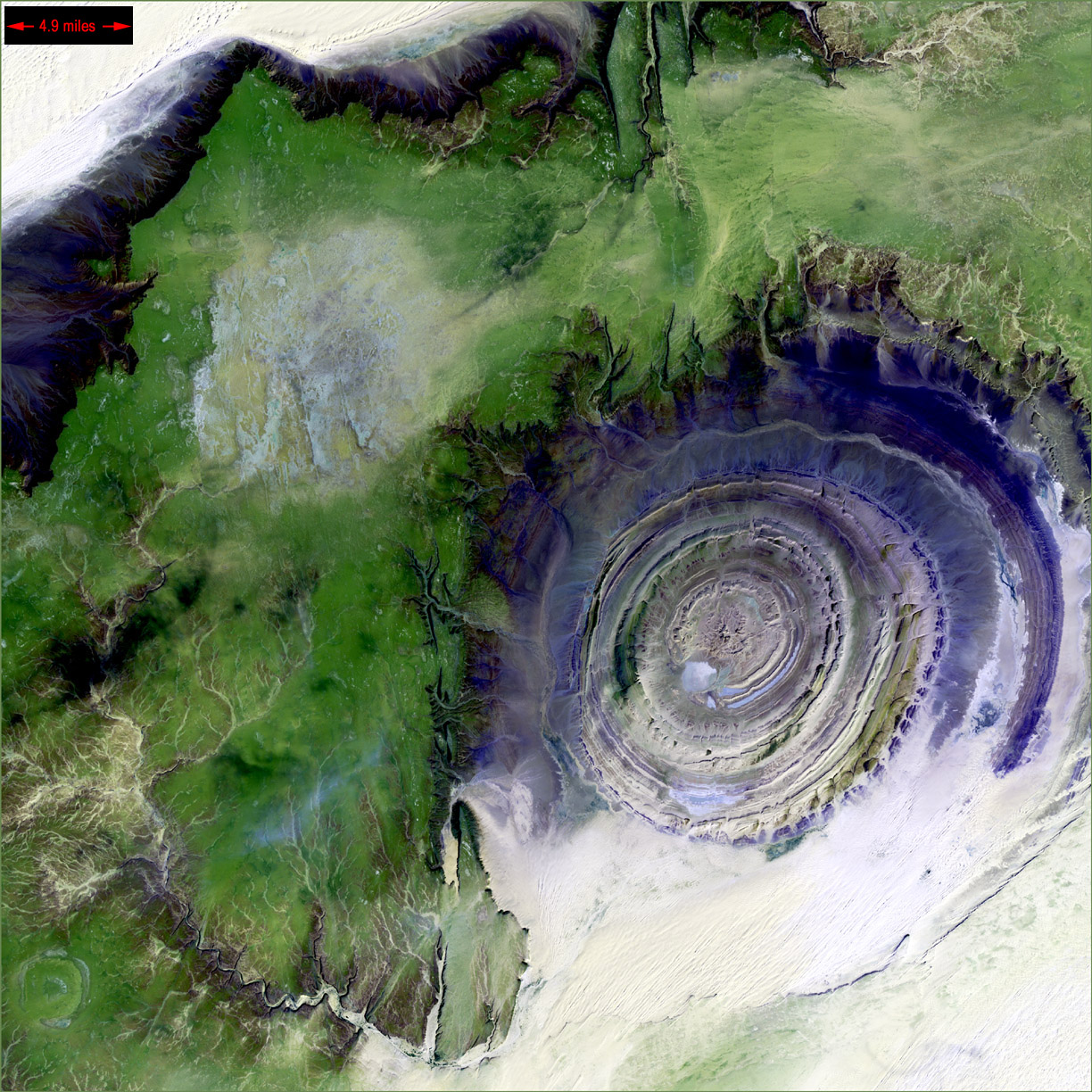
What on Earth is that? The Richat Structure in the Sahara Desert of Mauritania is easily visible from space because it is nearly 50 kilometers across. Once thought to be an impact crater, the Richat Structure's flat middle and lack of shock-altered rock indicates otherwise. The possibility that the Richat Structure was formed by a volcanic eruption also seems improbable because of the lack of a dome of igneous or volcanic rock. Rather, the layered sedimentary rock of the Richat structure is now thought by many to have been caused by uplifted rock sculpted by erosion. The above image was captured last year by the orbiting Landsat 7 satellite. Why the Richat Structure is nearly circular remains a mystery.
¿Qué es eso en la Tierra? La Estructura de Richat en el desierto del Sáhara de Mauritania es fácilmente visible desde el espacio porque mide casi 50 kilómetros de diámetro. Antaño se creía que era un cráter de impacto, pero la base plana de la Estructura de Richat y la ausencia de rocas alteradas por el impacto indican lo contrario. La posibilidad de que la Estructura de Richat se haya formado por una erupción volcánica también parece improbable debido a la falta de una bóveda de roca ígnea o volcánica. En cambio, muchos científicos consideran actualmente que la roca sedimentaria estratificada de la Estructura de Richat fue causada por el levantamiento de roca esculpida por la erosión. La imagen anterior fue capturada el año pasado por el satélite Landsat 7 en órbita. Por qué la Estructura de Richat es casi circular sigue siendo un misterio.