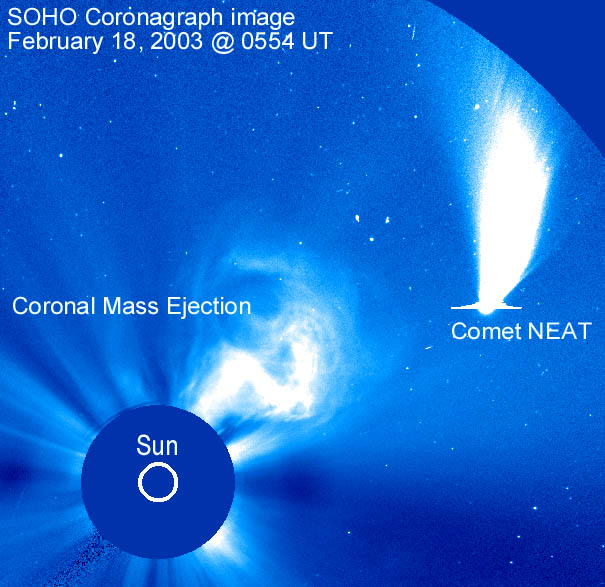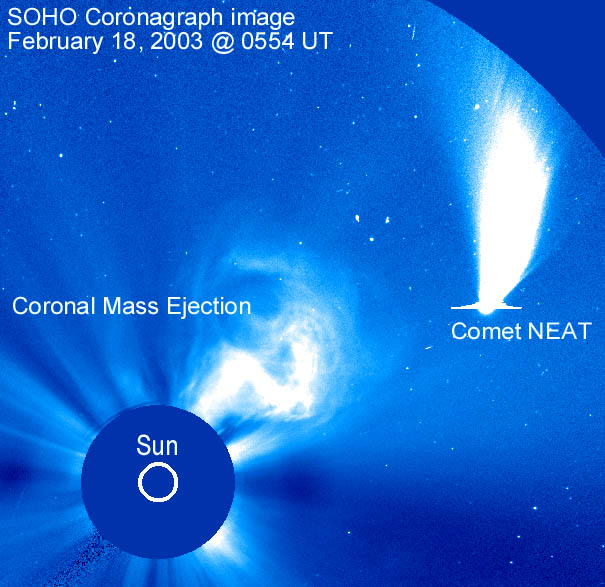
As Comet NEAT flared last week, the Sun roared. Just as the comet swooped inside the orbit of Mercury and developed a long and flowing tail of gas and dust, the Sun emitted a huge Coronal Mass Ejection (CME). Neither the fortuitous hot ball of solar gas nor the intense glare of sunlight appeared to disrupt the comet's nucleus. The action was too close to the Sun to be easily visible by humans, but the orbiting Sun-pointing SOHO satellite had a clear view of the celestial daredevil show. The above image was taken on February 18 when the comet was so bright it created an artificial horizontal streak on the camera image. During the encounter, Comet NEAT, official designation (C/2002 V1), brightened to second magnitude. An opaque disk blocked the Sun's image. The now-outbound comet remains bright but will surely fade as it moves away from the Sun. Nevertheless, Comet NEAT will likely be visible with binoculars to southern hemisphere observers for the next month.
Mientras el Cometa NEAT se iluminaba intensamente la semana pasada, el Sol rugía. Justo cuando el cometa se acercó dentro de la órbita de Mercurio y desarrolló una larga y fluida cola de gas y polvo, el Sol emitió una enorme Eyección de Masa Coronal (CME). Ni la afortunada bola incandescente de gas solar ni el brillo intenso de la luz solar parecieron perturbar el núcleo del cometa. La acción fue demasiado cercana al Sol para ser fácilmente visible por los humanos, pero el satélite SOHO en órbita, orientado hacia el Sol, tuvo una vista clara de este espectáculo celestial de audacia. La imagen anterior fue tomada el 18 de febrero cuando el cometa era tan brillante que creó una raya horizontal artificial en la imagen de la cámara. Durante el encuentro, el Cometa NEAT, con la designación oficial (C/2002 V1), se iluminó alcanzando magnitud dos. Un disco opaco bloqueó la imagen del Sol. El cometa, ahora en su trayectoria de salida, permanece brillante pero sin duda se desvanecerá a medida que se aleja del Sol. Sin embargo, el Cometa NEAT probablemente seguirá siendo visible con binoculares para los observadores del hemisferio sur durante el próximo mes.