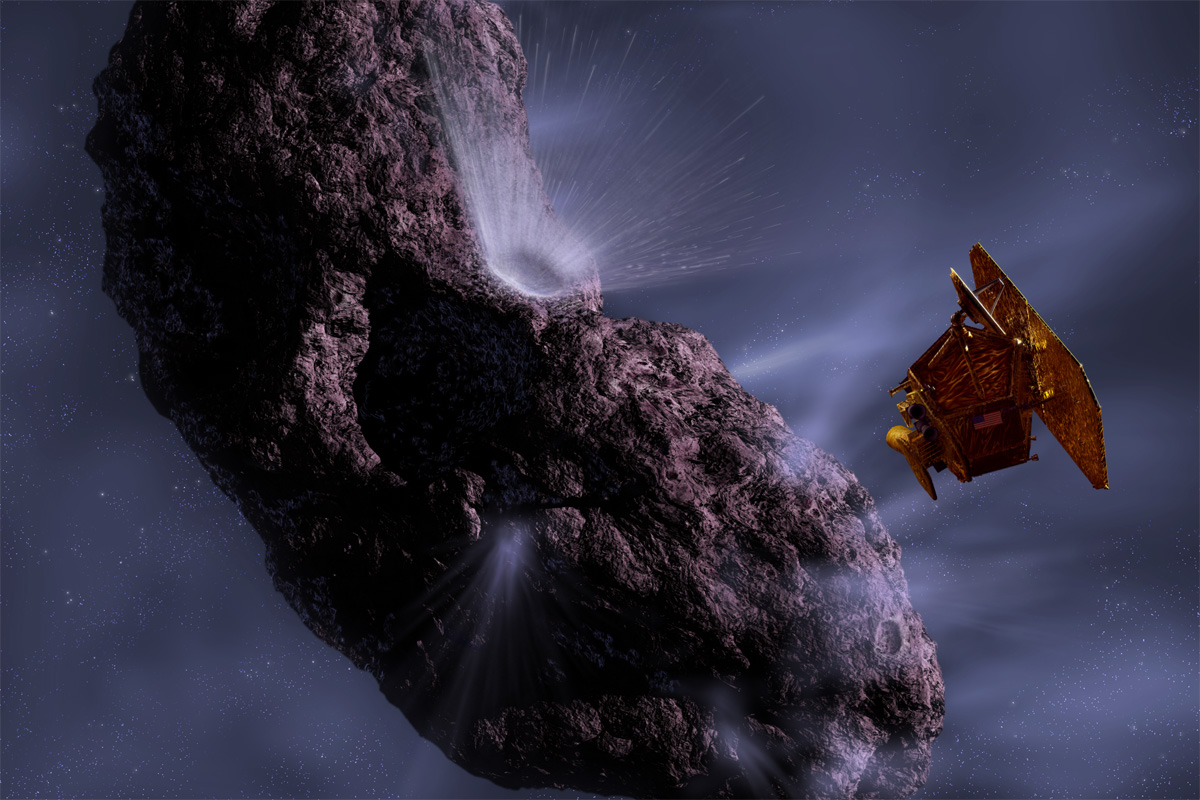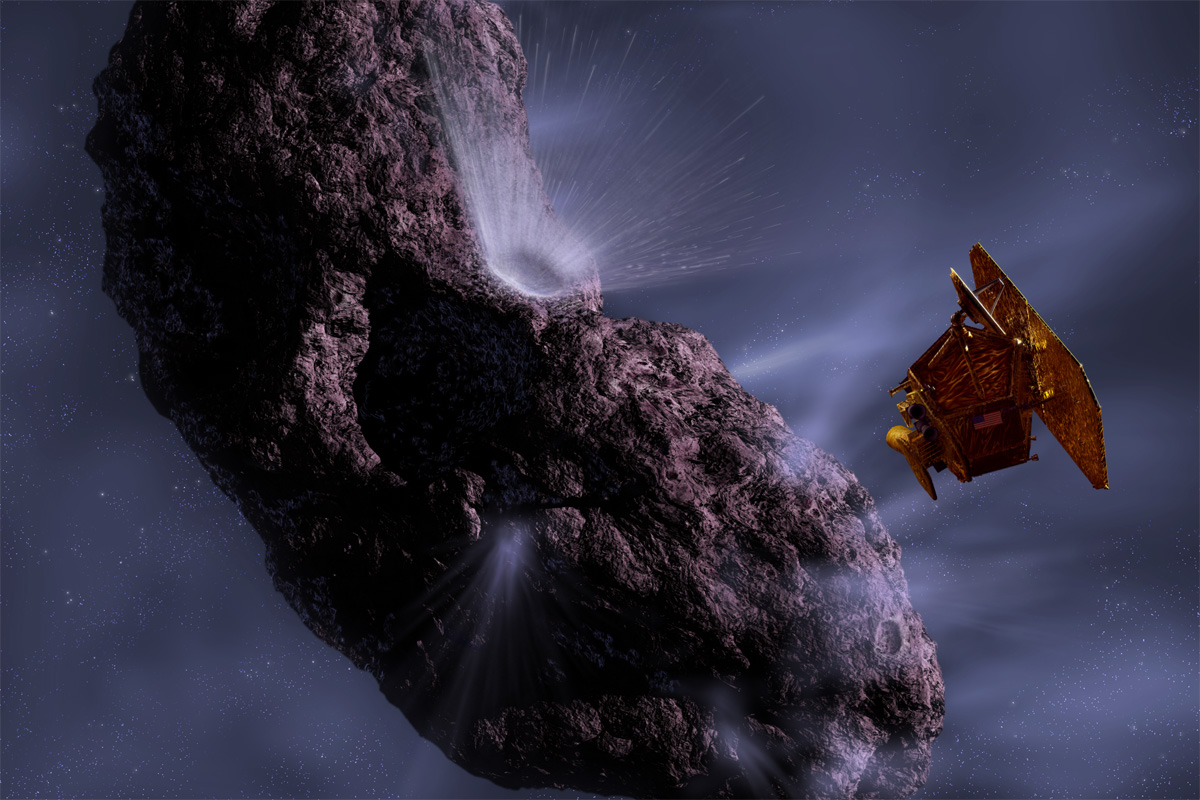
What happens when you crash into a comet? That was a question considered by astronomers when they designed the Deep Impact mission, launched in January. This coming July 4, the Deep Impact spaceship will reach its target - Comet Tempel 1 -- and release an impactor over five times the mass of a person toward its surface. The mothership will photograph the result. The remaining crater may tell how Tempel 1 is constructed. If, for example, Comet Tempel 1 is an extremely loose pile of debris, the impactor may leave little or no discernable crater. On the other hand, if the comet's surface is relatively firm, the impactor's ripple may leave quite a large crater. A contest is even being held to predict the size of the resulting crater. Pictured above is an artist's impression of the initial encounter between the spacecraft and the comet.
¿Qué sucede cuando se impacta contra un cometa? Esta fue una pregunta que los astrónomos se plantearon al diseñar la misión Deep Impact, lanzada en enero. El próximo 4 de julio, la nave Deep Impact alcanzará su objetivo —el cometa Tempel 1— y liberará un impactador con una masa cinco veces mayor a la de una persona hacia su superficie. La nave nodriza fotografiará el resultado. El cráter resultante podría revelar cómo está construido el Tempel 1. Si, por ejemplo, el cometa Tempel 1 es un aglomerado extremadamente suelto de escombros, el impactador podría dejar poco o ningún cráter discernible. Por otro lado, si la superficie del cometa es relativamente firme, la onda de choque del impactador podría dejar un cráter bastante grande. Incluso se está llevando a cabo un concurso para predecir el tamaño del cráter resultante. La imagen superior es una impresión artística del encuentro inicial entre la nave espacial y el cometa.