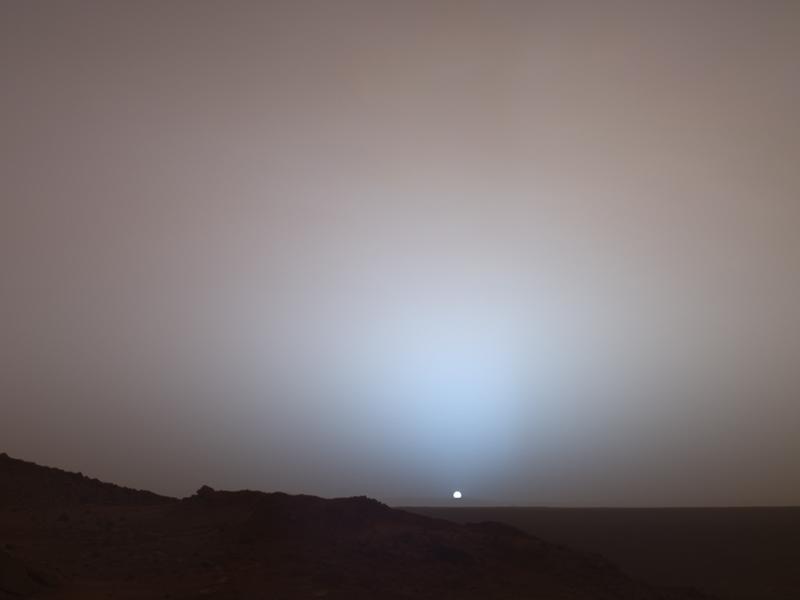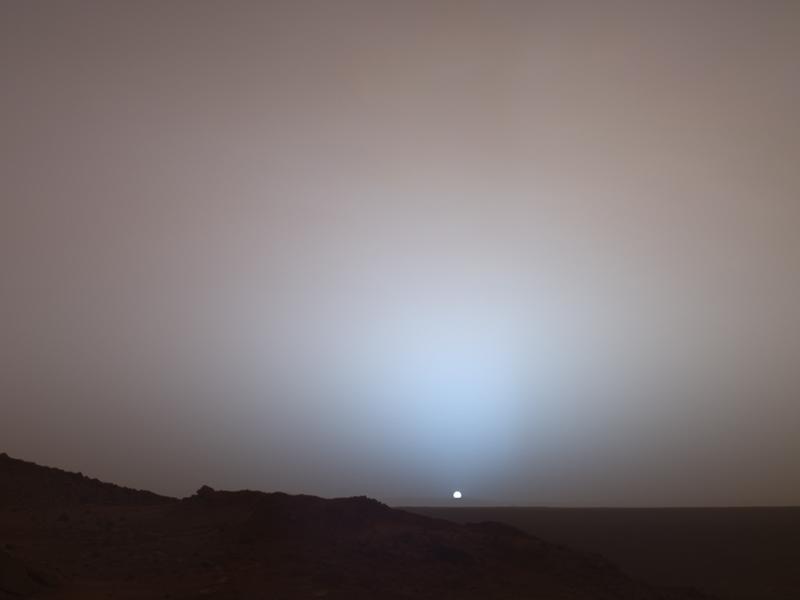
What would it be like to see a sunset on Mars? To help find out, the robotic rover Spirit was deployed last month to park and serenely watch the Sun dip below the distant lip of Gusev crater. It was a tough job, but some robot had to do it. Now on Earth a red sunset is caused by two effects -- by blue light being preferentially scattered out of sunlight by oxygen and nitrogen molecules in the atmosphere, and by scattering off a small amount of impurities like volcanic dust. (The magnitude of the first effect was computed in one of Albert Einstein's most cited papers.) Although Mars lacks oxygen and nitrogen, it is covered in red dust frequently hoisted into the atmosphere by fast but thin winds. Analyses of images like the above photograph show that at least some Martian days are capped by a sunset significantly longer and redder than typical on Earth. For up to two hours after twilight, sunlight continued to reflect off Martian dust high in the atmosphere, casting a diffuse glow. The result helps atmospheric scientists understand not only the atmosphere of Mars, but atmospheres across the Solar System, including our home Earth.
¿Cómo sería presenciar una puesta de sol en Marte? Para ayudar a responder esta pregunta, el róver robótico Spirit fue enviado el mes pasado para estacionarse y observar serenamente cómo el Sol se hundía bajo el borde distante del cráter Gusev. Fue una tarea difícil, pero algún robot tenía que hacerlo. Ahora bien, en la Tierra una puesta de sol roja es causada por dos efectos: por la dispersión preferente de la luz azul fuera de la luz solar por moléculas de oxígeno y nitrógeno en la atmósfera, y por la dispersión de una pequeña cantidad de impurezas como polvo volcánico. (La magnitud del primer efecto fue calculada en uno de los artículos más citados de Albert Einstein.) Aunque Marte carece de oxígeno y nitrógeno, está cubierto de polvo rojo frecuentemente levantado hacia la atmósfera por vientos rápidos pero tenues. Los análisis de imágenes como la fotografía anterior muestran que al menos en algunos días marcianos la puesta de sol es significativamente más larga y más roja que la típica en la Tierra. Durante hasta dos horas después del crepúsculo, la luz solar continuó reflejándose en el polvo marciano alto en la atmósfera, proyectando un resplandor difuso. Este resultado ayuda a los científicos atmosféricos a comprender no solo la atmósfera de Marte, sino las atmósferas en todo el Sistema Solar, incluida nuestra Tierra.