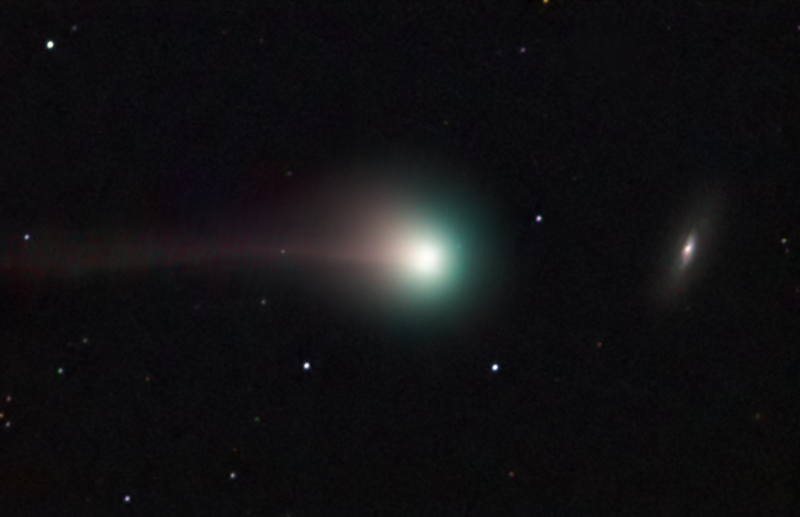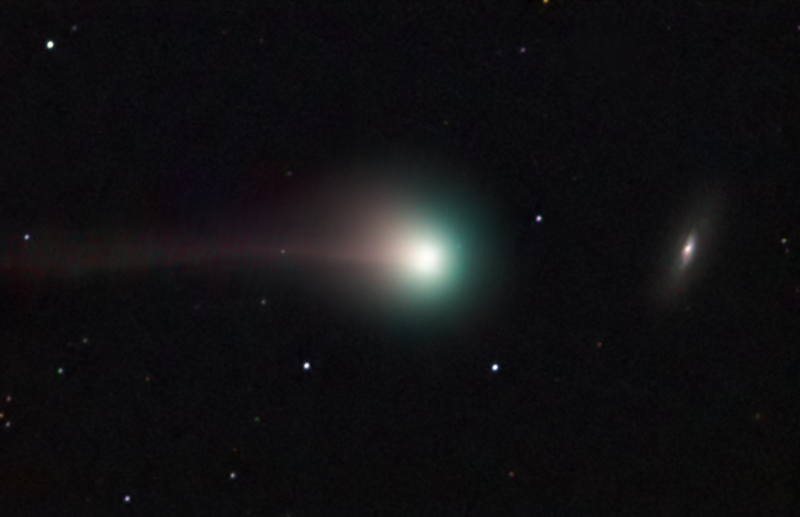
This cosmic portrait recorded October 9th features the lovely blue-green coma of Comet SWAN posing with spiral galaxy NGC 5005 in the northern constellation Canes Venatici. At the time the comet (center) was in the close foreground, a mere 9 light-minutes from planet Earth, with the galaxy a more substantial 60 million light-years distant. Not actually related to a bird, Comet SWAN (C/2006 M4) was so named as it was first spotted in image data from the SWAN (Solar Wind ANisotropies) camera aboard the sun-staring SOHO spacecraft. Having rounded the Sun, this comet is headed for interstellar space, but first it will make its closest approach to Earth on October 24. With binoculars, northern hemisphere observers can now spot the comet above the northwestern horizon, near the handle of the Big Dipper in the early evening sky.
Esta imagen cósmica registrada el 9 de octubre muestra la hermosa coma azul-verdosa del cometa SWAN posando junto a la galaxia en espiral NGC 5005 en la constelación norteña de Canes Venatici. En ese momento, el cometa (centro) se encontraba en primer plano, a solo 9 minutos luz de la Tierra, mientras que la galaxia se hallaba a una distancia mucho mayor de 60 millones de años luz. El cometa SWAN (C/2006 M4) no tiene relación real con una ave, sino que recibió su nombre porque fue descubierto por primera vez en datos de imagen del instrumento SWAN (Solar Wind ANisotropies) a bordo de la nave espacial SOHO, que observa al Sol. Tras haber rodeado al Sol, este cometa se dirige al espacio interestelar, pero antes alcanzará su punto más cercano a la Tierra el 24 de octubre. Con binoculares, los observadores del hemisferio norte pueden ver ahora al cometa sobre el horizonte noroeste, cerca del mango de la Osa Mayor en el cielo de la tarde temprana.