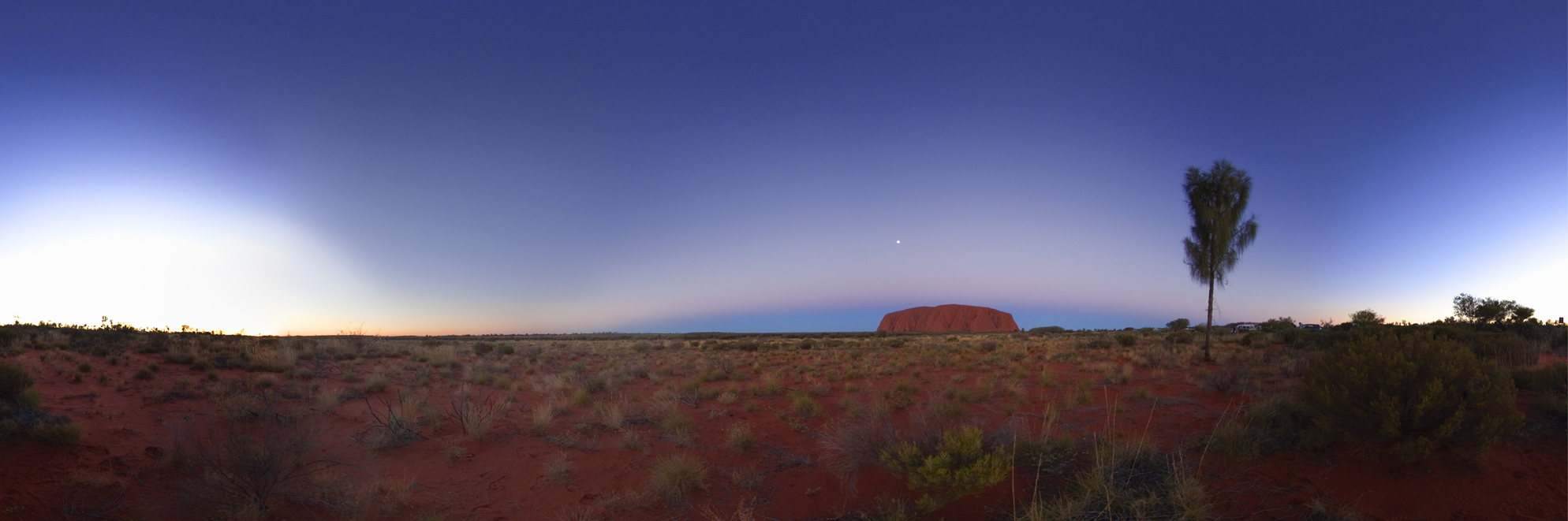
From central Australia, this serene 360 degree panorama follows a clear horizon as twilight began on May 28. At left, a bright western sky is still illuminated by the setting Sun. But sweeping right, toward a view centered on the countryside's dominating sandstone formation called Uluru or Ayers Rock, the sky takes on progressively darker hues and subtle colors. Behind Uluru is the shadow of planet Earth itself, a dark blue arch rising in the east. Cast through the dense atmosphere and still close to the horizon, Earth's long shadow is bounded above by a pinkish glow or antitwilight arch. Known as the Belt of Venus, the lovely color of the antitwilight arch is due to backscattering of reddened light from the setting Sun. On that night, a nearly full Moon also rose above Earth's shadow in the eastern sky.
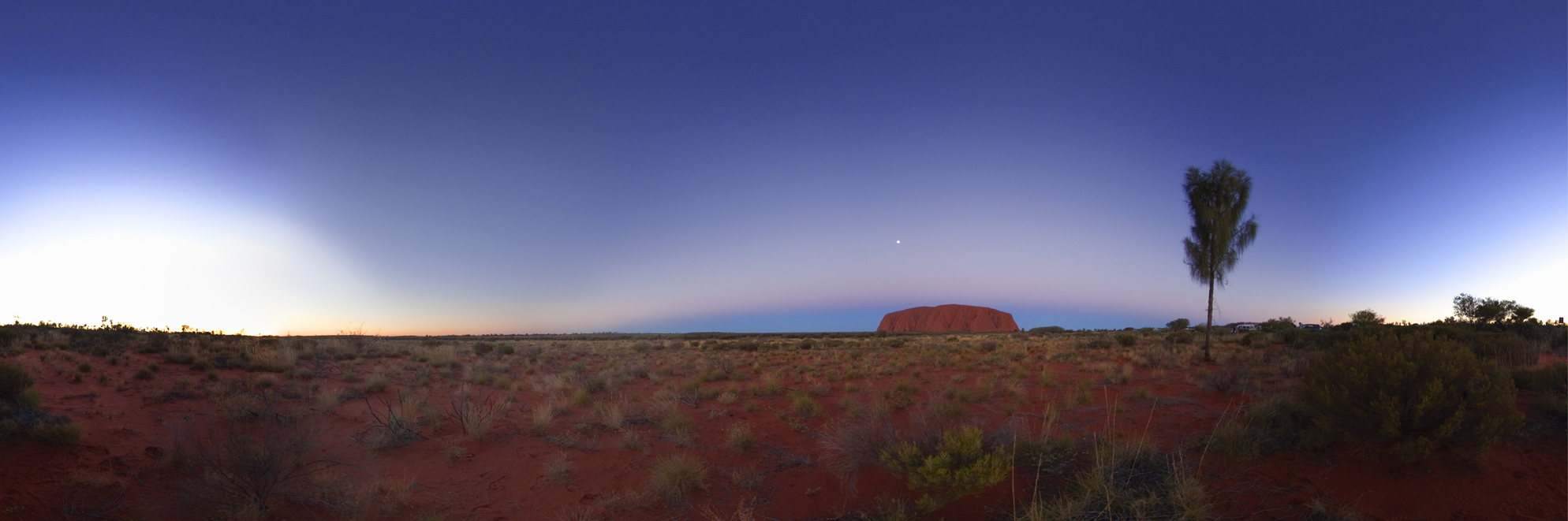
Desde el centro de Australia, esta serena panorámica de 360 grados sigue un horizonte despejado cuando comenzaba la puesta de sol el 28 de mayo. A la izquierda, un cielo occidental brillante aún está iluminado por el Sol que se pone. Pero al girar hacia la derecha, hacia una vista centrada en la formación de arenisca dominante del paisaje conocida como Uluru o Ayers Rock, el cielo adquiere tonos progresivamente más oscuros y colores sutiles. Detrás de Uluru se encuentra la sombra del propio planeta Tierra, un arco azul oscuro que se eleva en el este. Proyectada a través de la densa atmósfera y aún cerca del horizonte, la larga sombra de la Tierra está delimitada superiormente por un resplandor rosáceo o arco de antitwilight. Conocido como el Cinturón de Venus, el hermoso color del arco de antitwilight se debe a la retrodispersión de la luz rojiza del Sol que se pone. Esa noche, una Luna casi llena también se elevó por encima de la sombra de la Tierra en el cielo oriental.