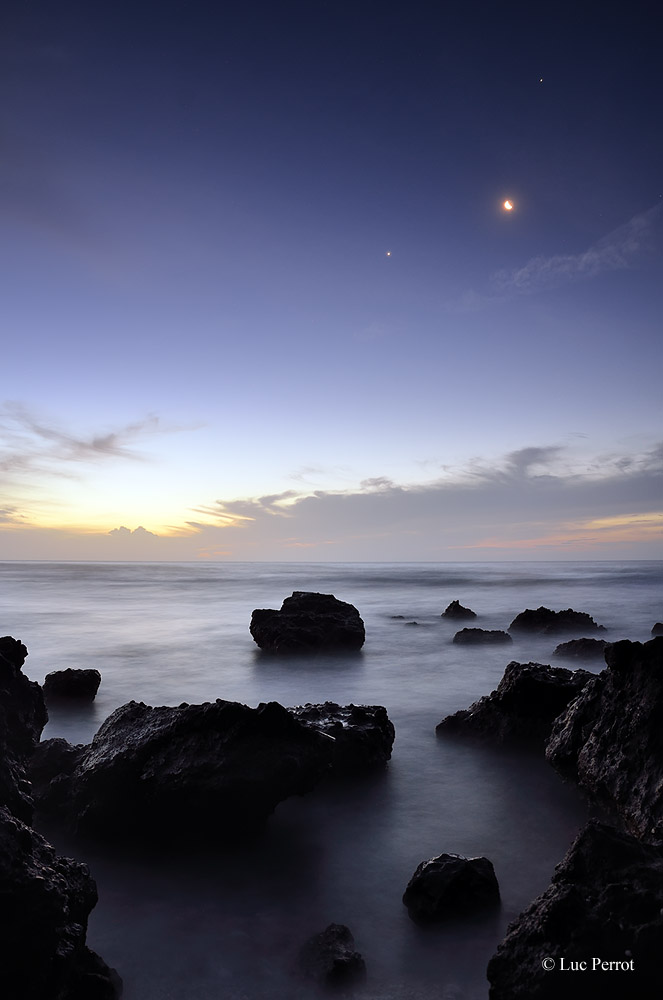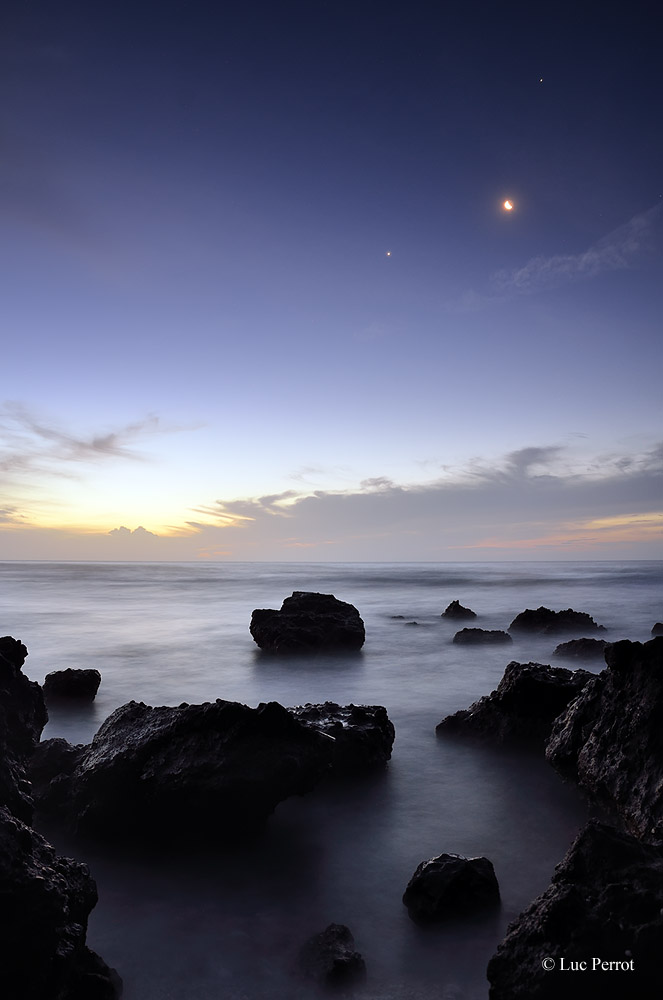
You don't have to be on Reunion Island to see this week's planetary conjunction. Only if you want to see this picturesque seascape as well. To see the conjunction from just about anywhere in the world, look to the west after sunset. The first planet you may notice is Venus, the brightest object in the western sky. Above Venus, the second brightest object is Jupiter. The hardest planet to spot is Mercury, which is visible only briefly after sunset as a faint dot just above the horizon. Picturesque rocks leading out from Reunion Island to the Indian Ocean populate the foreground of the above picture. Taken last week, the distant planets Venus and Jupiter were joined by a bright crescent Moon, which has now moved away. Students (of all ages): See free astronomy lectures online
No es necesario estar en la isla de la Reunión para observar la conjunción planetaria de esta semana, a menos que se desee contemplar también este pintoresco paisaje marino. Para observar la conjunción desde prácticamente cualquier lugar del mundo, basta con mirar hacia el oeste después del ocaso. El primer planeta que posiblemente se distinga es Venus, el objeto más brillante en el cielo occidental. Por encima de Venus, el segundo objeto más brillante es Júpiter. El planeta más difícil de localizar es Mercurio, visible solo brevemente tras la puesta del Sol como un tenue punto justo sobre el horizonte. En el primer plano de la imagen se aprecian las características rocas que se adentran desde la isla de la Reunión hacia el océano Índico. Tomada la semana pasada, los distantes planetas Venus y Júpiter estaban acompañados por una brillante Luna creciente, que desde entonces se ha desplazado.