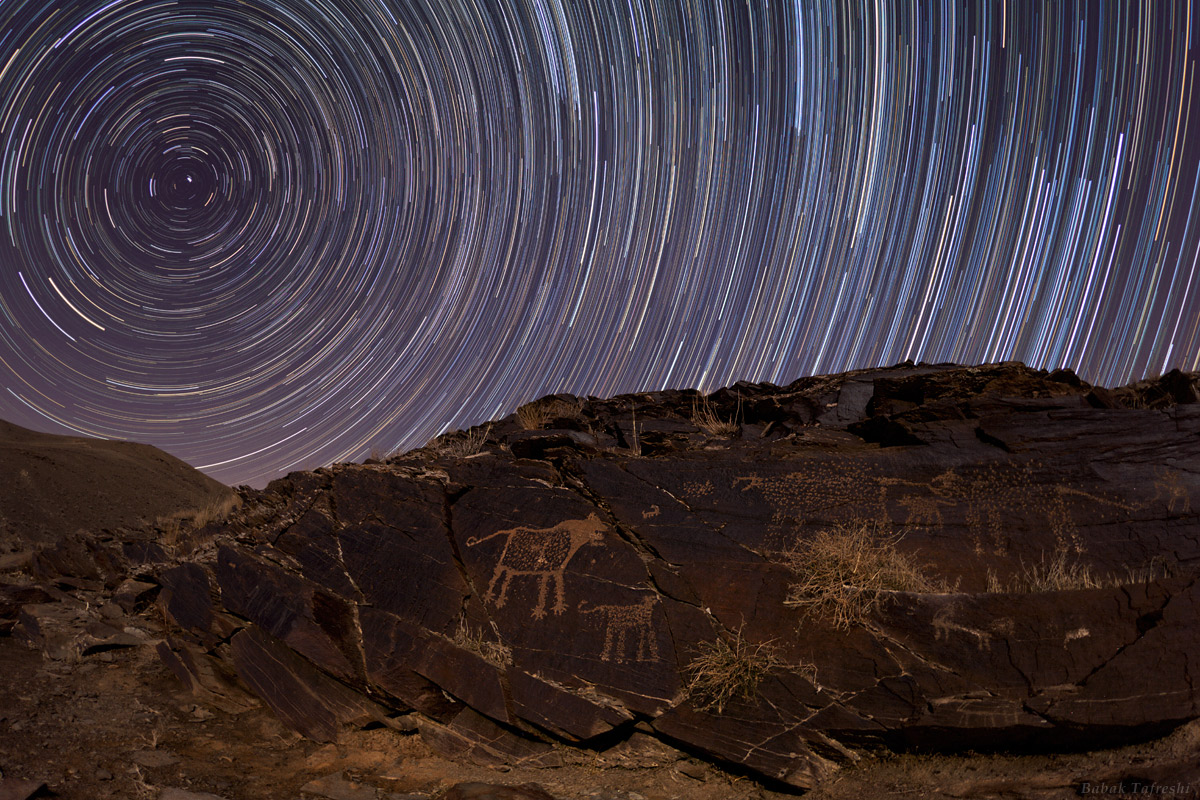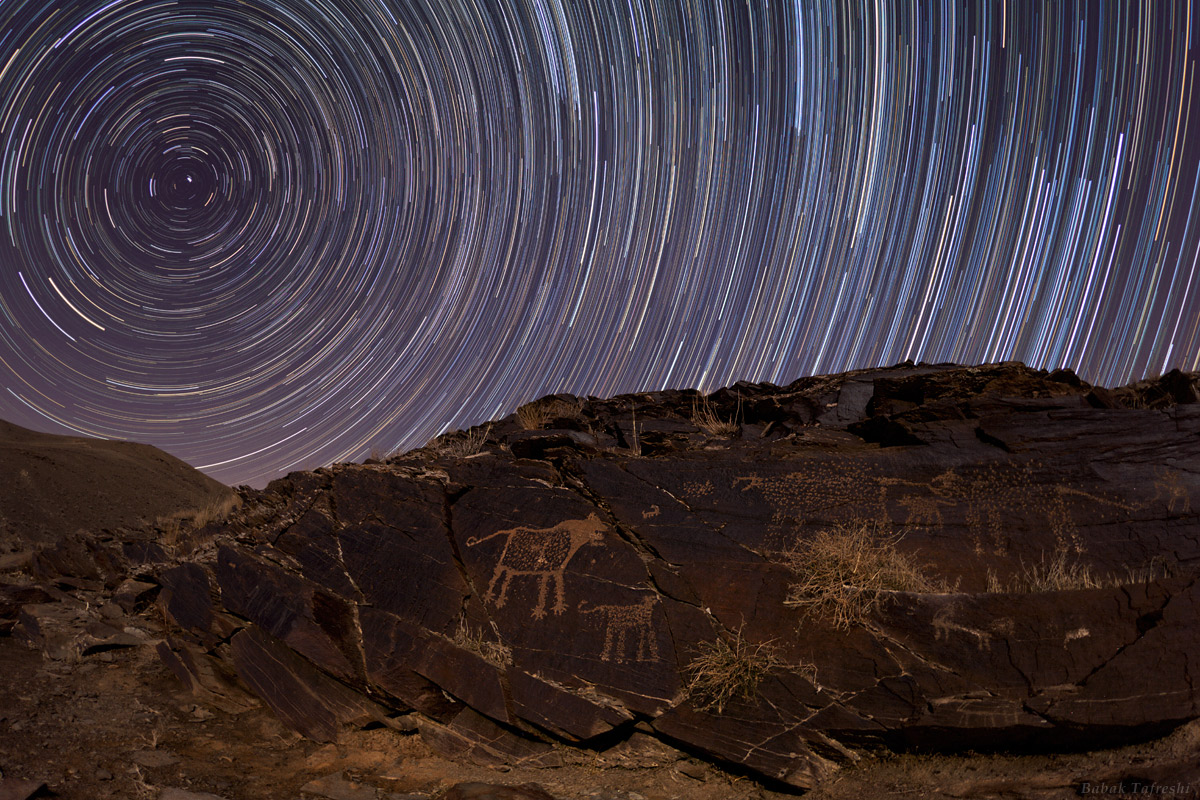
graved in rock, these ancient petroglyphs are abundant in the Teimareh valley, located in the Zagros Mountains of central Iran. They likely tell a tale of hunters and animals found in the middle eastern valley 6,000 years ago or more, etched by artists in a prehistoric age. In the night sky above are star trails etched by the rotation of planet Earth during the long composite exposure made with a modern digital camera. On the left, the center of the star trail arcs is the North Celestial Pole (NCP), the extension of Earth's axis into space. Polaris, the North Star, leaves the bright, short, stubby trail closest to the NCP. But when these petroglyphs were carved, Polaris would have made a long arc through the night. Since the Earth's rotation axis precesses like a wobbling top, 6,000 years ago the NCP was near the border of the constellations Draco and Ursa Major, some 30 degrees from its current location in planet Earth's sky.
Grabados en roca, estos antiguos petroglifos son abundantes en el valle de Teimareh, ubicado en la cordillera de Zagros en Irán central. Probablemente cuentan la historia de cazadores y animales que habitaban el valle del Medio Oriente hace 6,000 años o más, tallados por artistas en una época prehistórica. En el cielo nocturno sobre ellos, los rastros estelares son grabados por la rotación del planeta Tierra durante la larga exposición compuesta realizada con una cámara digital moderna. A la izquierda, el centro de los arcos de los rastros estelares es el Polo Celeste Norte (PCN), la extensión del eje terrestre hacia el espacio. Polaris, la Estrella Polar, deja el rastro brillante, corto y estrecho más cercano al PCN. Pero cuando se tallaron estos petroglifos, Polaris habría trazado un arco largo a través de la noche. Dado que el eje de rotación de la Tierra precesa como un trompo que se tambalea, hace 6,000 años el PCN estaba cerca de la frontera entre las constelaciones Draco y Ursa Major, a unos 30 grados de su ubicación actual en el cielo terrestre.