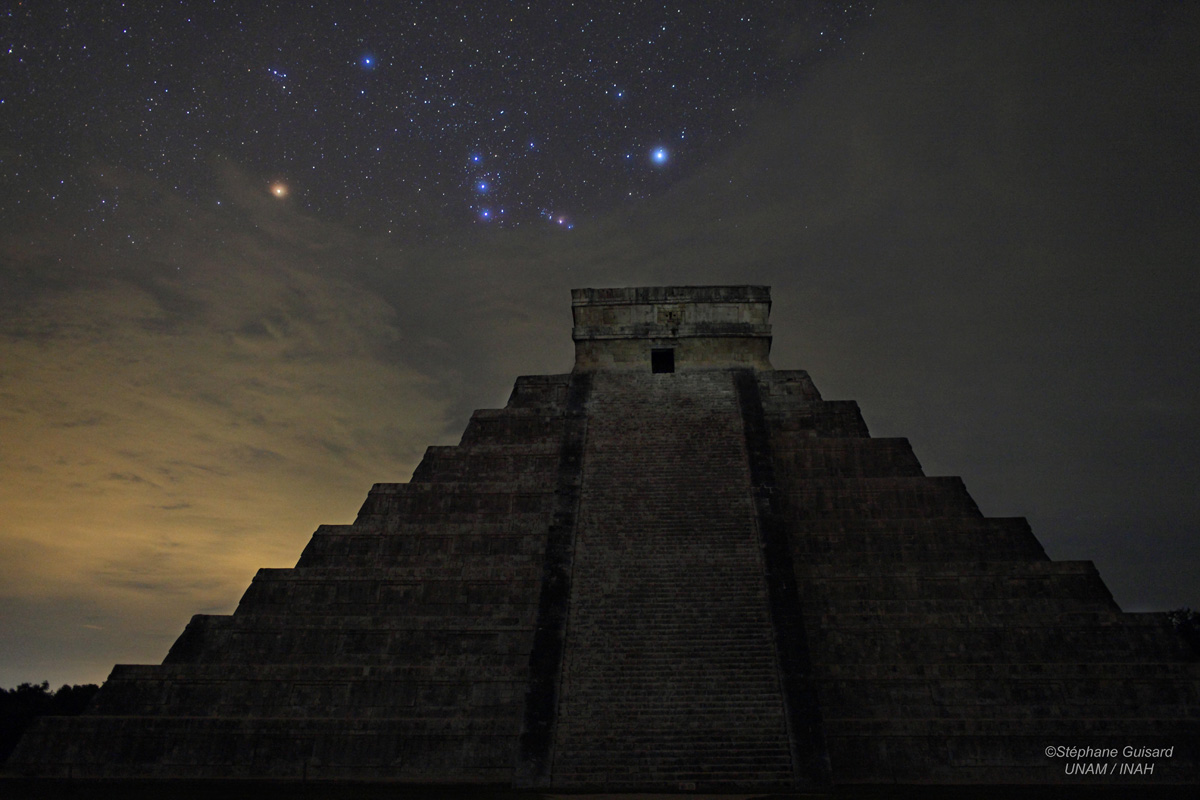
Welcome to the December solstice, a day the world does not end ... even according to the Mayan Calendar. To celebrate, consider this dramatic picture of Orion rising over El Castillo, the central pyramid at Chichén Itzá, one of the great Mayan centers on the Yucatán peninsula. Also known as the Temple of Kukulkan it stands 30 meters tall and 55 meters wide at the base. Built up as a series of square terraces by the pre-Columbian civilization between the 9th and 12th century, the structure can be used as a calendar and is noted for astronomical alignments. In fact, the Mayans were accomplished astronomers and mathematicians, accurately using the cyclic motions of the stars, Sun, Moon, and planets to measure time and construct calendars. Peering through clouds in this night skyscape, stars in the modern constellation Orion the Hunter represented a turtle in the Mayan sky. Tak sáamal.
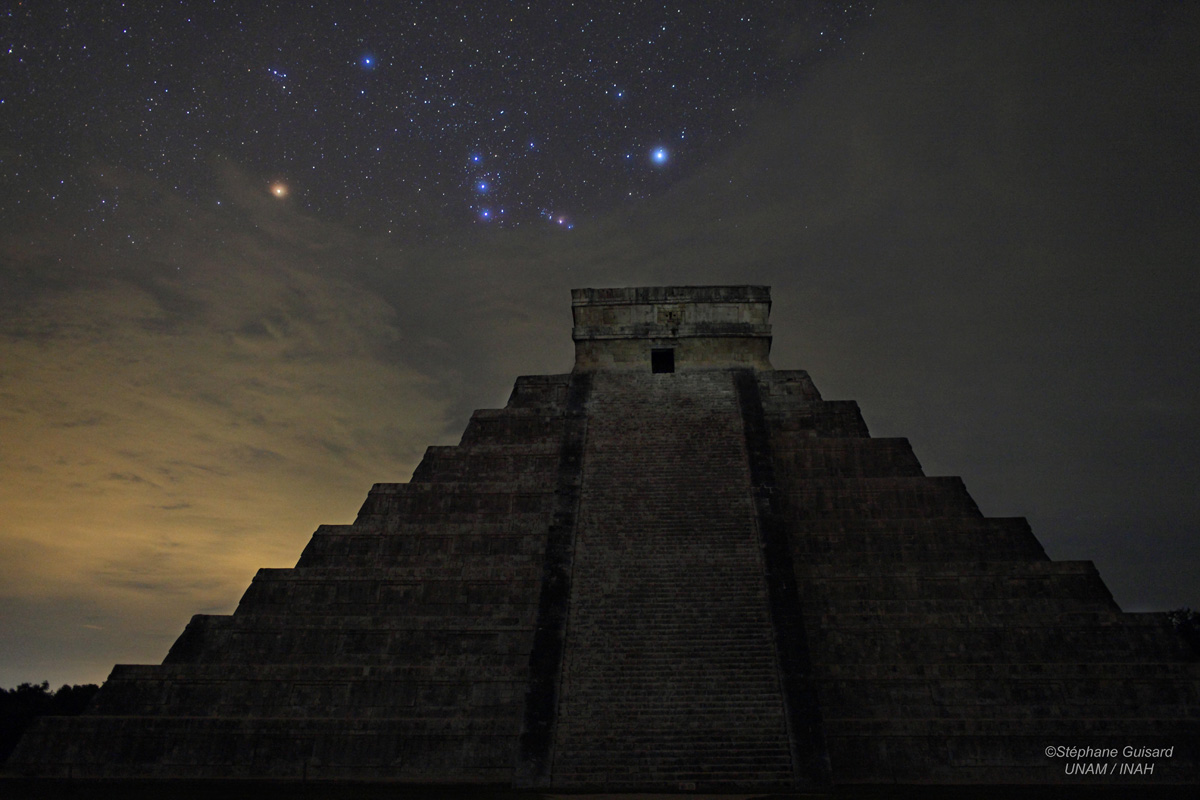
Crédito: NASA, CGRO SSC Bienvenido al solsticio de diciembre, un día en el que el mundo no termina... incluso según el calendario maya. Para celebrarlo, considere esta dramática imagen de Orión ascendiendo sobre El Castillo, la pirámide central en Chichén Itzá, uno de los grandes centros mayas en la península de Yucatán. También conocido como el Templo de Kukulkan, tiene 30 metros de altura y 55 metros de ancho en la base. Construido como una serie de terrazas cuadradas por la civilización precolombina entre los siglos IX y XII, la estructura puede usarse como un calendario y es conocida por sus alineaciones astronómicas. De hecho, los mayas eran astrónomos y matemáticos destacados, utilizando con precisión los movimientos cíclicos de las estrellas, el Sol, la Luna y los planetas para medir el tiempo y construir calendarios. Mirando a través de las nubes en esta escena nocturna, las estrellas en la constelación moderna de Orón el Cazador representaban una tortuga en el cielo maya. Tak sáamal.