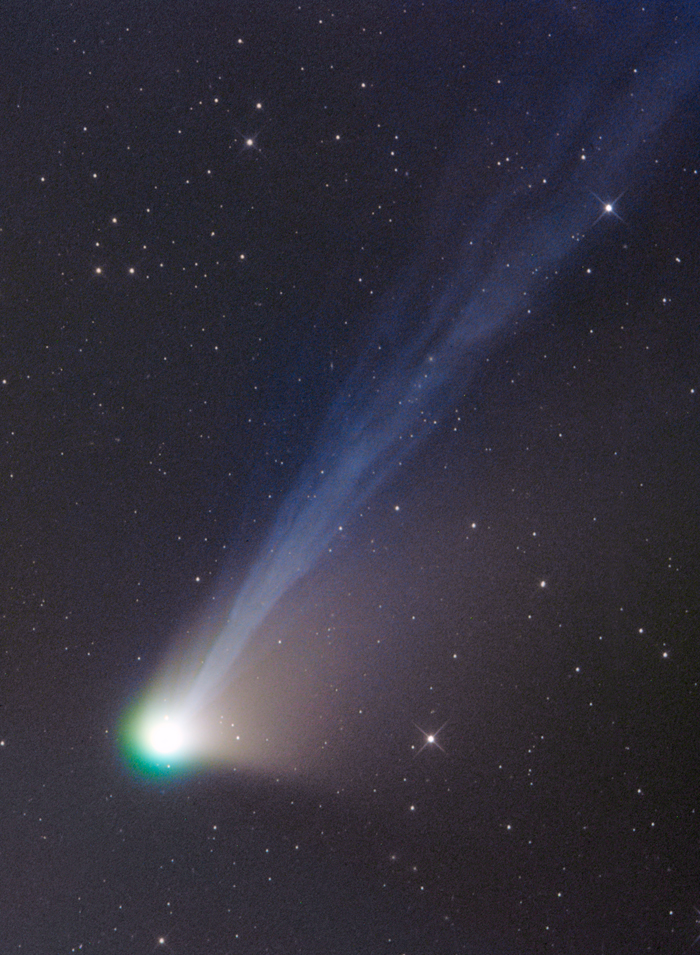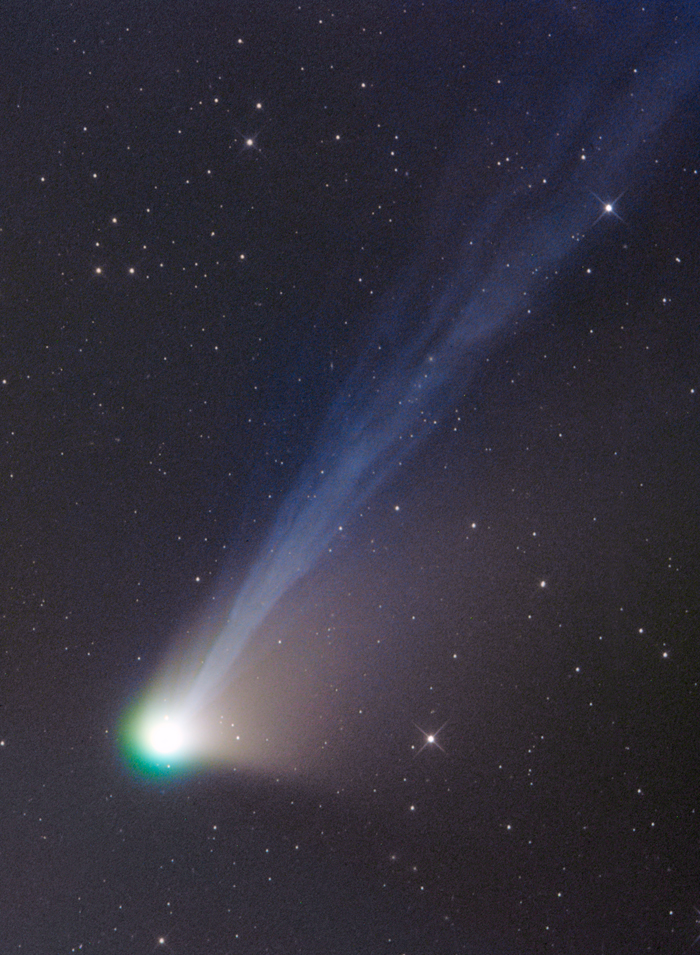
What caused the interestingly intricate tails that Comet Lemmon displayed earlier this year? First of all, just about every comet that nears the Sun displays two tails: a dust tail and an ion tail. Comet Lemmon's dust tail, visible above and around the comet nucleus in off-white, is produced by sun-light reflecting dust shed by the comet's heated nucleus. Flowing and more sculptured, however, is C/2012 F6 (Lemmon)'s blue ion tail, created by the solar wind pushing ions expelled by the nucleus away from the Sun. Also of note is the coma seen surrounding Comet Lemmon's nucleus, tinted green by diatomic C2 gas fluorescing in sunlight. The above image was taken from the dark skies of Namibia in mid-April. Comet Lemmon is fading as it now heads back to the outer Solar System. Cosmonova: APOD editor to speak in Sweden on May 28
Crédito: NASA, ESA, y el equipo de la misión Stardust-NExT ¿Qué causó las interesantes y complejas colas que mostró el Cometa Lemmon a principios de este año? En primer lugar, casi todos los cometas que se acercan al Sol muestran dos colas: una cola de polvo y una cola de iones. La cola de polvo del Cometa Lemmon, visible arriba y alrededor del núcleo del cometa en tonos casi blancos, se produce por la luz solar reflejada en el polvo expulsado por el núcleo del cometa al ser calentado. Sin embargo, más fluida y más escultórica es la cola de iones azul del cometa C/2012 F6 (Lemmon), creada por el viento solar que empuja los iones expulsados por el núcleo del cometa alejándose del Sol. También merece mención la coma que rodea el núcleo del Cometa Lemmon, teñida de verde por el gas diatómico C2 que fluoresce bajo la luz solar. La imagen anterior fue tomada desde los cielos oscuros de Namibia a mediados de abril. El Cometa Lemmon está desvaneciéndose ahora que se dirige de regreso al Sistema Solar exterior.