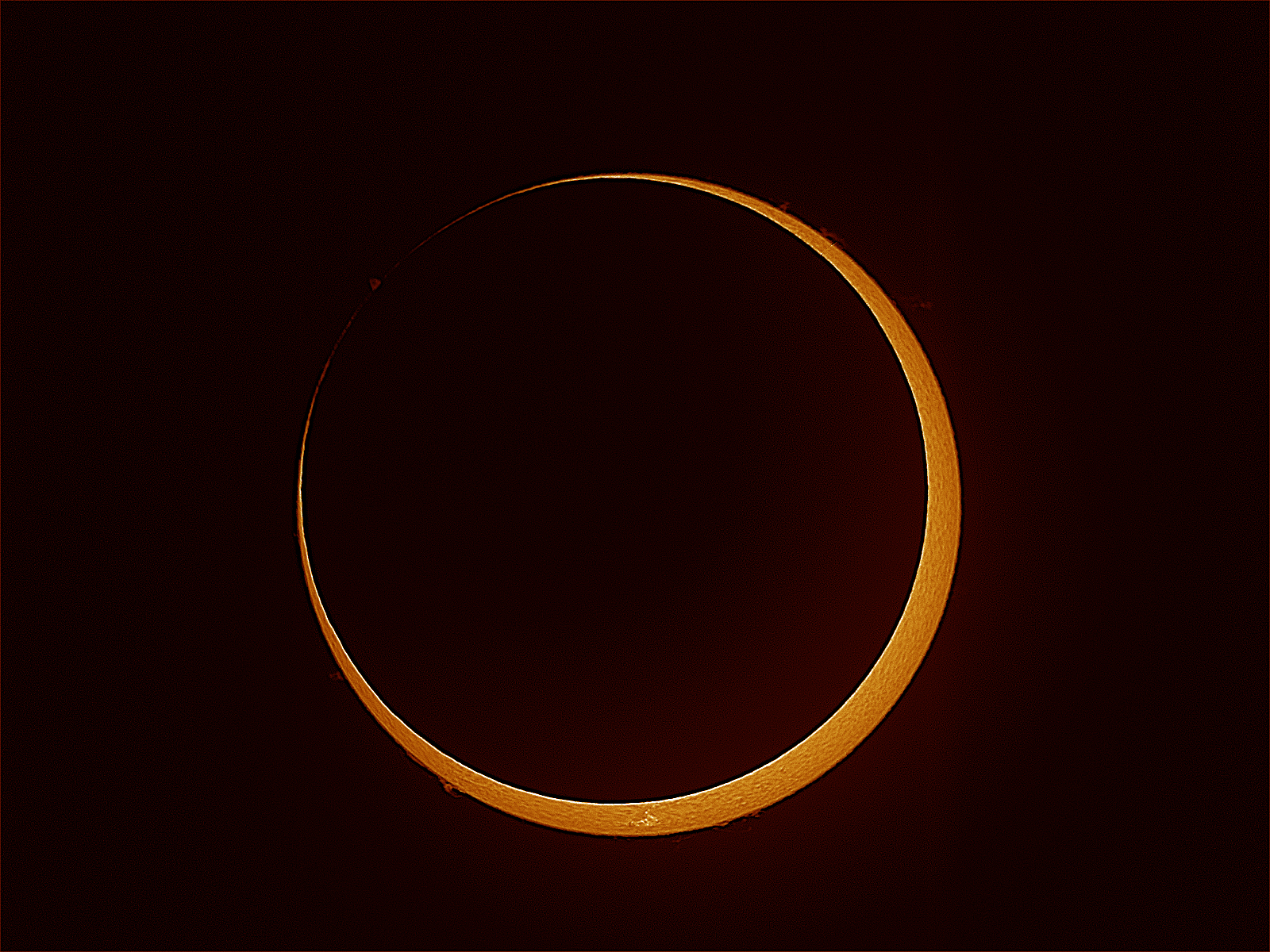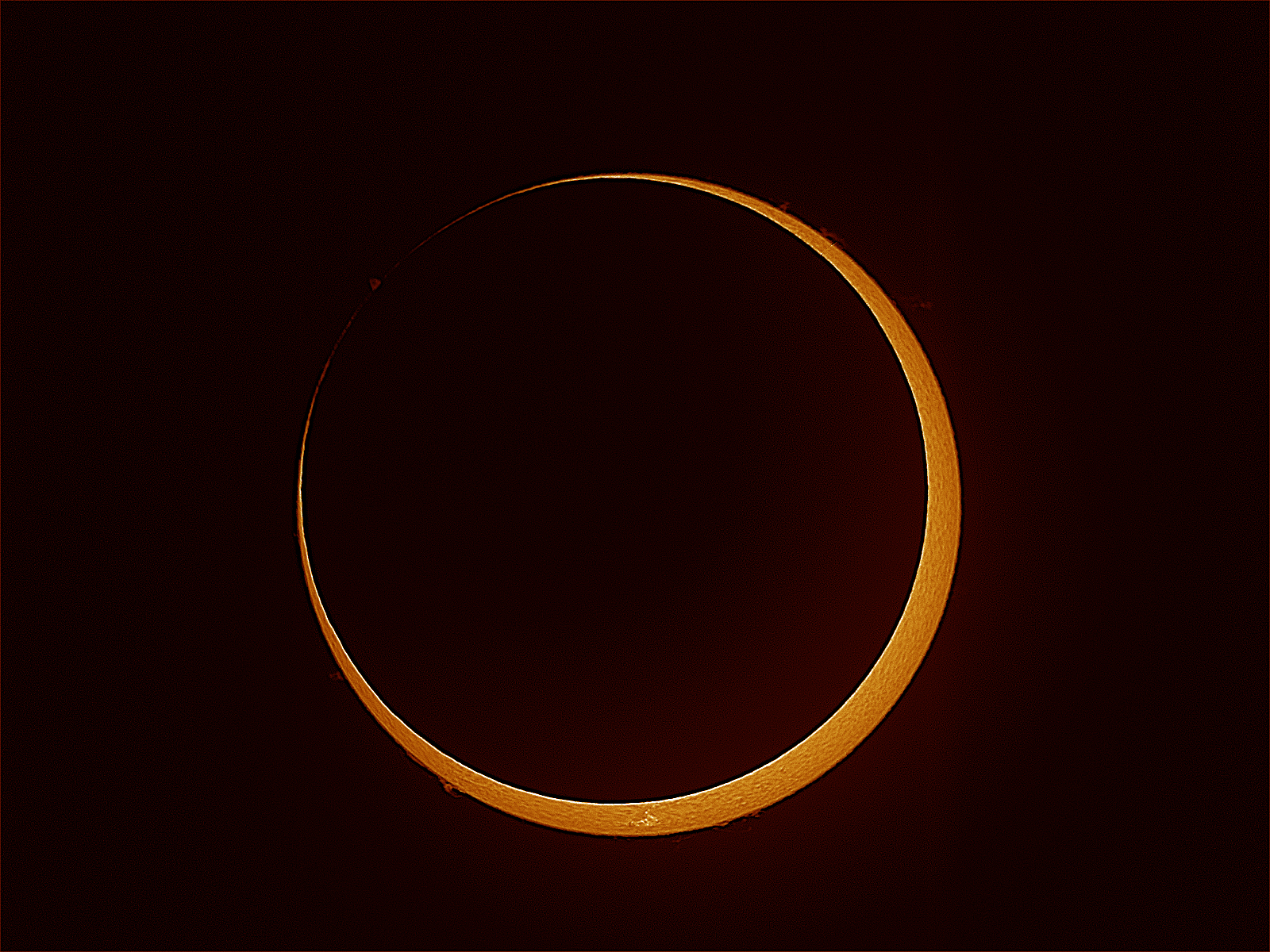
This week the shadow of the New Moon fell on planet Earth, crossing Queensland's Cape York in northern Australia ... for the second time in six months. On the morning of May 10, the Moon's apparent size was too small to completely cover the Sun though, revealing a "ring of fire" along the central path of the annular solar eclipse. Near mid-eclipse from Coen, Australia, a webcast team captured this telescopic snapshot of the annular phase. Taken with a hydrogen-alpha filter, the dramatic image finds the Moon's silhouette just within the solar disk, and the limb of the active Sun spiked with solar prominences. Still, after hosting back-to-back solar eclipses, northern Australia will miss the next and final solar eclipse of 2013. This November, a rare hybrid eclipse will track across the North Atlantic and equatorial Africa.
Esta semana, la sombra de la Luna Nueva cayó sobre la Tierra, cruzando el cabo York en el norte de Australia ... por segunda vez en seis meses. El 10 de mayo, el tamaño aparente de la Luna fue demasiado pequeño para cubrir completamente al Sol, revelando un "anillo de fuego" a lo largo del camino central del eclipse solar anular. Cerca del momento medio del eclipse desde Coen, Australia, un equipo de transmisión en vivo capturó esta imagen telescópica de la fase anular. Tomada con un filtro de hidrógeno-alfa, la dramática imagen muestra la silueta de la Luna justo dentro del disco solar, y el borde del Sol activo salpicado de prominencias solares. Sin embargo, después de albergar dos eclipses solares consecutivos, el norte de Australia se perderá el próximo y último eclipse solar de 2013. Este noviembre, un eclipse híbrido raro recorrerá el Atlántico Norte y África ecuatorial.