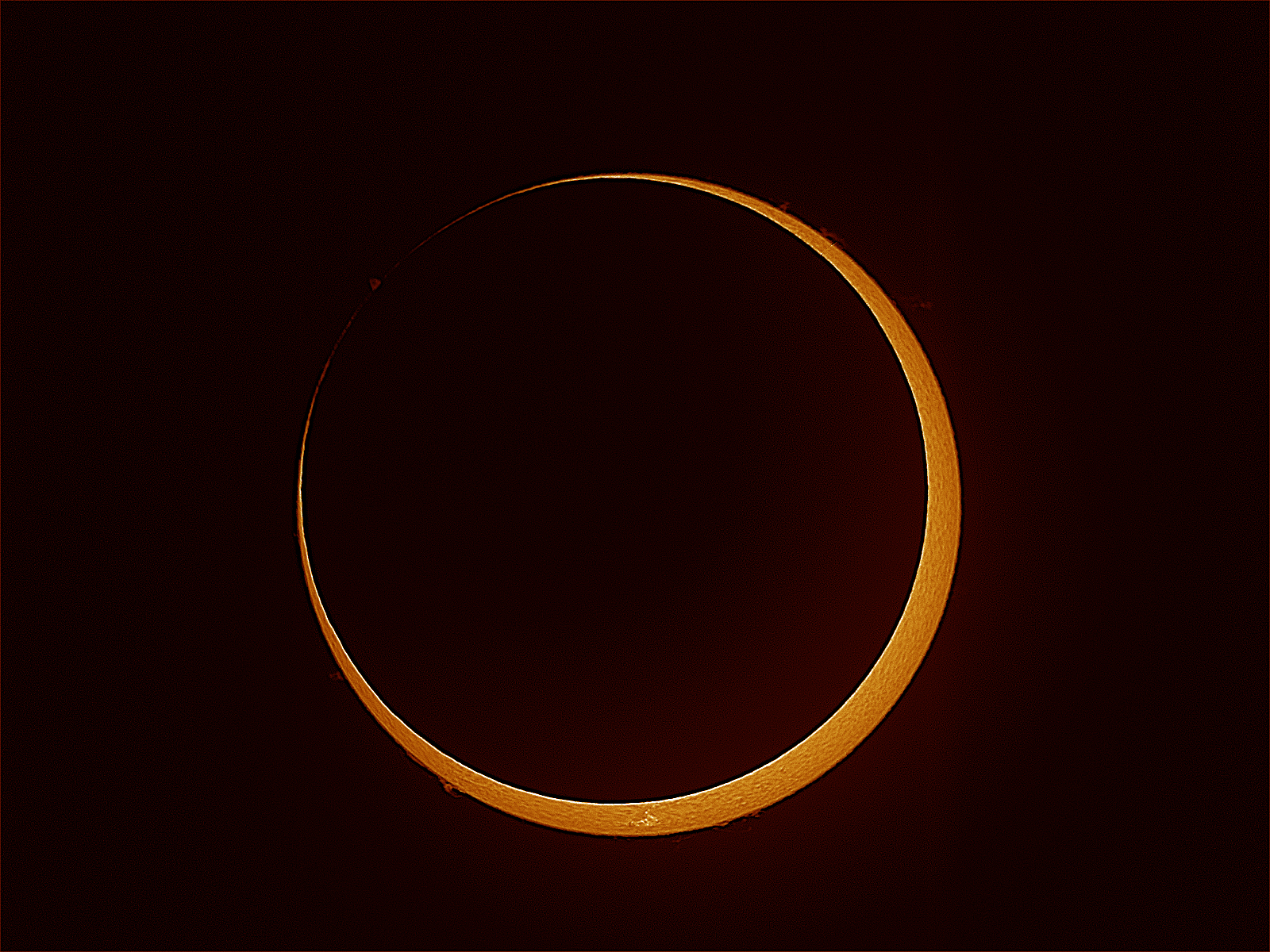
It's eclipse season, and on April 29 around 06:00 UT the shadow of the new Moon will reach out and touch planet Earth, though only just. Still, if you're standing on the continent of Antarctica within a few hundred kilometers of 79 degrees 38.7 minutes South latitude and 131 degrees 15.6 minutes East longitude you could see an annular solar eclipse with the Sun just above the horizon. Because the Moon will be approaching apogee, the most distant point in the elliptical lunar orbit, its apparent size will be too small to completely cover the solar disk. A rare, off-center eclipse, the annular phase will last at most 49 seconds. At its maximum it could look something like this "ring of fire" image from last May's annular solar eclipse, captured by a webcast team operating near Coen, Australia. Otherwise, a partial eclipse with the Moon covering at least some part of the Sun will be seen across a much broader region in the southern hemipshere, including Australia in the afternoon.
Es temporada de eclipses, y el 29 de abril alrededor de las 06:00 UT, la sombra de la Luna nueva alcanzará y tocará la Tierra, aunque solo por un breve momento. Sin embargo, si estás de pie en el continente de Antártida, dentro de unos pocos cientos de kilómetros de la latitud 79 grados 38.7 minutos Sur y la longitud 131 grados 15.6 minutos Este, podrías ver un eclipse solar anular con el Sol apenas por encima del horizonte. Debido a que la Luna se acercará al apogeo, el punto más alejado de la órbita elíptica lunar, su tamaño aparente será demasiado pequeño para cubrir completamente el disco solar. Un eclipse raro y desplazado, la fase anular durará como máximo 49 segundos. En su máximo, podría parecerse a esta imagen de "anillo de fuego" de un eclipse solar anular del mes pasado, capturada por un equipo de transmisión en vivo operando cerca de Coen, Australia. De lo contrario, un eclipse parcial, con la Luna cubriendo al menos parte del Sol, se verá en una región mucho más amplia en el hemisferio sur, incluyendo Australia en la tarde.