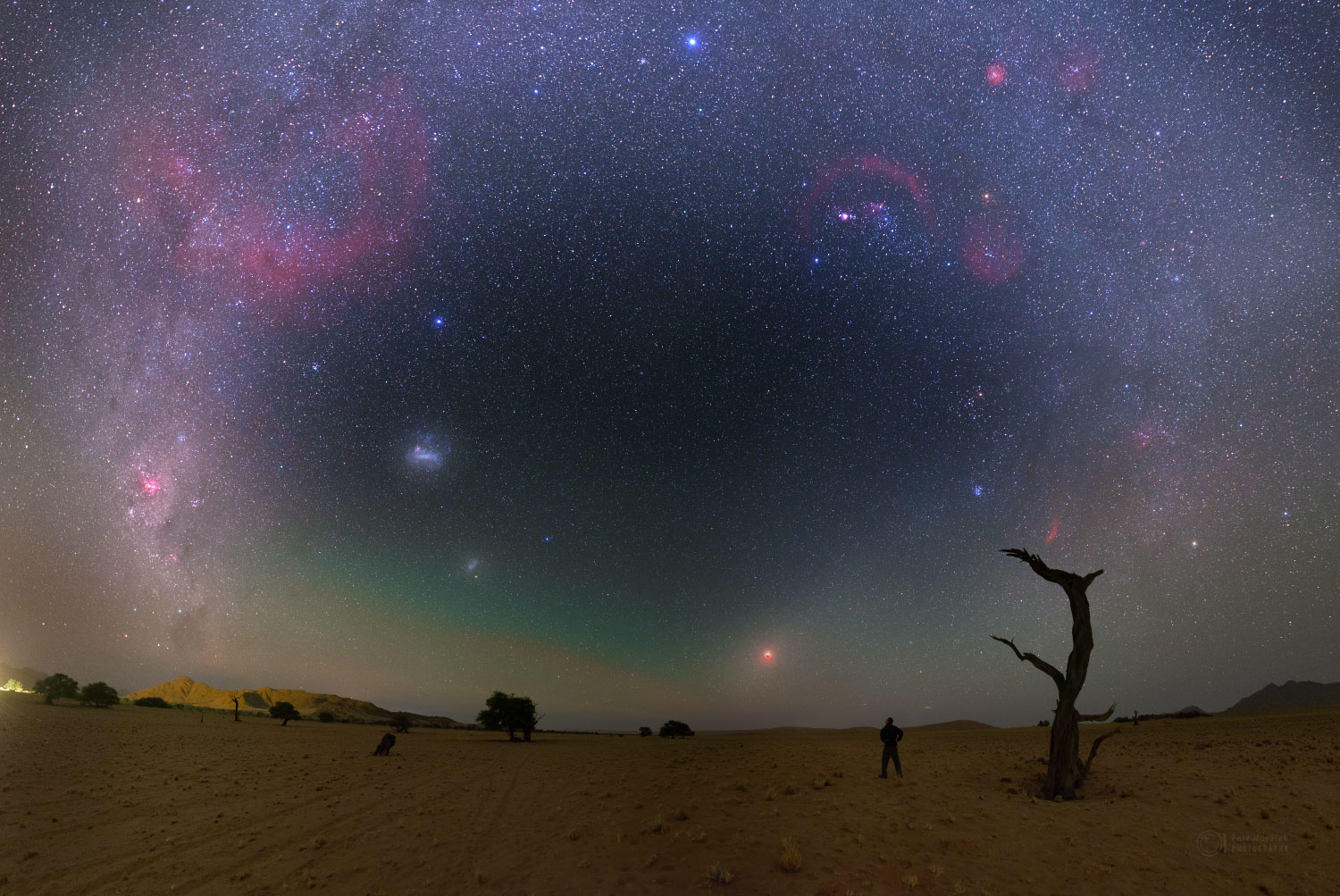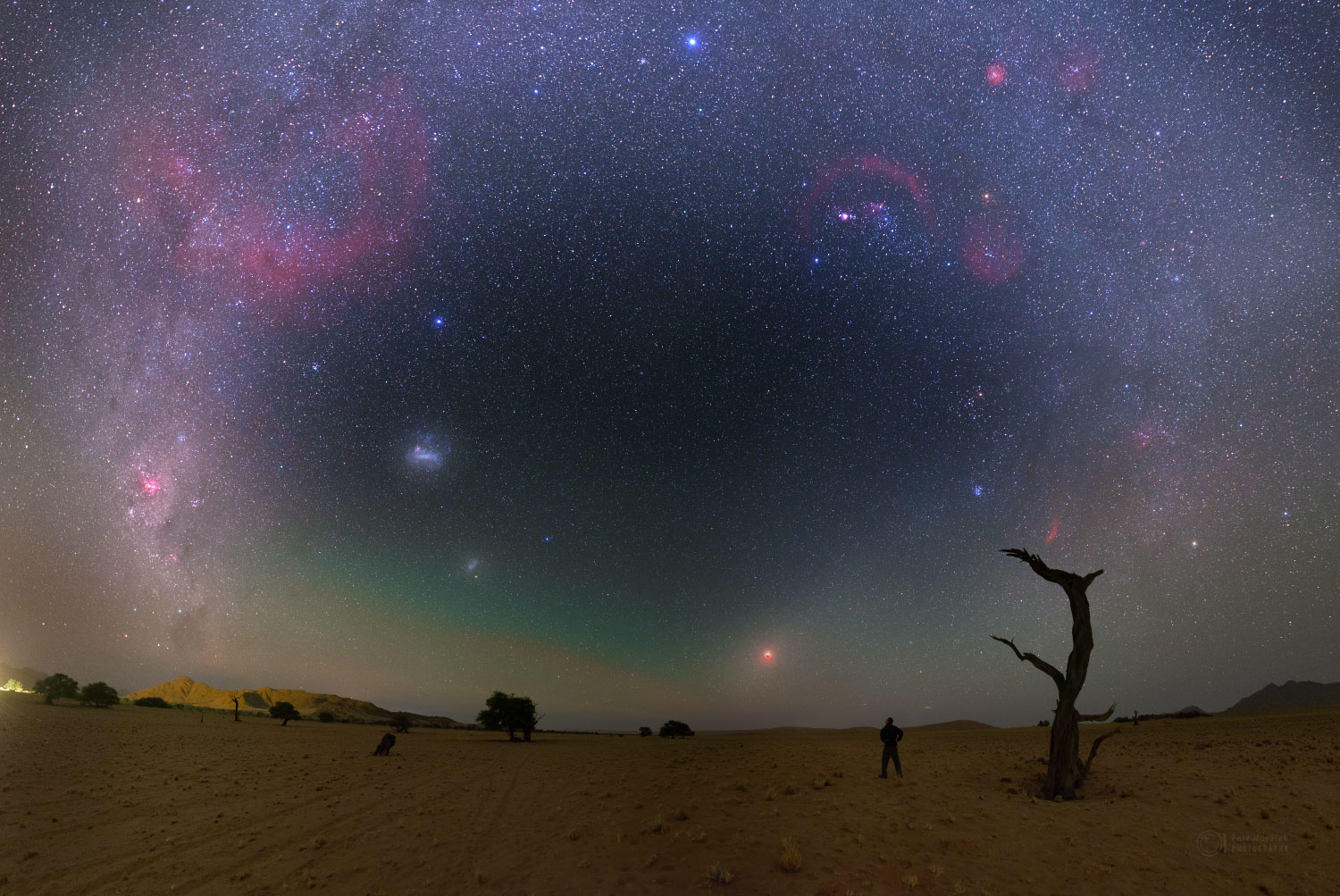
Is there anything interesting to see in the direction opposite the Sun? One night last month, there were quite a few things. First, the red-glowing orb on the lower right of the featured image is the full moon, darkened and reddened because it has entered Earth's shadow. Beyond Earth's cone of darkness are backscattering dust particles orbiting the Sun that standout with a diffuse glow called the gegenschein, visible as a faint band rising from the central horizon and passing behind the Moon. A nearly horizontal stripe of green airglow is also discernable just above the horizon, partly blocked by blowing orange sand. Visible in the distant sky as the blue dot near the top of the image is the star Sirius, while the central band of our Milky Way Galaxy arches up on the image left and down again on the right. The fuzzy light patches just left of center are the Large and Small Magellanic Clouds. Red emission nebulas too numerous to mention are scattered about the sky, but are labelled in a companion annotated image. In the image foreground is the desolate Deadvlei region of the Namib-Naukluft National Park in Namibia, featuring the astrophotographer himself surveying a land and sky so amazing that he described it as one of the top experiences of his life. Quiz: Astronomy Picture of the Day Caption or Harlequin Novel?
¿Hay algo interesante que ver en la dirección opuesta al Sol? Una noche del mes pasado, había bastante. En primer lugar, la bola rojilenta en la parte inferior derecha de la imagen destacada es la luna llena, oscurecida y enrojecida porque ha entrado en la sombra de la Tierra. Más allá del cono de oscuridad de la Tierra se encuentran partículas de polvo que orbitan alrededor del Sol y que retroreflejan la luz, destacándose con un brillo difuso llamado gegenschein, visible como una banda tenue que se eleva desde el horizonte central y pasa detrás de la Luna. También es discernible una banda casi horizontal de brillo verde justo por encima del horizonte, parcialmente bloqueada por arena naranja que se mueve. En el cielo distante, como un punto azul cerca de la parte superior de la imagen, se encuentra la estrella Sirio, mientras que la banda central de nuestra Galaxia de la Vía Láctea se arquea hacia arriba en la izquierda de la imagen y hacia abajo nuevamente en la derecha. Las manchas tenues de luz justo a la izquierda del centro son las Nubes Magellánicas Mayor y Menor. Hay demasiadas nebulosas de emisión roja dispersas por el cielo para mencionarlas todas, pero se etiquetan en una imagen complementaria con anotaciones. En primer plano de la imagen se encuentra la desolada región de Deadvlei del Parque Nacional Namib-Naukluft en Namibia, donde se encuentra al propio fotógrafo astronómico observando una tierra y un cielo tan asombrosos que los describió como una de las experiencias más extraordinarias de su vida.