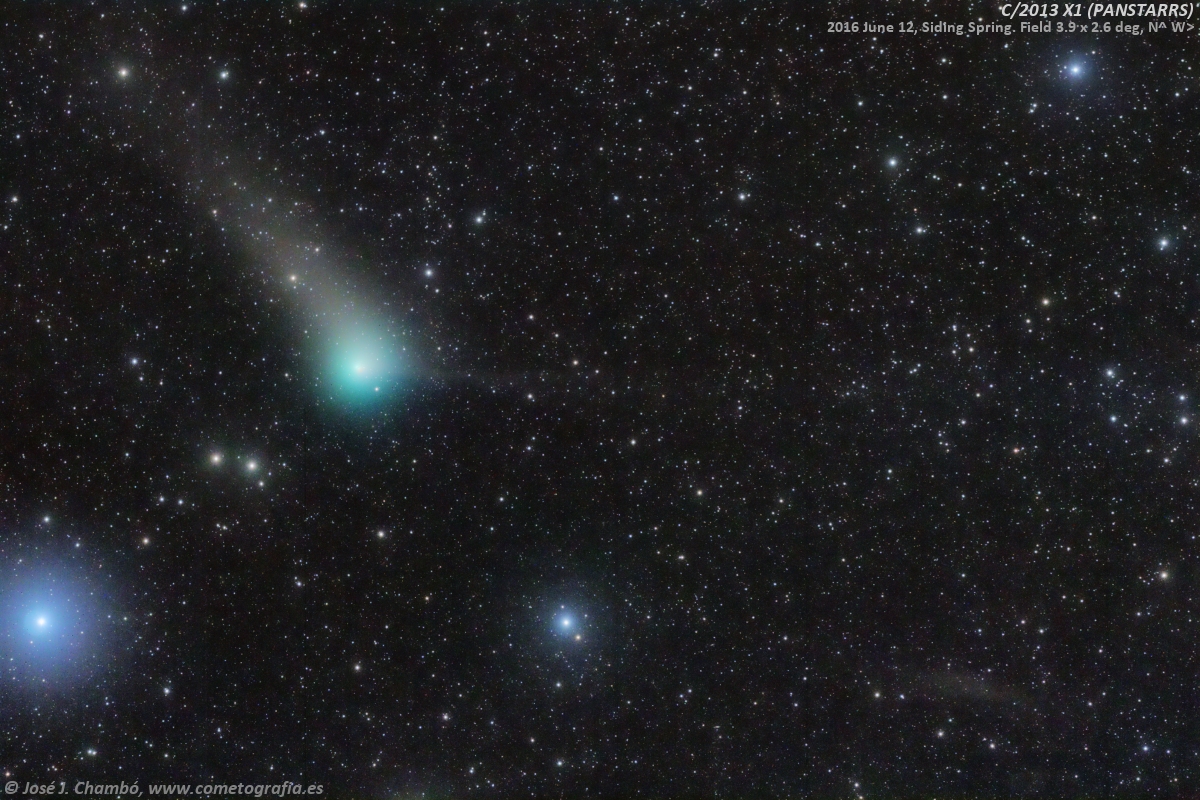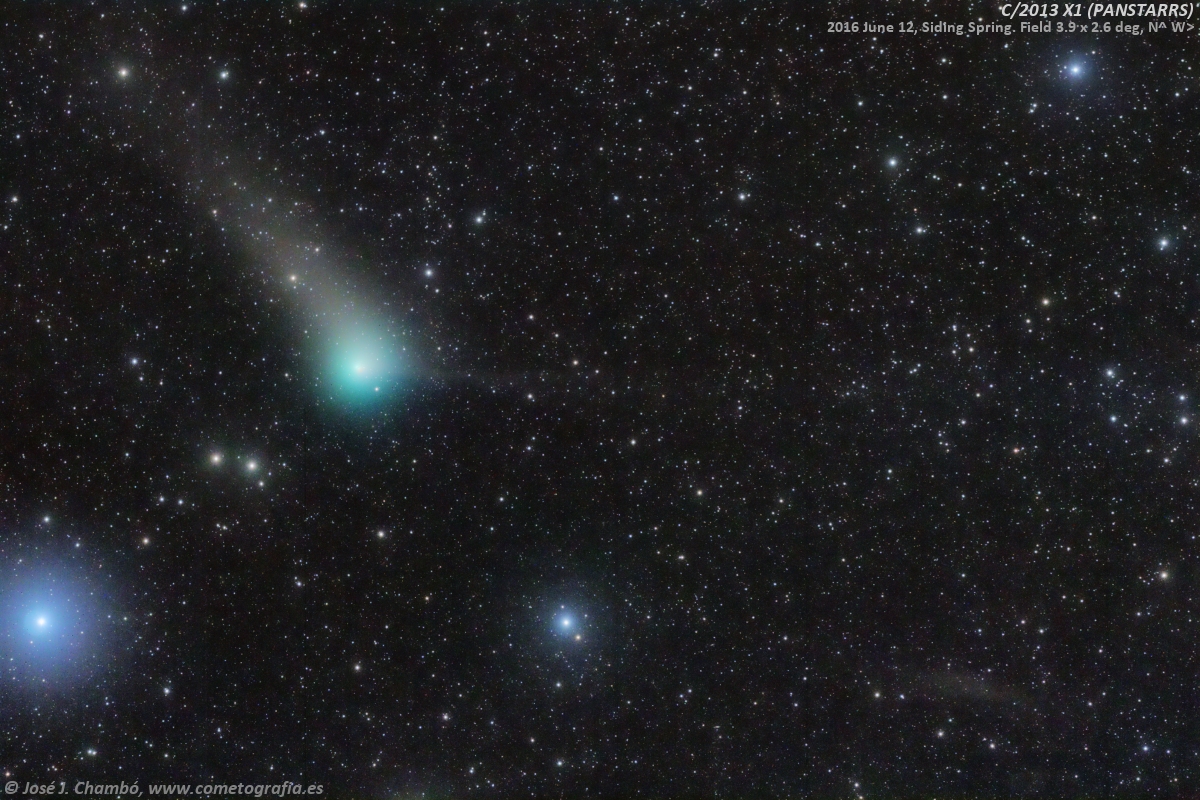
Now approaching our fair planet this Comet PanSTARRS (C/2013 X1) will come closest on June 21-22, a mere 5.3 light-minutes away. By then its appearance low in northern hemisphere predawn skies (high in the south), will be affected by the light of a nearly Full Moon, though. Still the comet's pretty green coma is about the apparent size of the Full Moon in this telescopic portrait, captured on June 12 from the southern hemisphere's Siding Spring Observatory. The deep image also follows a broad, whitish dust tail up and toward the left in the frame, sweeping away from the Sun and trailing behind the comet's orbit. Buffeted by the solar wind, a fainter, narrow ion tail extends horizontally toward the right. On the left edge, the brightest star is bluish Iota Piscis Austrini. Shining at about fourth magnitude, that star is visible to the unaided eye in the constellation of the Southern Fish.
Ahora acercándose a nuestro planeta, este Cometa PanSTARRS (C/2013 X1) alcanzará su punto más cercano el 21 o 22 de junio, a una distancia mínima de 5,3 minutos-luz. Para entonces, su aparición en el cielo prealba del hemisferio norte (alta en el sur) será afectada por la luz de una Luna casi llena. Sin embargo, la coma verde del cometa tiene aproximadamente el tamaño aparente de la Luna llena en esta imagen telescópica capturada el 12 de junio desde el Observatorio Siding Spring en el hemisferio sur. La imagen también muestra una amplia cola de polvo blanquecina que se extiende hacia arriba y hacia la izquierda en el marco, alejándose del Sol y siguiendo la órbita del cometa. A su vez, una cola más tenue e ionizada se extiende horizontalmente hacia la derecha, afectada por el viento solar. En el borde izquierdo, la estrella más brillante es la azul Iota Piscis Austrini. Con una magnitud aproximada de 4, esa estrella es visible a simple vista en la constelación del Peces del Sur.