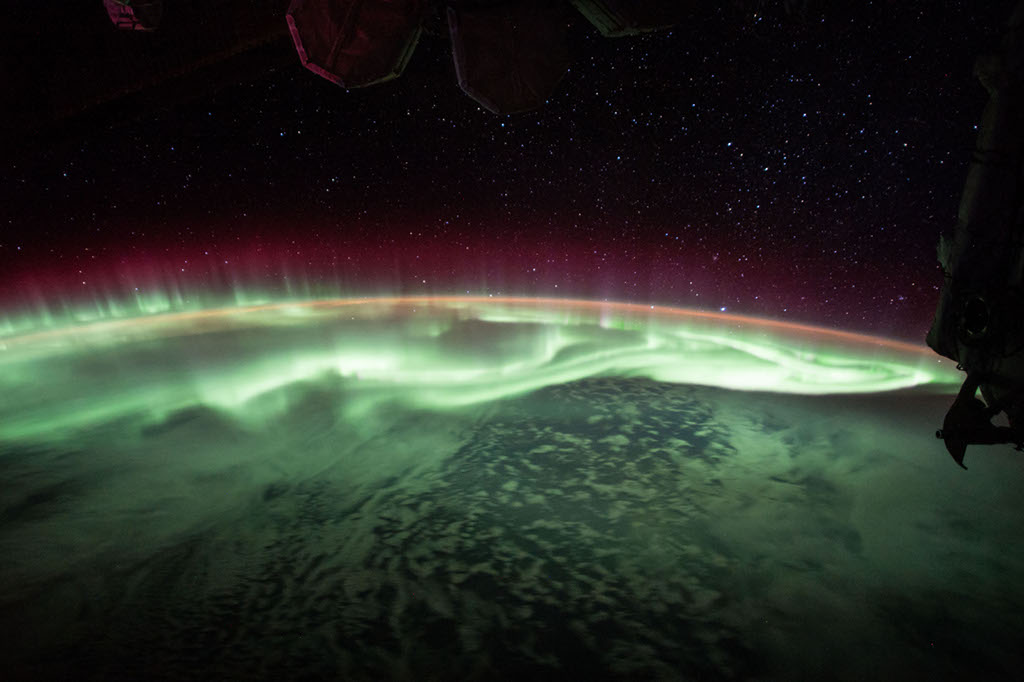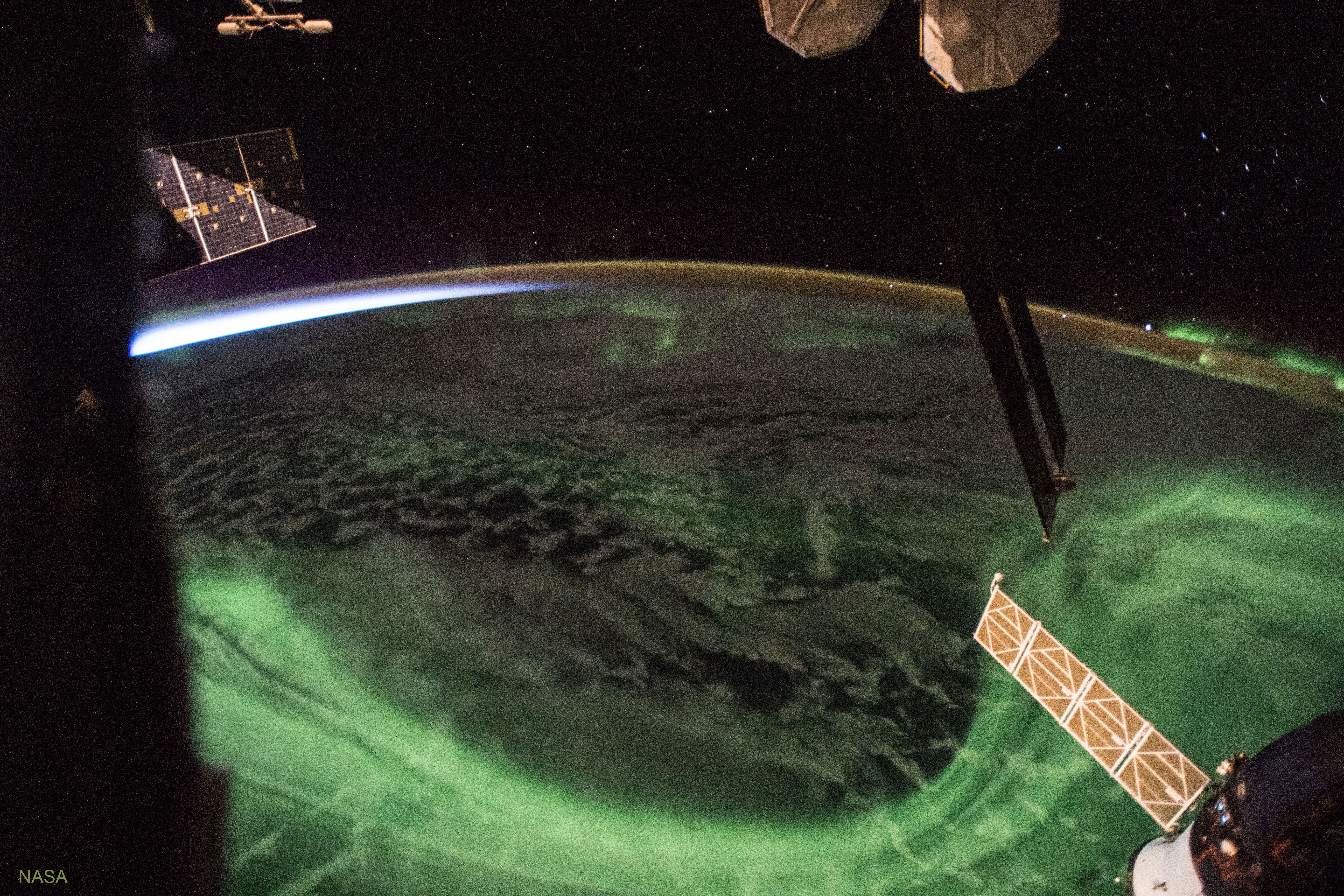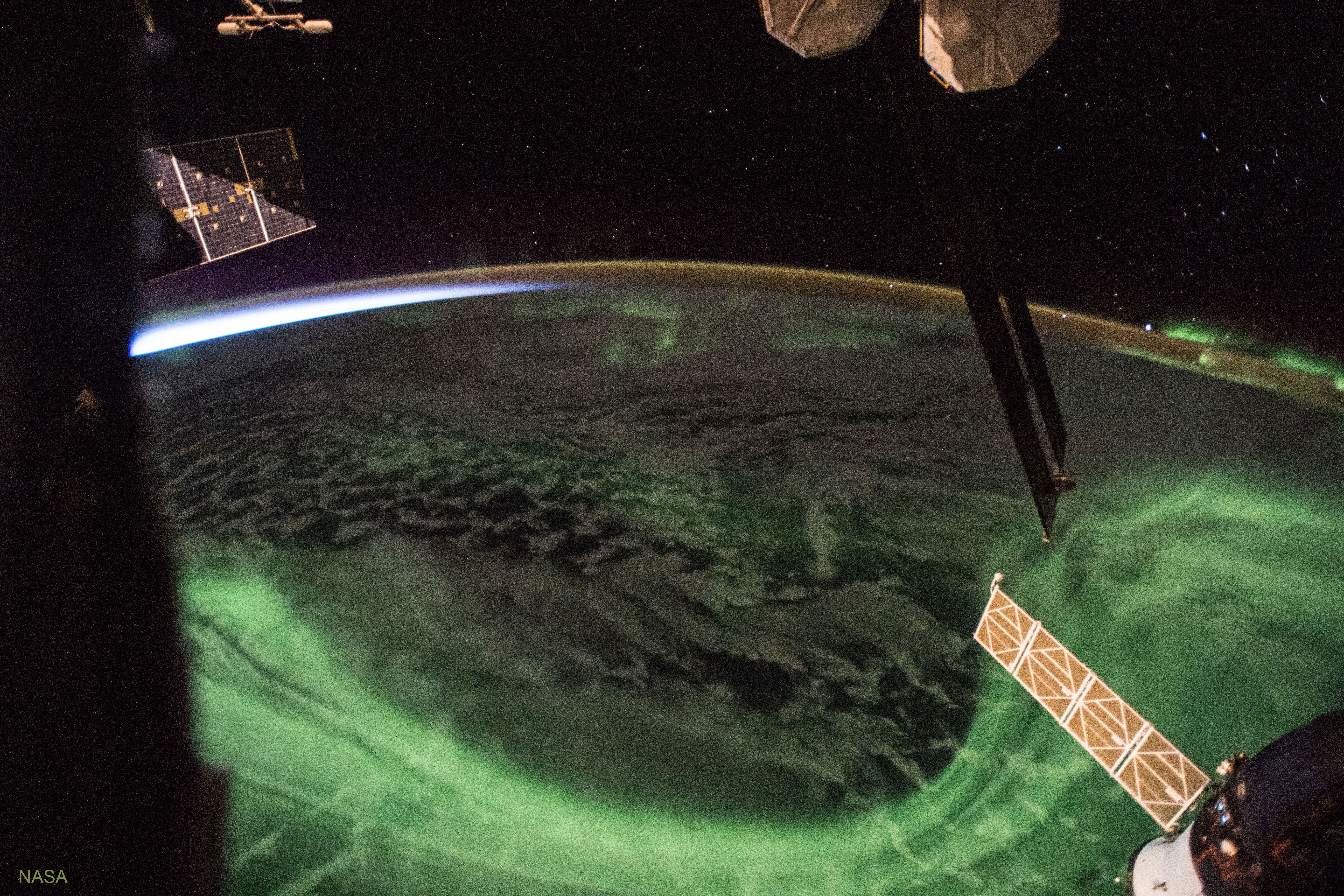
On the International Space Station (ISS), you can only admire an aurora until the sun rises. Then the background Earth becomes too bright. Unfortunately, after sunset, the rapid orbit of the ISS around the Earth means that sunrise is usually less than 47 minutes away. In the featured image, a green aurora is visible below the ISS -- and on the horizon to the upper right, while sunrise approaches ominously from the upper left. Watching an aurora from space can be mesmerizing as its changing shape has been compared to a giant green amoeba. Auroras are composed of energetic electrons and protons from the Sun that impact the Earth's magnetic field and then spiral down toward the Earth so fast that they cause atmospheric atoms and molecules to glow. The ISS orbits at nearly the same height as auroras, many times flying right through an aurora's thin upper layers, an event that neither harms astronauts nor changes the shape of the aurora. Share the Sky: NASA Open API for APOD
En la Estación Espacial Internacional (ISS), solo puedes admirar una aurora hasta que el sol se levanta. Entonces, el fondo terrestre se vuelve demasiado brillante. Desafortunadamente, después de la puesta de sol, la órbita rápida de la ISS alrededor de la Tierra significa que el amanecer suele estar a menos de 47 minutos. En la imagen destacada, una aurora verde es visible debajo de la ISS, y en el horizonte a la parte superior derecha, mientras el amanecer se acerca ominosamente desde la parte superior izquierda. Ver una aurora desde el espacio puede ser hipnótico, ya que su forma cambiante ha sido comparada con una ameba verde gigante. Las auroras están compuestas por electrones y protones energéticos del Sol que impactan el campo magnético de la Tierra y luego se espiralan hacia la Tierra tan rápido que hacen brillar los átomos y moléculas de la atmósfera. La ISS orbita a casi la misma altura que las auroras, muchas veces volando directamente a través de las capas superiores finas de una aurora, un evento que no daña a los astronautas ni cambia la forma de la aurora.