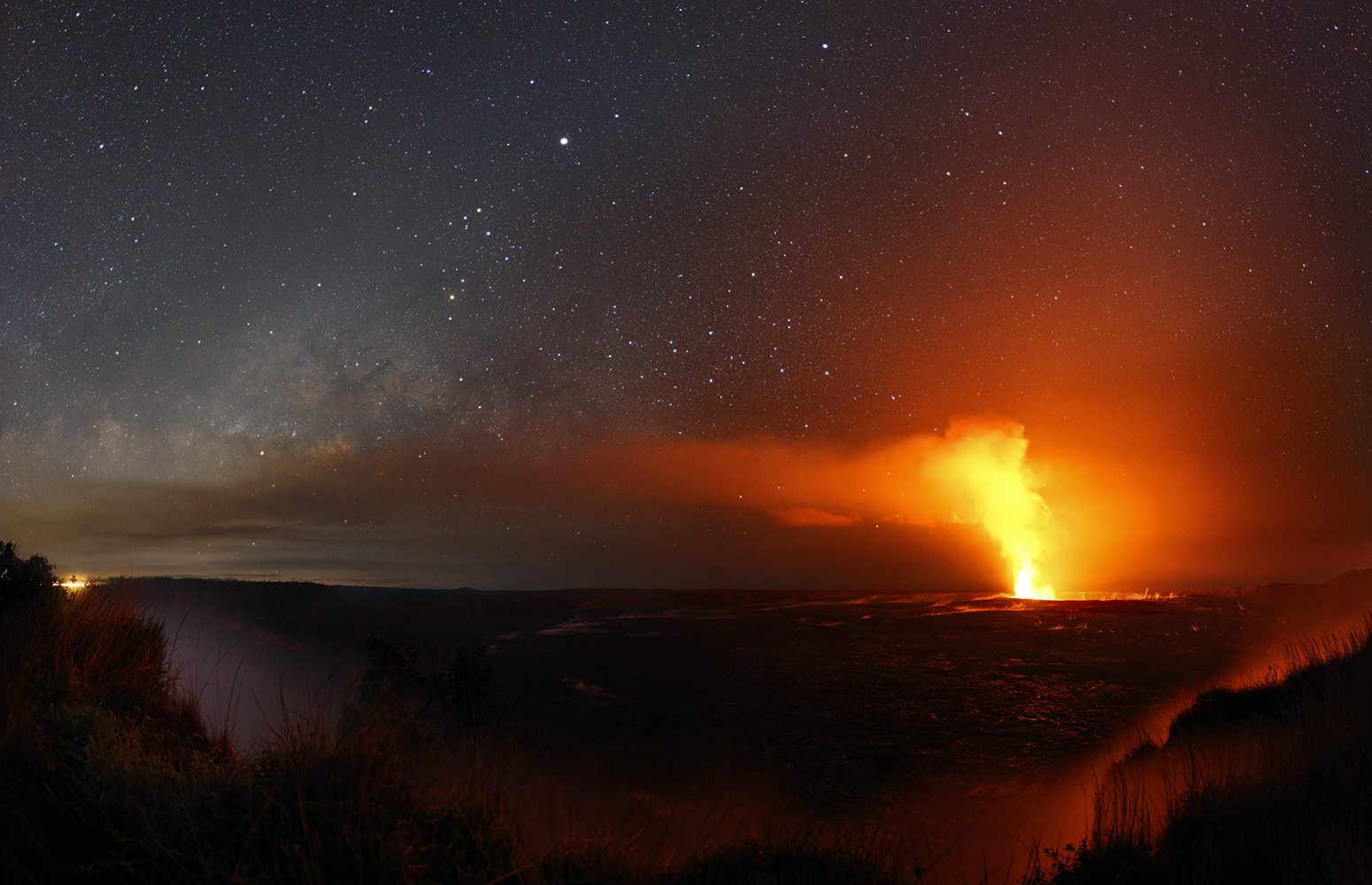
Volcanic activity on the Big Island of Hawaii has increased since this Hawaiian night skyscape was recorded earlier this year. Recent vents and lava flows are about 30 kilometers to the east, the direction of the blowing smoke and steam in the panoramic view of the Kilauea caldera with Halemaumau crater taken from Volcanoes National Park. Still, this year Jupiter is bright in late spring to early summer skies. High in the south it is easily the brightest celestial beacon in the scene where the central bulge of the Milky Way seems to rise above vapors and clouds. Yellowish Antares is the bright star near the end of the dark rivers of dust seen toward the center of our galaxy. Near the horizon, stars Alpha and Beta Centauri and the compact Southern Cross shine through the almost too bright volcanic smoke.
La actividad volcánica en la isla Grande de Hawái ha aumentado desde que se registró esta escena del cielo nocturno hawaiano a principios de este año. Los recientes respiraderos y flujos de lava se encuentran a unos 30 kilómetros al este, en la dirección del humo y el vapor que se ven en la vista panorámica de la caldera de Kīlauea con el cráter Halemaʻumaʻu, tomada desde el Parque Nacional de Volcanes. Sin embargo, este año Júpiter es brillante en los cielos de finales de primavera a principios de verano. Alto en el sur, es fácilmente el faro celestial más brillante en la escena, donde el bulbo central de la Vía Láctea parece elevarse sobre el vapor y las nubes. Antares, de color amarillento, es la estrella brillante cerca del final de los ríos oscuros de polvo que se ven hacia el centro de nuestra galaxia. Cerca del horizonte, las estrellas Alpha y Beta Centauri y la compacta Cruz del Sur brillan a través del humo volcánico casi demasiado brillante.