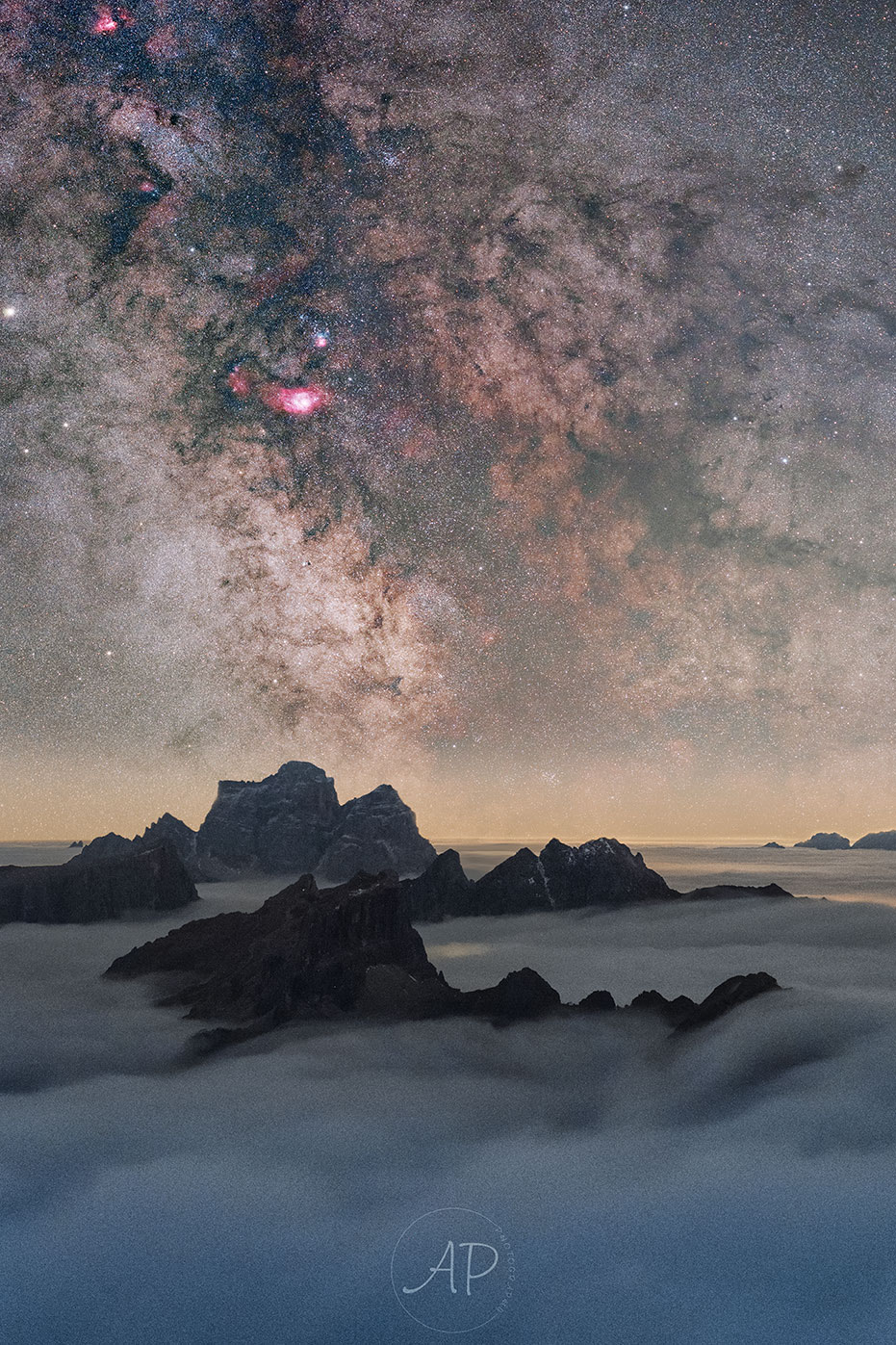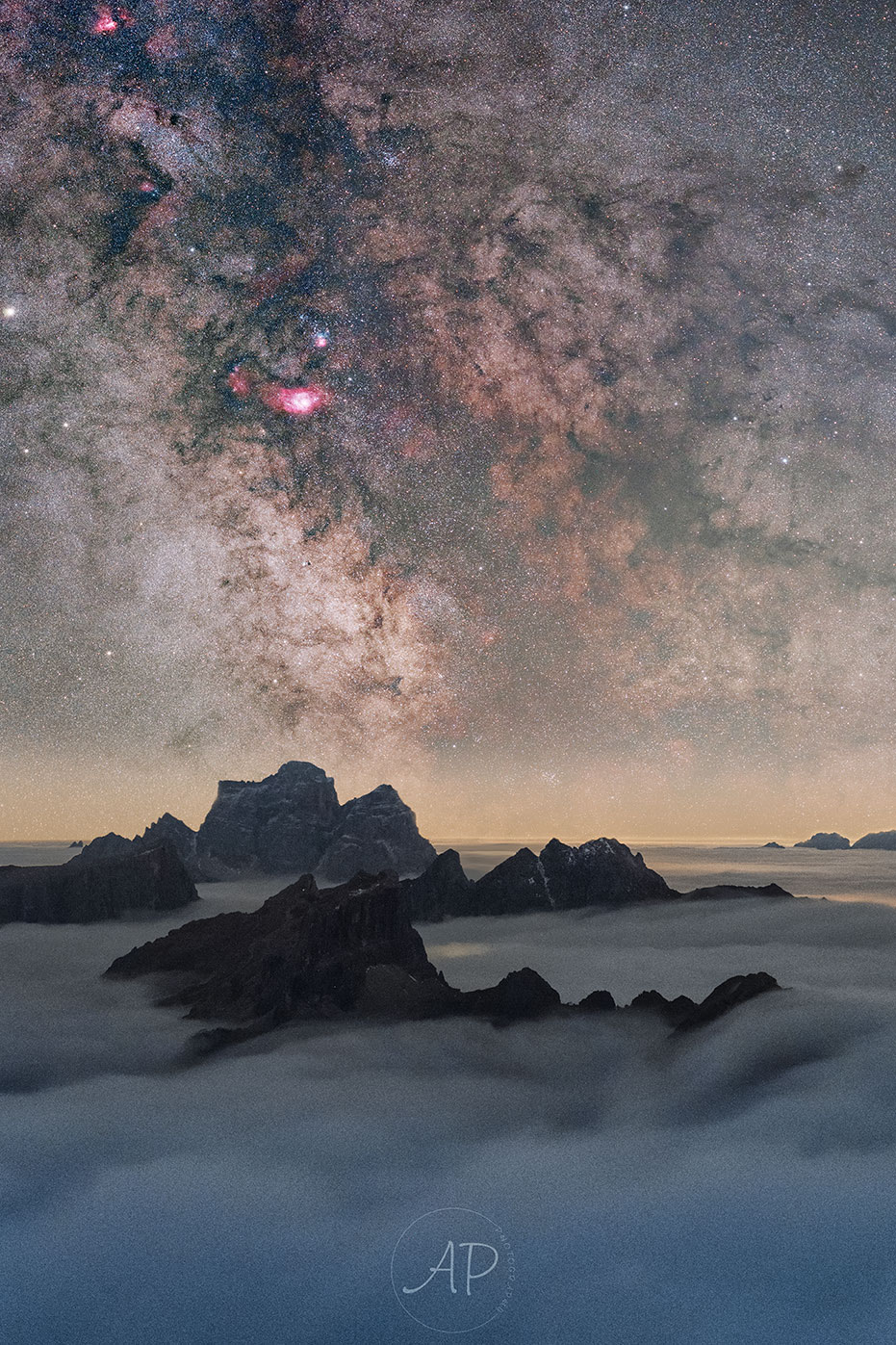
If you go high enough, you may find yourself on a picturesque perch between the water clouds of the Earth and the star clouds of the Milky Way. Such was the case last month for one adventurous alpinist astrophotographer. Captured here in the foreground above white clouds are mountain peaks in the Dolomite range in northern Italy. This multi-exposure image was captured from Lagazuoi, one of the Dolomites. Hundreds of millions of years ago, the Dolomites were not mountains but islands an ancient sea that rose through colliding tectonic plates. The Dolomites divergent history accounts for its unusually contrasting features, which include jagged crests and ancient marine fossils. High above even the Dolomites, and far in the distance, dark dust lanes streak out from the central plane of our Milky Way Galaxy. The stars and dust are dotted with bright red clouds of glowing hydrogen gas -- such as the Lagoon Nebula just above and to the left of center.
Si subes lo suficientemente alto, podrías encontrarte en un lugar pintoresco entre las nubes de agua de la Tierra y las nubes de estrellas de la Vía Láctea. Ese fue el caso el mes pasado para un apasionado alpinista y fotógrafo astronómico. En primer plano, sobre nubes blancas, se ven cumbres montañosas de la cadena de las Dolomitas en el norte de Italia. Esta imagen de múltiples exposiciones fue capturada desde Lagazuoi, una de las cumbres de las Dolomitas. Hace cientos de millones de años, las Dolomitas no eran montañas, sino islas de un antiguo mar que emergió debido al choque de placas tectónicas. La historia divergente de las Dolomitas explica sus características inusualmente contrastantes, que incluyen crestas afiladas y fósiles marinos antiguos. Más allá aún de las Dolomitas, y muy lejos en la distancia, surcos oscuros de polvo salen del plano central de nuestra galaxia, la Vía Láctea. Las estrellas y el polvo están salpicados de nubes rojizas brillantes de gas hidrógeno, como la Nebulosa del Lago, que se encuentra justo encima y a la izquierda del centro.