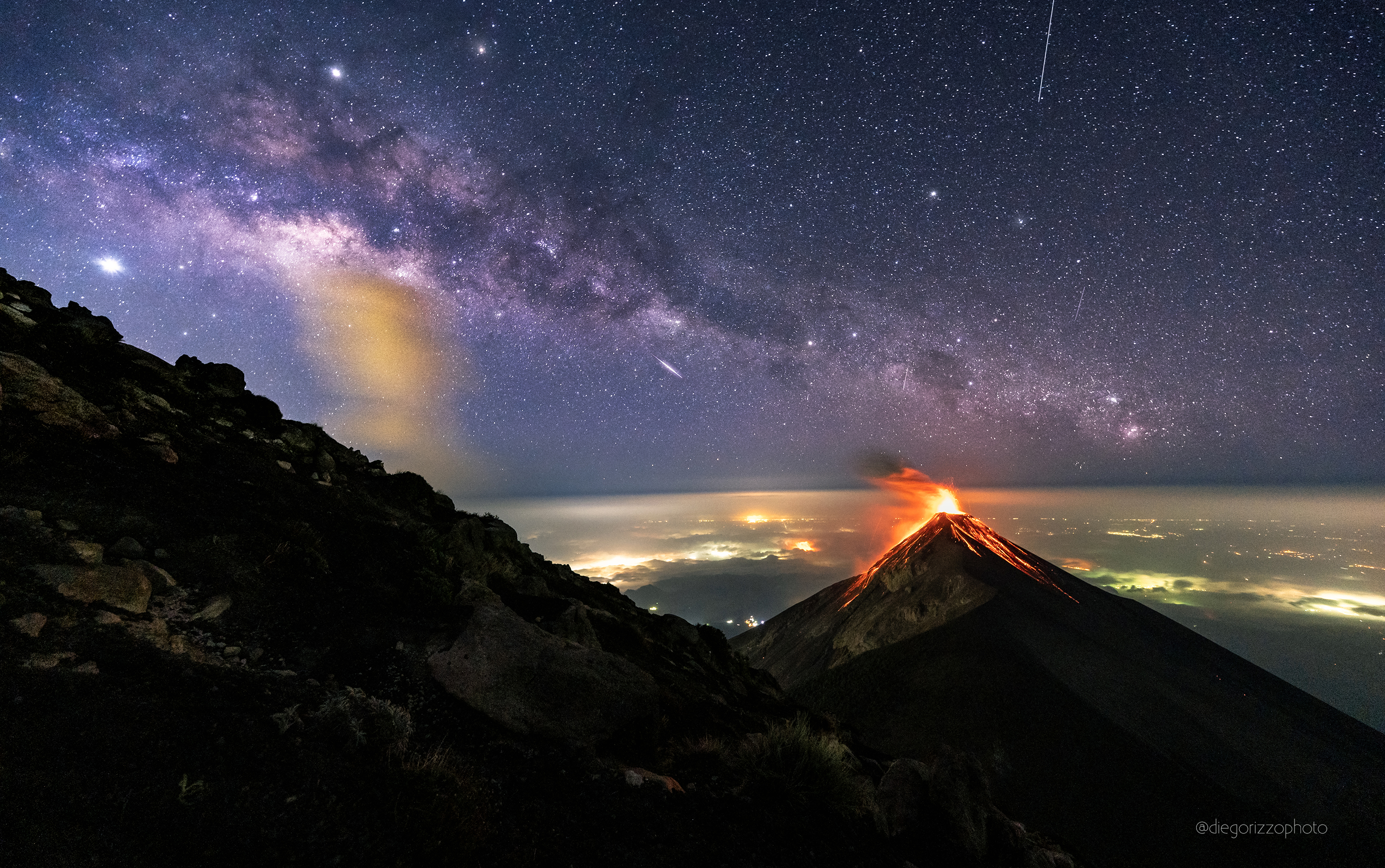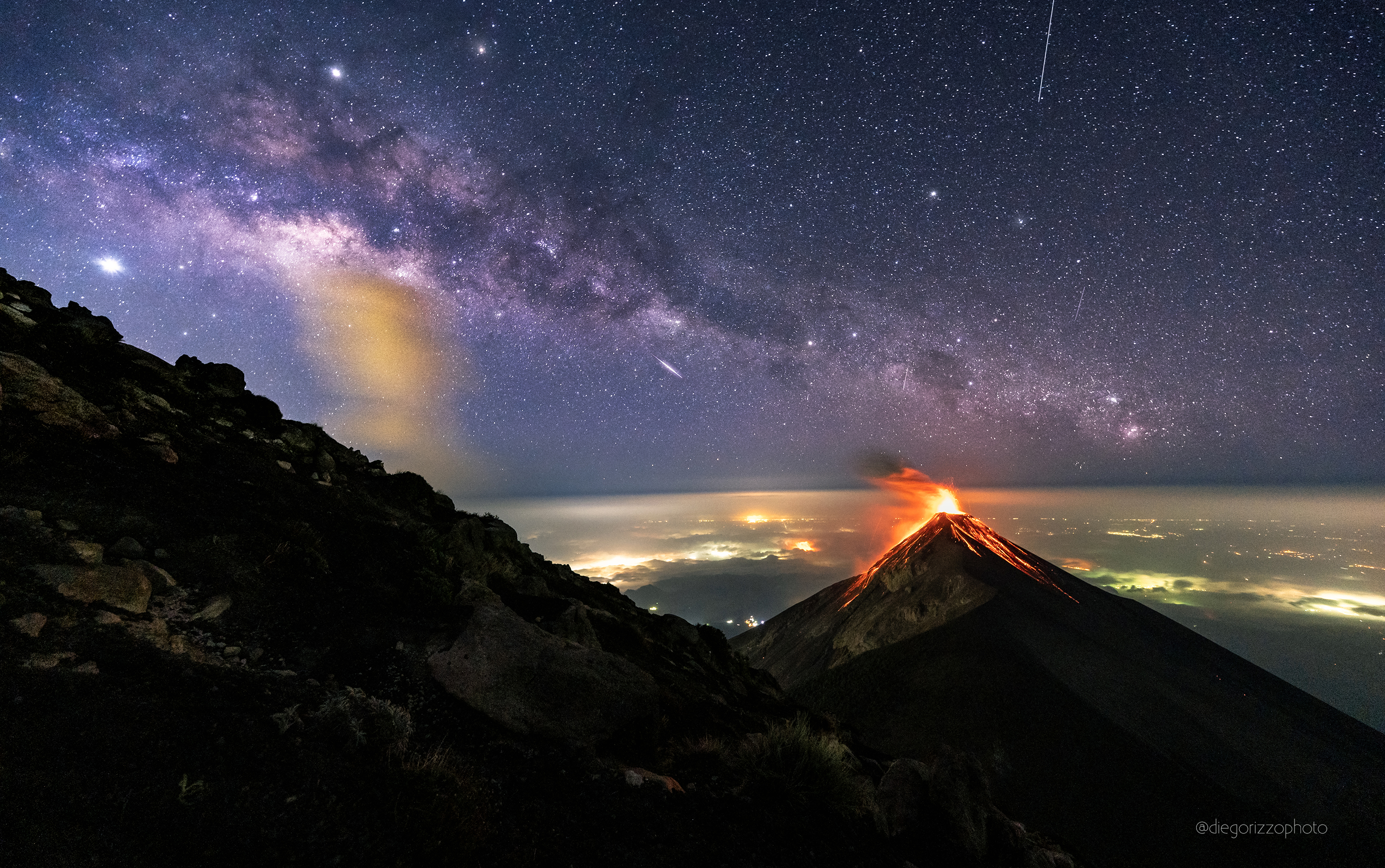
Sometimes it's hard to decide which is more impressive -- the land or the sky. On the land of the featured image, for example, the Volcano of Fire (Volc�n de Fuego) is seen erupting topped by red-hot, wind-blown ash and with streams of glowing lava running down its side. Lights from neighboring towns are seen through a thin haze below. In the sky, though, the central plane of our Milky Way Galaxy runs diagonally from the upper left, with a fleeting meteor just below, and the trail of a satellite to the upper right. The planet Jupiter also appears toward the upper left, with the bright star Antares just to its right. Much of the land and the sky were captured together in a single, well-timed, 25-second exposure taken in mid-April from the side of Fuego's sister volcano Acatenango in Guatemala. The image of the meteor, though, was captured in a similar frame taken about 30 minutes earlier -- when the volanic eruption was not as photogenic -- and added later digitally. Follow APOD on: Instagram, Facebook, Reddit, or Twitter
A veces es difícil decidir qué es más impresionante: la tierra o el cielo. En la tierra de la imagen destacada, por ejemplo, se ve el Volcán de Fuego (Volcán de Fuego) en erupción, coronado por ceniza rojiza y arrastrada por el viento, con corrientes de lava brillante que bajan por su flanco. A través de una leve neblina, se ven luces de pueblos vecinos debajo. En el cielo, sin embargo, el plano central de nuestra Galaxia Vía Láctea se extiende diagonalmente desde la esquina superior izquierda, con un meteoro fugaz justo debajo, y la trayectoria de un satélite hacia la esquina superior derecha. El planeta Júpiter también aparece hacia la esquina superior izquierda, con la brillante estrella Antares justo a su derecha. Gran parte de la tierra y el cielo se capturaron juntos en una única exposición bien calculada de 25 segundos, tomada a mediados de abril desde el flanco del volcán hermano de Fuego, el Acatenango, en Guatemala. La imagen del meteoro, sin embargo, se capturó en un fotograma similar tomado unos 30 minutos antes, cuando la erupción volcánica no era tan fotogénica, y se añadió digitalmente más tarde.