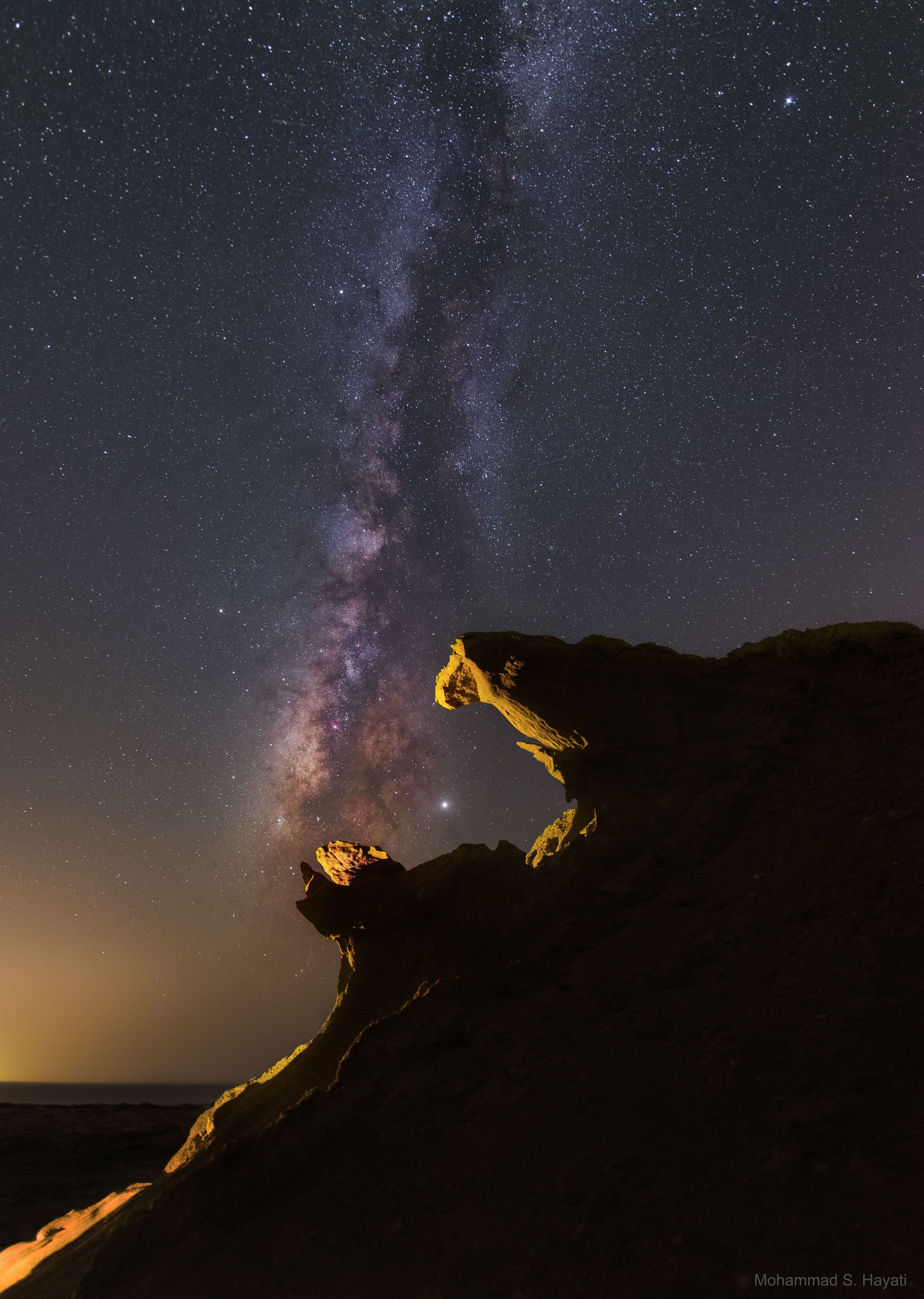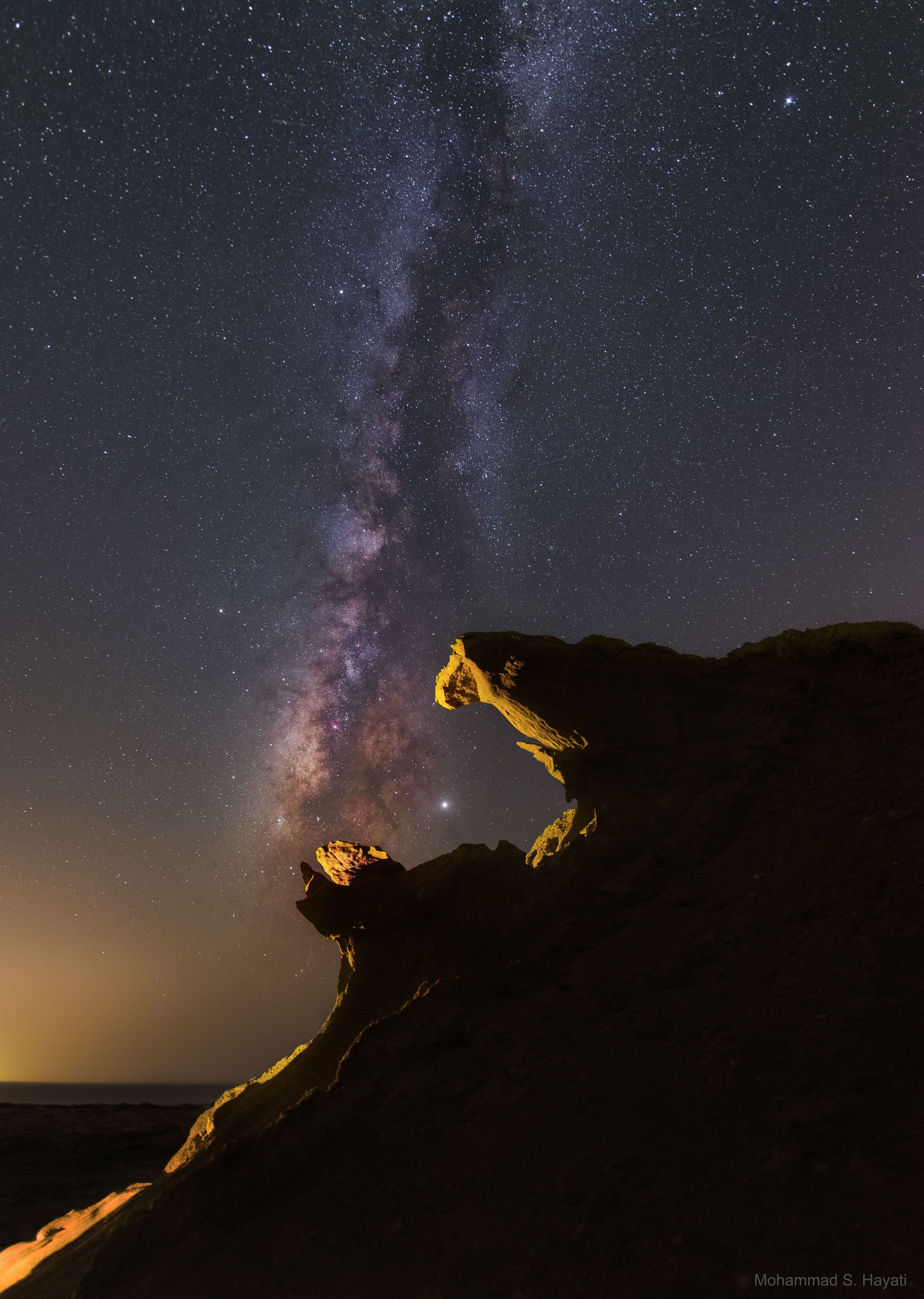
This is a good month to see Jupiter. To find our Solar System's largest planet in your sky, look toward the southeast just after sunset -- Jupiter should be the brightest object in that part of the sky. If you have a binoculars or a small telescope, you should be able to see Jupiter's four brightest moons right nearby, and possibly some cloud bands. The featured image was taken about a month ago from the Persian Gulf. The image shows Jupiter just to the right of the nearly vertical band of the central disk of our Milky Way Galaxy. The unnamed rock formations appear in projection like the jaws of a giant monster ready to engulf the Jovian giant. When you see Jupiter, it may be interesting to know that NASA's robotic Juno spacecraft is simultaneously visiting and studying the giant planet. Saturn is also visible this month, and although it is nearby to Jupiter, it is not as bright.
Este es un buen mes para ver a Júpiter. Para encontrar al planeta más grande de nuestro Sistema Solar en tu cielo, mira hacia el sureste justo después de la puesta de sol — Júpiter debería ser el objeto más brillante en esa parte del cielo. Si tienes unos binoculares o un pequeño telescopio, deberías poder ver las cuatro lunas más brillantes de Júpiter cerca, y posiblemente algunas bandas de nubes. La imagen destacada fue tomada hace aproximadamente un mes desde el Golfo Pérsico. La imagen muestra a Júpiter justo a la derecha de la banda casi vertical del disco central de nuestra galaxia, la Vía Láctea. Las formaciones rocosas sin nombre aparecen en proyección como si fueran las mandíbulas de un monstruo gigante listo para engullir al gigante joviano. Cuando veas a Júpiter, puede ser interesante saber que la nave espacial robótica Juno de la NASA está visitando y estudiando simultáneamente al planeta gigante. Saturno también es visible este mes, y aunque está cerca de Júpiter, no es tan brillante.