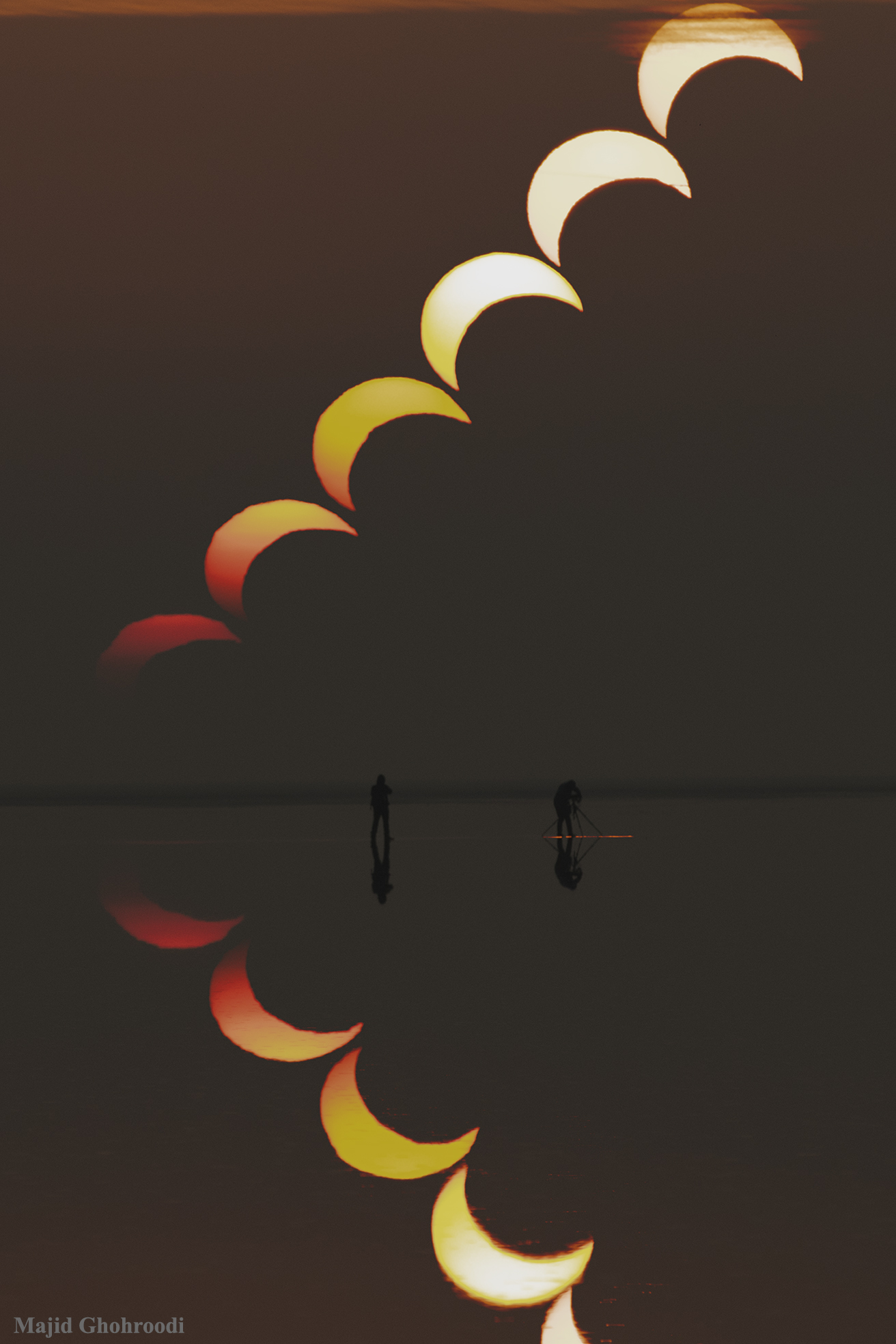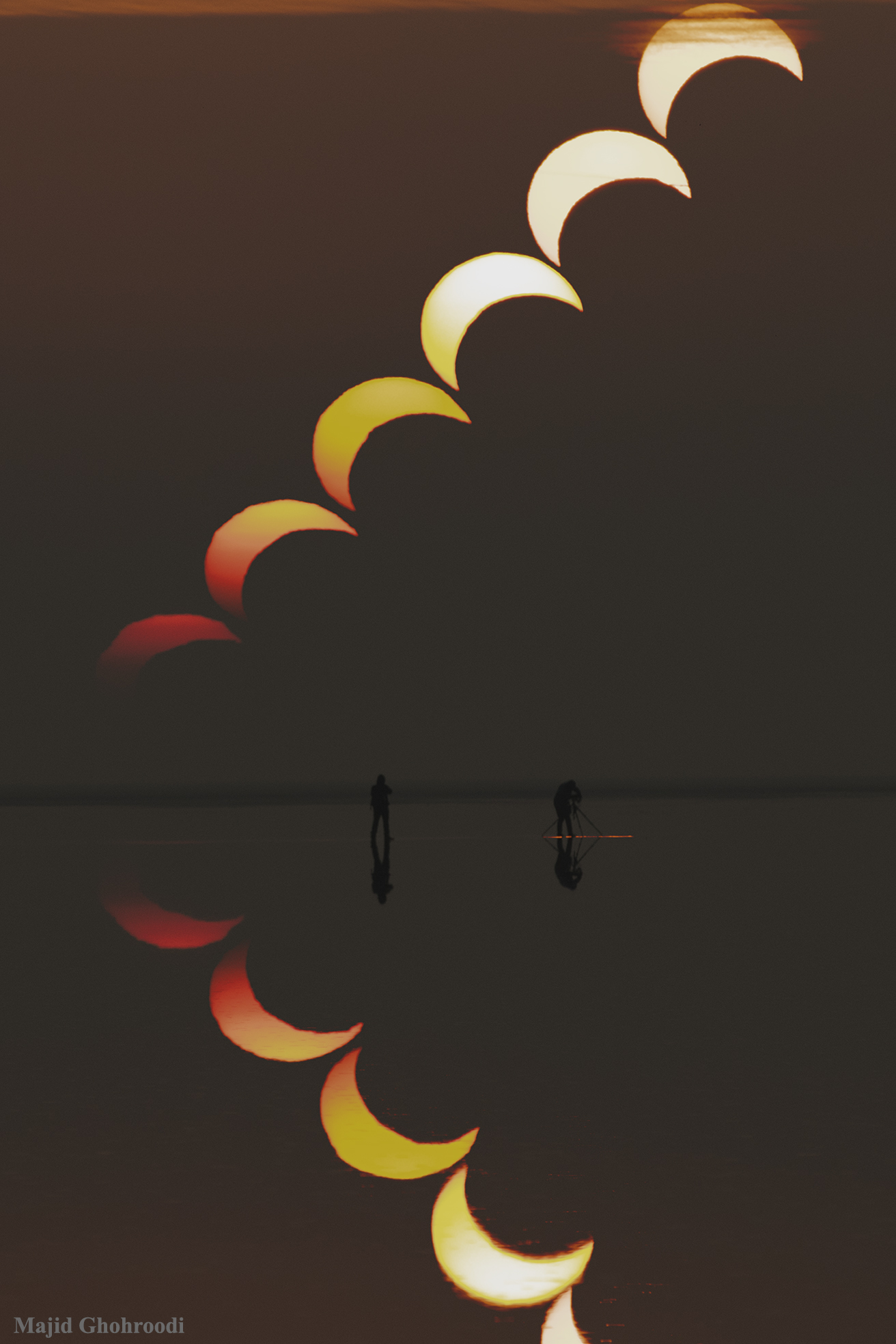
What's happened to the Sun? Yesterday, if you were in the right place at the right time, you could see the Sun rise partially eclipsed by the Moon. The unusual sight was captured in dramatic fashion in the featured image not only directly, in a sequence of six images, but also in reflection from Soltan Salt Lake in Iran. The almost-white Sun appears dimmer and redder near the horizon primarily because Earth's atmosphere preferentially scatters away more blue light. Yesterday's partial solar eclipse appeared in the sky over much of Asia and Australia, but those with a clear enough sky in a thin band across the Earth's surface were treated to a more complete annular solar eclipse -- where the Moon appears completely surrounded by the Sun in what is known as a ring of fire. The next annular solar eclipse will occur in 2020 June. Notable Images Submitted to APOD: The Partial Solar Eclipse of 2019 December
¿Qué le ha ocurrido al Sol? Ayer, si estabas en el lugar y momento adecuados, pudiste ver el Sol salir parcialmente eclipsado por la Luna. Esta escena inusual fue capturada de manera dramática en la imagen destacada, no solo directamente, en una secuencia de seis imágenes, sino también en reflejo desde el Lago Soltan de sal en Irán. El Sol casi blanco aparece más tenue y rojizo cerca del horizonte principalmente porque la atmósfera terrestre dispersa selectivamente más luz azul. El eclipse solar parcial de ayer apareció en el cielo sobre gran parte de Asia y Australia, pero quienes tenían un cielo suficientemente despejado en una banda estrecha sobre la superficie terrestre fueron recompensados con un eclipse solar anular más completo, en el que la Luna aparece completamente rodeada por el Sol, en lo que se conoce como anillo de fuego. El próximo eclipse solar anular ocurrirá en junio de 2020. Imágenes notables enviadas a APOD: El eclipse solar parcial de diciembre de 2019