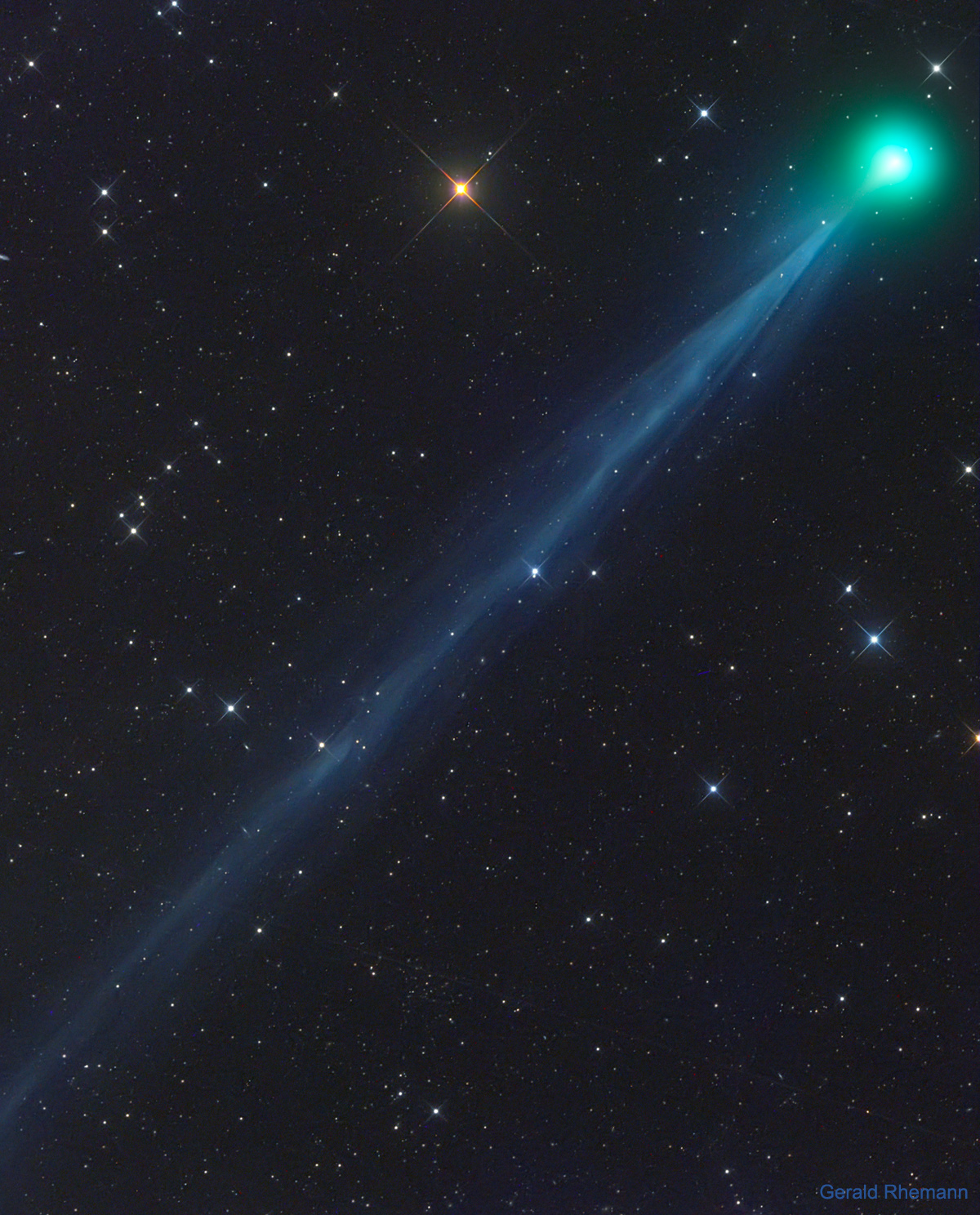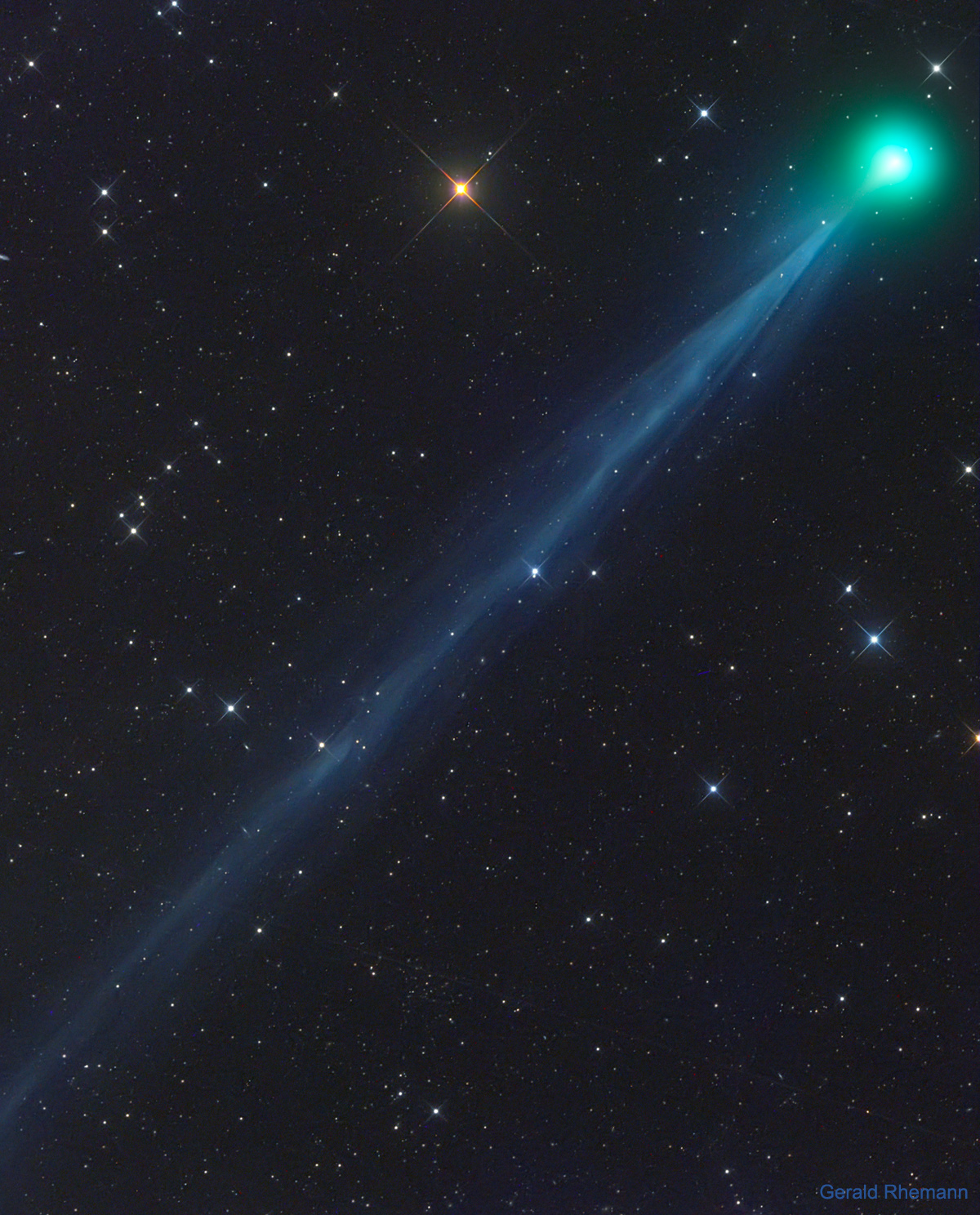
Newly discovered Comet SWAN has already developed an impressive tail. The comet came in from the outer Solar System and has just passed inside the orbit of the Earth. Officially designated C/2020 F8 (SWAN), this outgassing interplanetary iceberg will pass its closest to the Earth on May 13, and closest to the Sun on May 27. The comet was first noticed in late March by an astronomy enthusiast looking through images taken by ESA's and NASA's Sun-orbiting SOHO spacecraft, and is named for this spacecraft's Solar Wind Anisotropies (SWAN) camera. The featured image, taken from the dark skies in Namibia in mid-April, captured Comet SWAN's green-glowing coma and unexpectedly long, detailed, and blue ion-tail. Although the brightness of comets are notoriously hard to predict, some models have Comet SWAN becoming bright enough to see with the unaided eye during June. Experts Debate: How will humanity first discover extraterrestrial life?
El recién descubierto cometa SWAN ya ha desarrollado una cola impresionante. El cometa llegó desde el exterior del Sistema Solar y recientemente pasó dentro de la órbita de la Tierra. Oficialmente designado como C/2020 F8 (SWAN), este iceberg interestelar que libera gas pasará más cerca de la Tierra el 13 de mayo, y más cerca del Sol el 27 de mayo. El cometa fue notado por primera vez a finales de marzo por un entusiasta de la astronomía que revisaba imágenes tomadas por la nave espacial SOHO, que orbita el Sol y es operada por la ESA y NASA, y se le nombró en honor a la cámara de Anisotropías del Viento Solar (SWAN) de esta nave espacial. La imagen destacada, tomada desde el cielo oscuro en Namibia a mediados de abril, capturó la coma brillante en verde del cometa SWAN y una cola iónica inesperadamente larga, detallada y de color azul. Aunque la brillantez de los cometas es notablemente difícil de predecir, algunos modelos sugieren que el cometa SWAN podría volverse lo suficientemente brillante como para ser visible a simple vista durante junio.