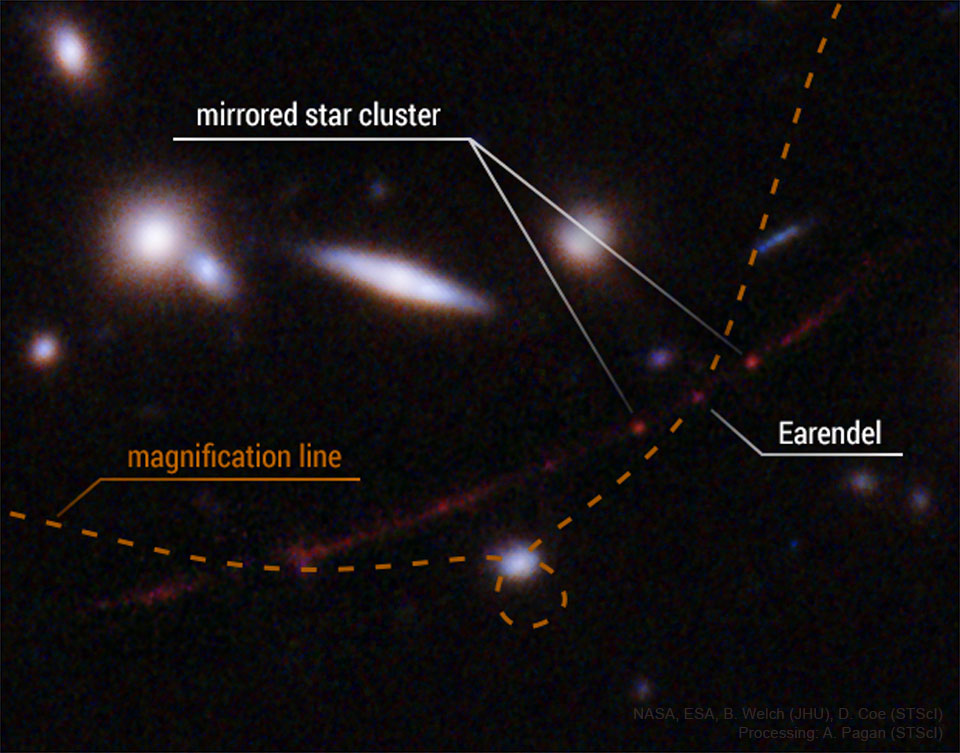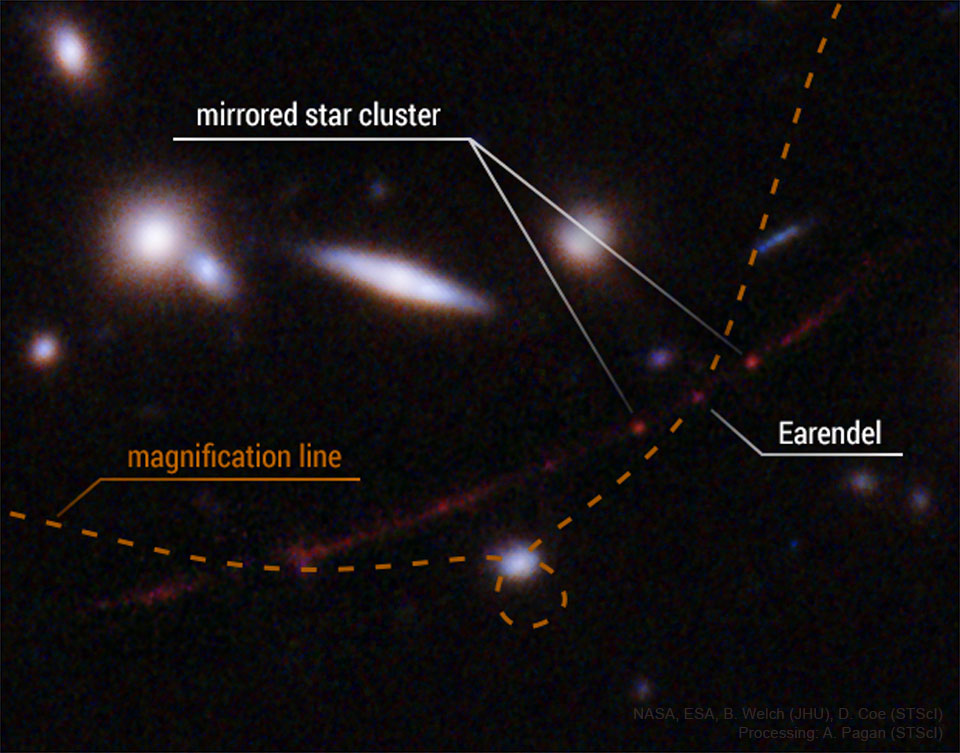
Is Earendel the farthest star yet discovered? This scientific possibility started when the Hubble Space Telescope observed a huge cluster of galaxies. The gravitational lens effect of this cluster was seen to magnify and distort a galaxy far in the background. This distorted background galaxy -- so far away it has a redshift of 6.2 -- appears in the featured image as a long red string, while beads on that string are likely to be star clusters. The galaxy cluster lens creates a line of maximum magnification line where superposed background objects may appear magnified many thousands of times. On the intersection between the galaxy line and the maximum magnification line is one "bead" which shows evidence of originating from a single bright star in the early universe -- now named Earendel. Future investigations may include more imaging by Hubble to see how Earendel's brightness varies, and, quite possibly, by the new James Webb Space Telescope when it becomes operational later this year. Earendel's great distance exceeds that of any known stable star -- although the star that exploded creating GRB 090423 had a redshift of 8.2.
¿Es Earendel la estrella más distante descubierta hasta ahora? Esta posibilidad científica surgió cuando el telescopio espacial Hubble observó un gran cúmulo de galaxias. El efecto lente gravitacional de este cúmulo se vio ampliar y distorsionar una galaxia muy distante en el fondo. Esta galaxia de fondo distorsionada — tan lejos que tiene un corrimiento al rojo de 6,2 — aparece en la imagen destacada como una cuerda roja larga, mientras que las cuentas de esa cuerda probablemente sean cúmulos estelares. El cúmulo galáctico actúa como una lente que crea una línea de máxima magnificación, donde los objetos de fondo superpuestos pueden aparecer magnificados miles de veces. En la intersección entre la línea de la galaxia y la línea de máxima magnificación hay una 'cuenta' que muestra evidencia de provenir de una única estrella brillante en el universo primitivo — ahora llamada Earendel. Investigaciones futuras pueden incluir más imágenes por parte de Hubble para ver cómo varía la brillantez de Earendel, y posiblemente por el nuevo telescopio espacial James Webb cuando entre en funcionamiento a finales de este año. La gran distancia de Earendel supera la de cualquier estrella estable conocida — aunque la estrella que explotó creando el GRB 090423 tenía un corrimiento al rojo de 8,2.