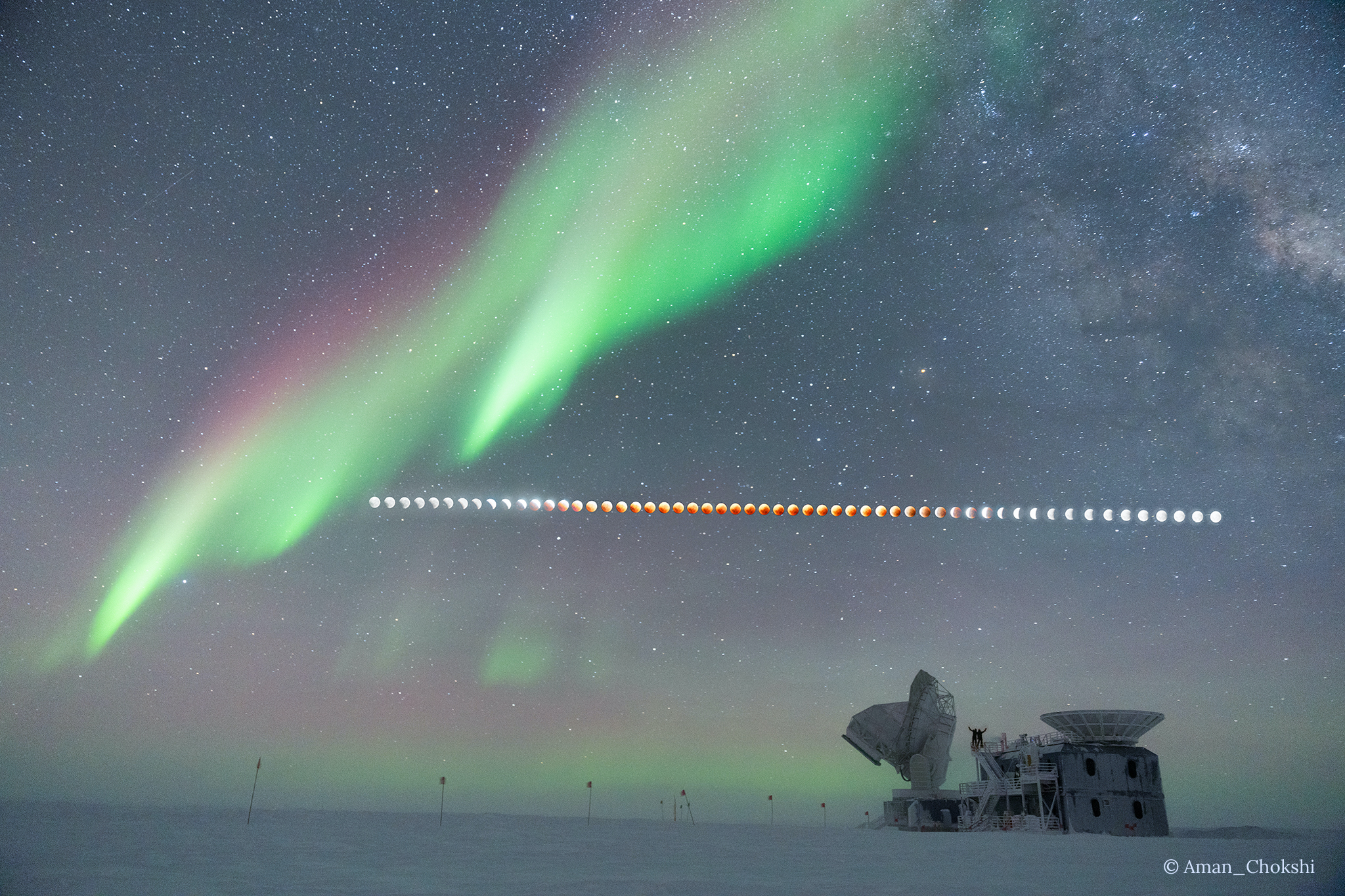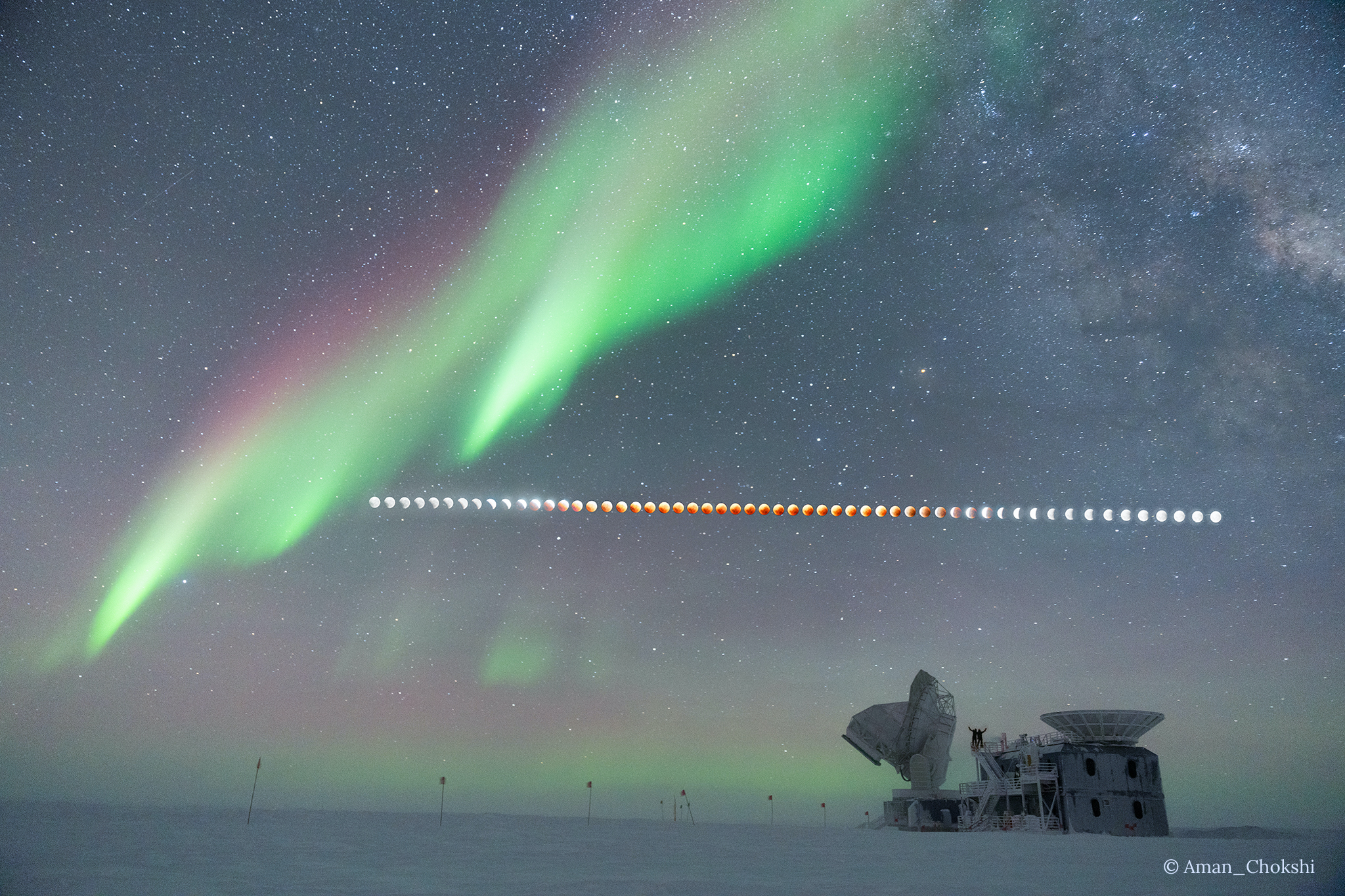
Last May 16 the Moon slid through Earth's shadow, completely immersed in the planet's dark umbra for about 1 hour and 25 minutes during a total lunar eclipse. In this composited timelapse view, the partial and total phases of the eclipse were captured as the Moon tracked above the horizon from Amundsen-Scott South Pole Station. There it shared a cold and starry south polar night with a surging display of the aurora australis and central Milky Way. In the foreground are the BICEP (right) and South Pole telescopes at the southernmost station's Dark Sector Laboratory. But while polar skies can be spectacular, you won't want to go to the South Pole to view the total lunar eclipse coming up on November 8. Instead, that eclipse can be seen from locations in Asia, Australia, the Americas and the Pacific. It will be your last chance to watch a total lunar eclipse until 2025.
Crédito: NASA, CGRO SSC El 16 de mayo pasado, la Luna atravesó la sombra de la Tierra, quedando completamente sumergida en la oscura umbra del planeta durante aproximadamente 1 hora y 25 minutos durante un eclipse lunar total. En esta vista compuesta de timelapse, las fases parcial y total del eclipse fueron capturadas mientras la Luna se desplazaba sobre el horizonte desde la Estación Amundsen-Scott del Polo Sur. Allí compartió la fría y estrellada noche polar sur con una intensa exhibición de la aurora austral y la Vía Láctea central. En primer plano se encuentran los telescopios BICEP (a la derecha) y del Polo Sur en el Laboratorio del Sector Oscuro de la estación más austral. Sin embargo, aunque los cielos polares pueden ser espectaculares, no querrás ir al Polo Sur para observar el próximo eclipse lunar total del 8 de noviembre. En su lugar, ese eclipse será visible desde lugares en Asia, Australia, las Américas y el Pacífico. Será tu última oportunidad de observar un eclipse lunar total hasta 2025.