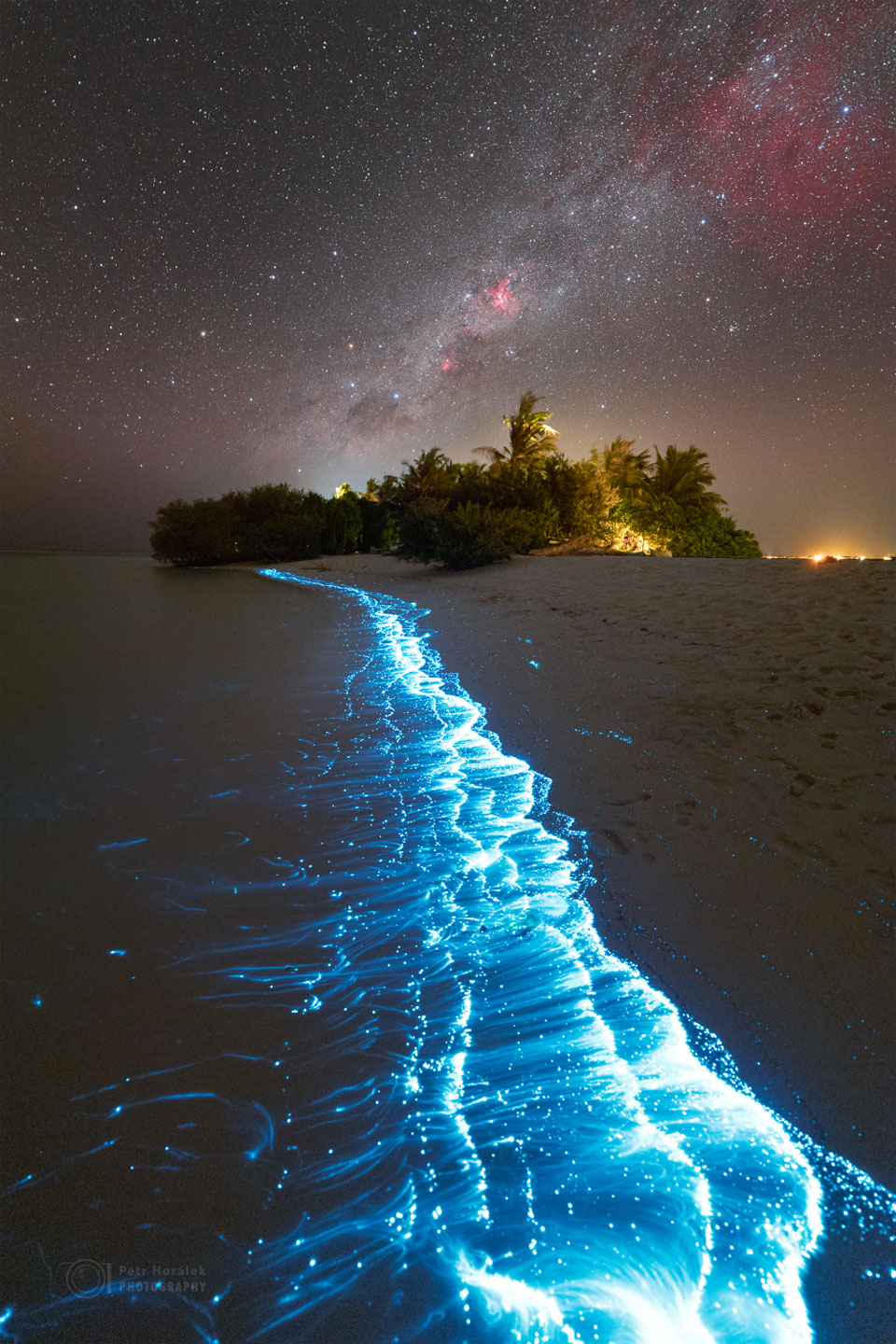
What glows there? The answer depends: sea or sky? In the sea, the unusual blue glow is bioluminescence. Specifically, the glimmer arises from Noctiluca scintillans, single-celled plankton stimulated by the lapping waves. The plankton use their glow to startle and illuminate predators. This mid-February display on an island in the Maldives was so intense that the astrophotographer described it as a turquoise wonderland. In the sky, by contrast, are the more familiar glows of stars and nebulas. The white band rising from the artificially-illuminated green plants is created by billions of stars in the central disk of our Milky Way Galaxy. Also visible in the sky is the star cluster Omega Centauri, toward the left, and the famous Southern Cross asterism in the center. Red-glowing nebulas include the bright Carina Nebula, just right of center, and the expansive Gum Nebula on the upper right.
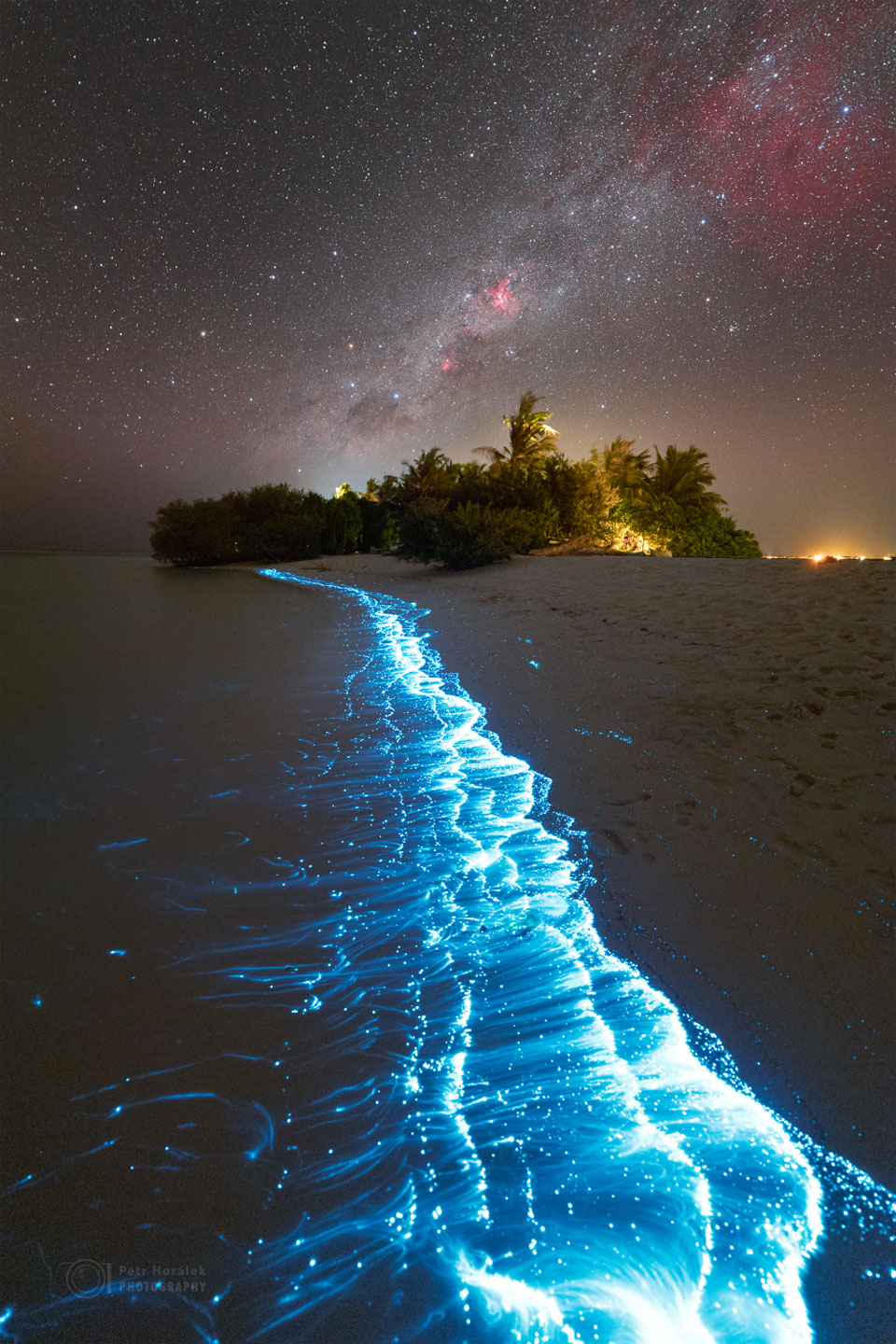
¿Qué brilla allí? La respuesta depende: ¿mar o cielo? En el mar, el inusual brillo azul es bioluminiscencia. Específicamente, el resplandor proviene de Noctiluca scintillans, plancton unicelular estimulado por las olas que rompen. El plancton utiliza su brillo para asustar e iluminar a sus depredadores. Esta exhibición, en febrero, en una isla de las Maldivas, fue tan intensa que el fotógrafo astronómico la describió como un paraíso turquesa. En el cielo, en contraste, se encuentran los más familiares brillos de estrellas y nebulosas. La banda blanca que se eleva desde las plantas verdes iluminadas artificialmente es creada por miles de millones de estrellas en el disco central de nuestra galaxia, la Vía Láctea. También visible en el cielo se encuentra el cúmulo estelar Omega Centauri, hacia la izquierda, y el famoso asterismo de la Cruz del Sur, en el centro. Las nebulosas que emiten un brillo rojizo incluyen la brillante nebulosa Carina, justo a la derecha del centro, y la extensa nebulosa Gum en la parte superior derecha.