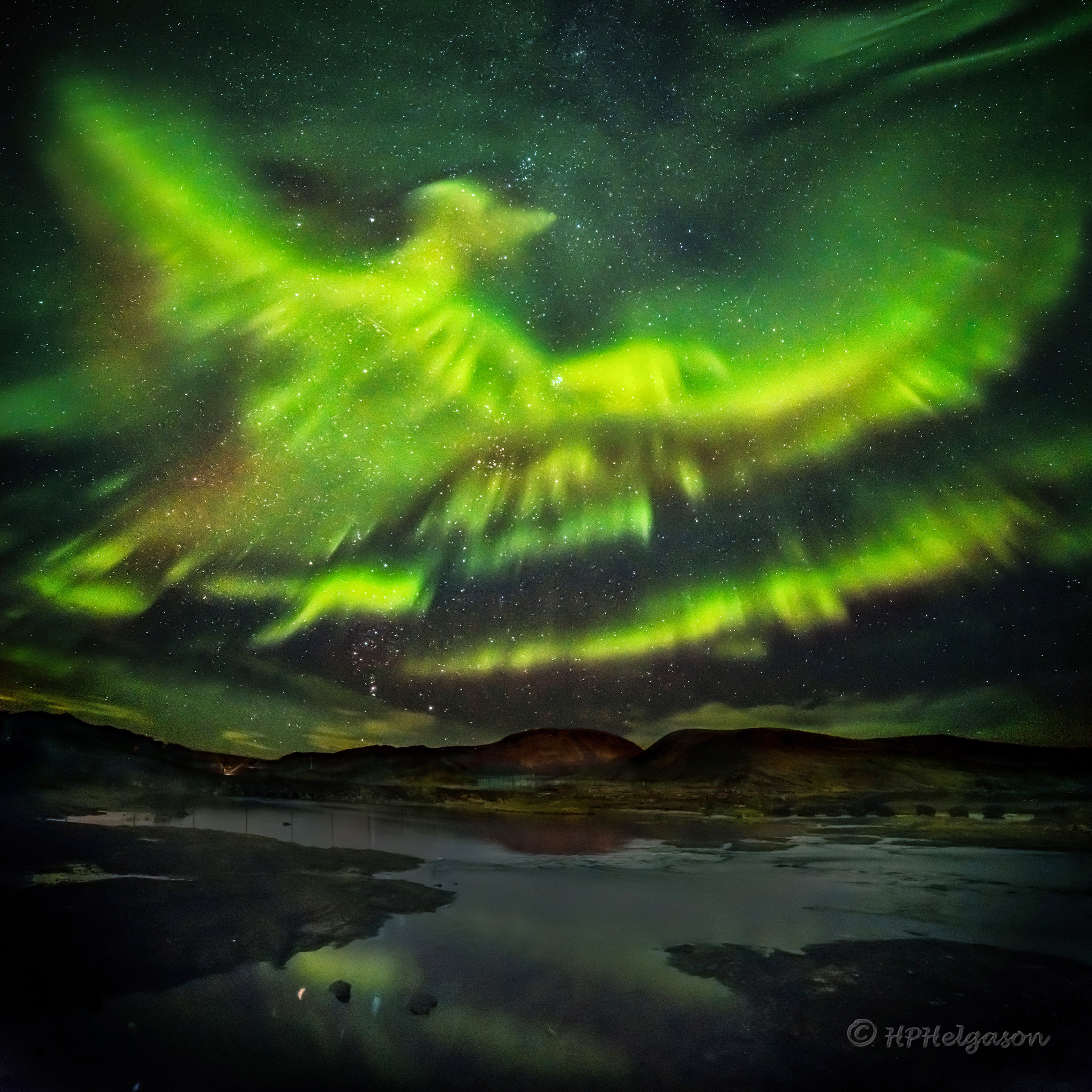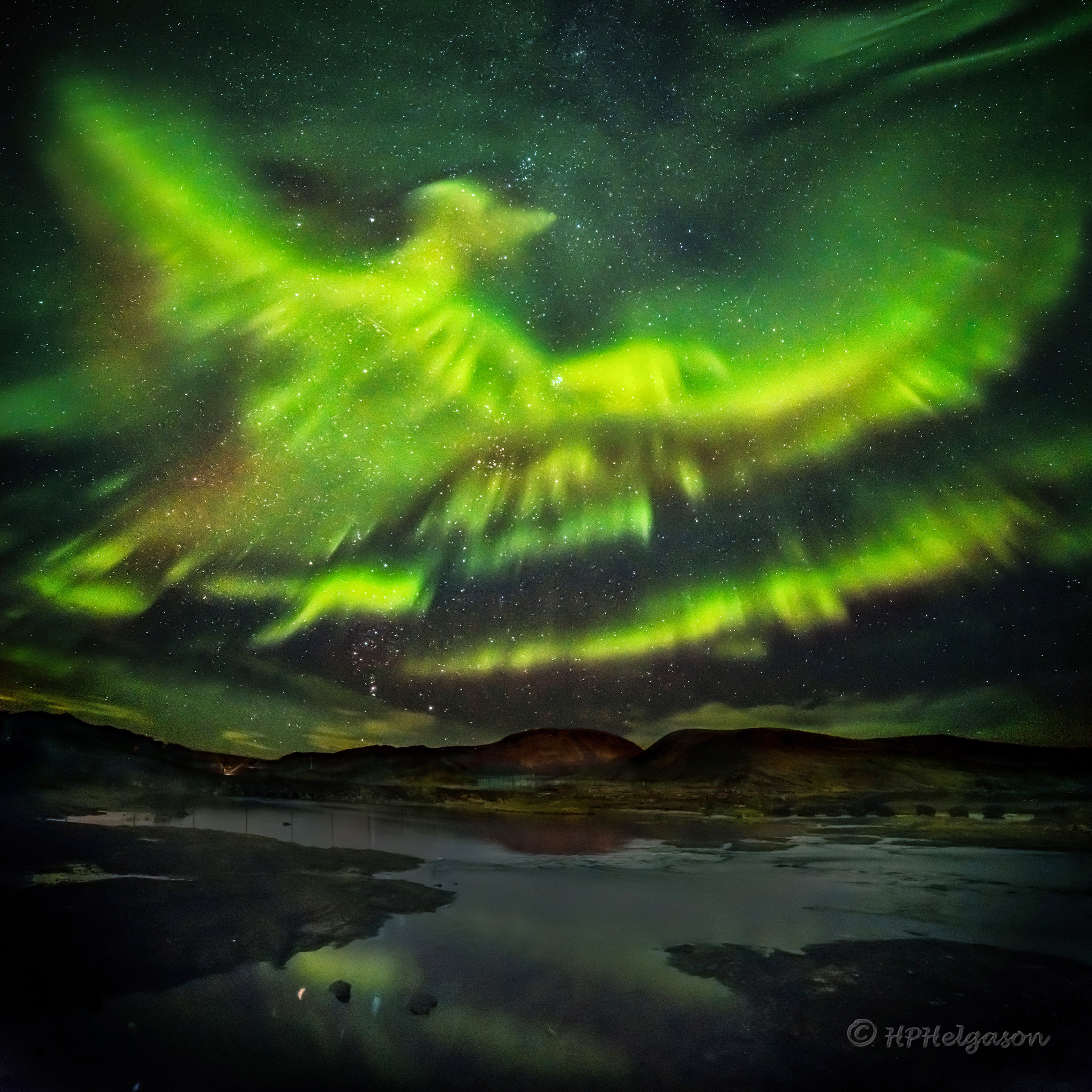
All of the other aurora watchers had gone home. By 3:30 am in Iceland, on a quiet September night, much of that night's auroras had died down. Suddenly, unexpectedly, a new burst of particles streamed down from space, lighting up the Earth's atmosphere once again. This time, surprisingly, pareidoliacally, the night lit up with an amazing shape reminiscent of a giant phoenix. With camera equipment at the ready, two quick sky images were taken, followed immediately by a third of the land. The mountain in the background is Helgafell, while the small foreground river is called Kaldá, both located about 30 kilometers north of Iceland's capital Reykjavík. Seasoned skywatchers will note that just above the mountain, toward the left, is the constellation of Orion, while the Pleiades star cluster is also visible just above the frame center. The 2016 aurora, which lasted only a minute and was soon gone forever -- would possibly be dismissed as a fanciful fable -- were it not captured in the featured, digitally-composed, image mosaic. Your Sky Surprise: What picture did APOD feature on your birthday? (post 1995)
Crédito: Autor de la imagen mencionado en el texto original Todos los demás observadores de auroras se habían ido a casa. A las 3:30 de la madrugada en Islandia, en una tranquila noche de septiembre, gran parte de las auroras de esa noche ya se habían apagado. De repente, inesperadamente, un nuevo chorro de partículas descendió del espacio, iluminando nuevamente la atmósfera terrestre. Esta vez, sorprendentemente, de forma pareidólica, la noche se iluminó con una forma asombrosa que recordaba a un gigantesco fénix. Con el equipo fotográfico listo, se tomaron dos rápidas imágenes del cielo, seguidas inmediatamente por una tercera del terreno. La montaña en primer plano es el Helgafell, mientras que el pequeño río delantero se llama Kaldá, ambos ubicados aproximadamente a 30 kilómetros al norte de la capital islandesa, Reikiavik. Los observadores experimentados notarán que justo encima de la montaña, hacia la izquierda, se encuentra la constelación de Orión, mientras que el cúmulo estelar de las Pléyades también es visible justo encima del centro del marco. La aurora de 2016, que duró solo un minuto y pronto desapareció para siempre, posiblemente sería desestimada como una fábula fantástica de no haber sido capturada en la imagen mosaico digital que se muestra. Tu sorpresa celeste: ¿Qué imagen destacó APOD en tu cumpleaños? (desde 1995)