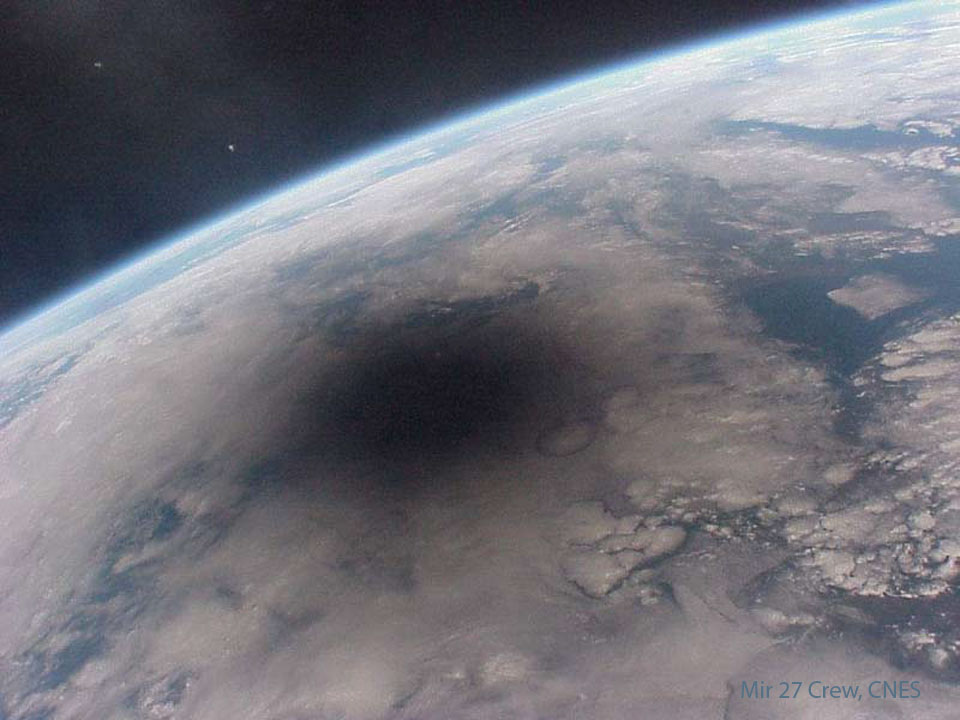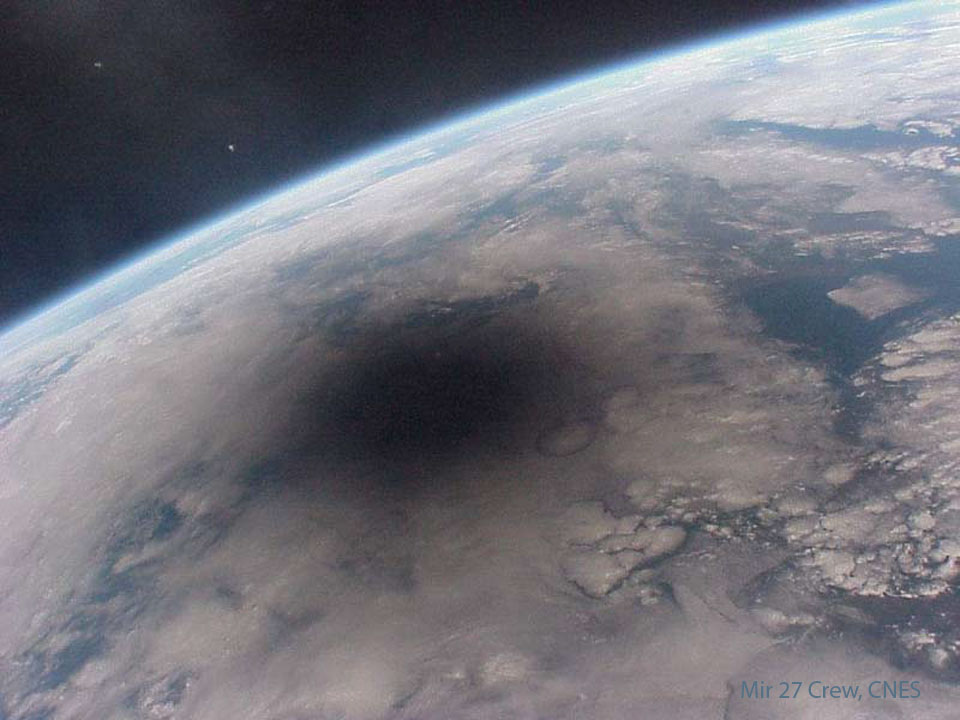
Here is what the Earth looks like during a solar eclipse. The shadow of the Moon can be seen darkening part of Earth. This shadow moved across the Earth at nearly 2000 kilometers per hour. Only observers near the center of the dark circle see a total solar eclipse - others see a partial eclipse where only part of the Sun appears blocked by the Moon. This spectacular picture of the 1999 August 11 solar eclipse was one of the last ever taken from the Mir space station. The two bright spots that appear on the upper left are thought to be Jupiter and Saturn. Mir was deorbited in a controlled re-entry in 2001. A new solar eclipse will occur over North America in about two weeks.
Crédito: NASA, Mir Esta es la apariencia que tiene la Tierra durante un eclipse solar. La sombra de la Luna se puede ver oscureciendo parte de la Tierra. Esta sombra se movió a través de la Tierra a casi 2000 kilómetros por hora. Solo los observadores cerca del centro del círculo oscuro ven un eclipse solar total - otros ven un eclipse parcial donde solo parte del Sol parece bloqueada por la Luna. Esta espectacular imagen del eclipse solar del 11 de agosto de 1999 fue una de las últimas jamás tomadas desde la estación espacial Mir. Los dos puntos brillantes que aparecen en la esquina superior izquierda se cree que son Júpiter y Saturno. Mir fue desorbitada en una reentrada controlada en 2001. Un nuevo eclipse solar ocurrirá sobre Norteamérica en aproximadamente dos semanas.