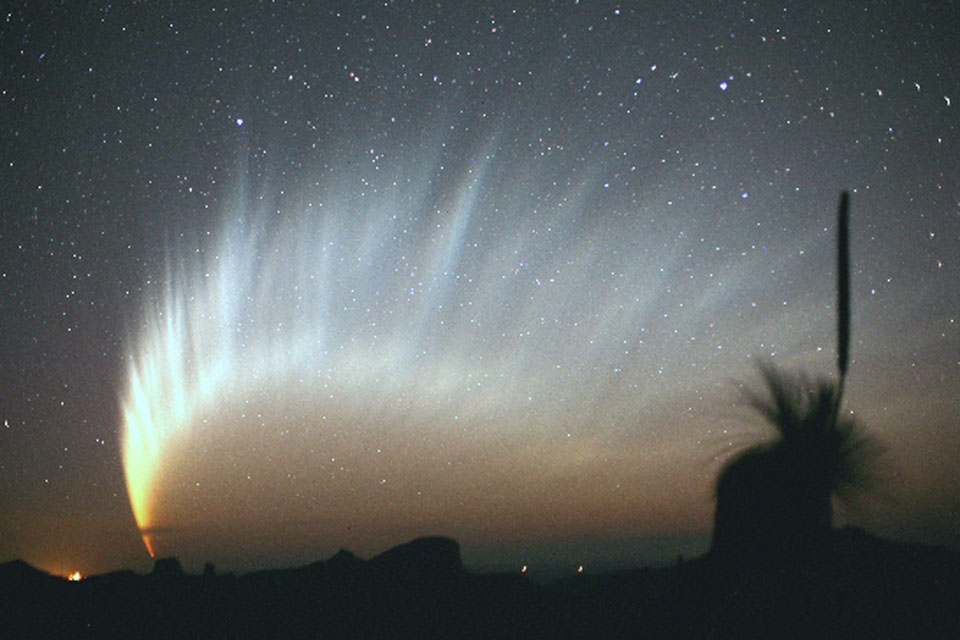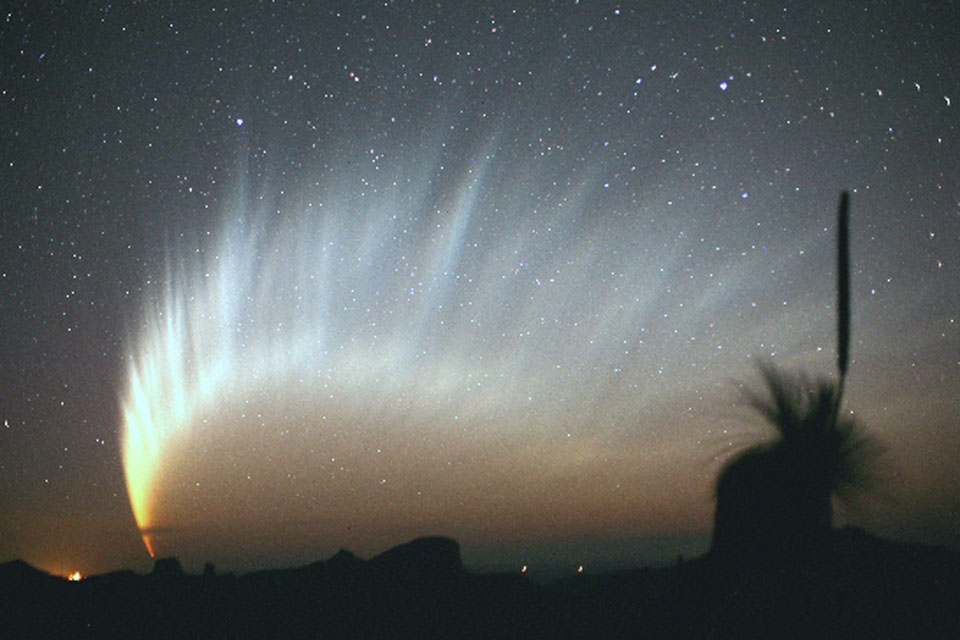
Comet McNaught, the Great Comet of 2007, grew a spectacularly long and filamentary tail. The magnificent tail spread across the sky and was visible for several days to Southern Hemisphere observers just after sunset. The amazing ion tail showed its greatest extent on long-duration, wide-angle camera exposures. During some times, just the tail itself was visible just above the horizon for many northern observers as well. Comet C/2006 P1 (McNaught), estimated to have attained a peak brightness of magnitude -5 (minus five), was caught by the comet's discoverer in the featured image just after sunset in January 2007 from Siding Spring Observatory in Australia. Comet McNaught, the brightest comet in decades, then faded as it moved further into southern skies and away from the Sun and Earth. Over the next month, Comet Tsuchinshan–ATLAS, a candidate for the Great Comet of 2024, should display its most spectacular tails visible from the Earth.
El cometa McNaught, el Gran Cometa de 2007, desarrolló una cola larga y filamentaria espectacular. La magnífica cola se extendió a través del cielo y fue visible durante varios días para observadores del hemisferio sur justo después del atardecer. La asombrosa cola iónica mostró su mayor extensión en exposiciones de larga duración con cámaras de amplio ángulo. En ciertos momentos, solo la cola misma era visible justo por encima del horizonte para muchos observadores del norte también. El cometa C/2006 P1 (McNaught), cuya brillantez máxima se estimó en magnitud -5 (menos cinco), fue capturado por el descubridor del cometa en la imagen destacada justo después del atardecer en enero de 2007 desde el Observatorio Siding Spring en Australia. El cometa McNaught, el más brillante en décadas, luego se atenuó a medida que se alejaba más hacia el cielo sur y se distanciaba del Sol y la Tierra. Durante el próximo mes, el cometa Tsuchinshan–ATLAS, candidato al título de Gran Cometa de 2024, debería mostrar sus colas más espectaculares visibles desde la Tierra.