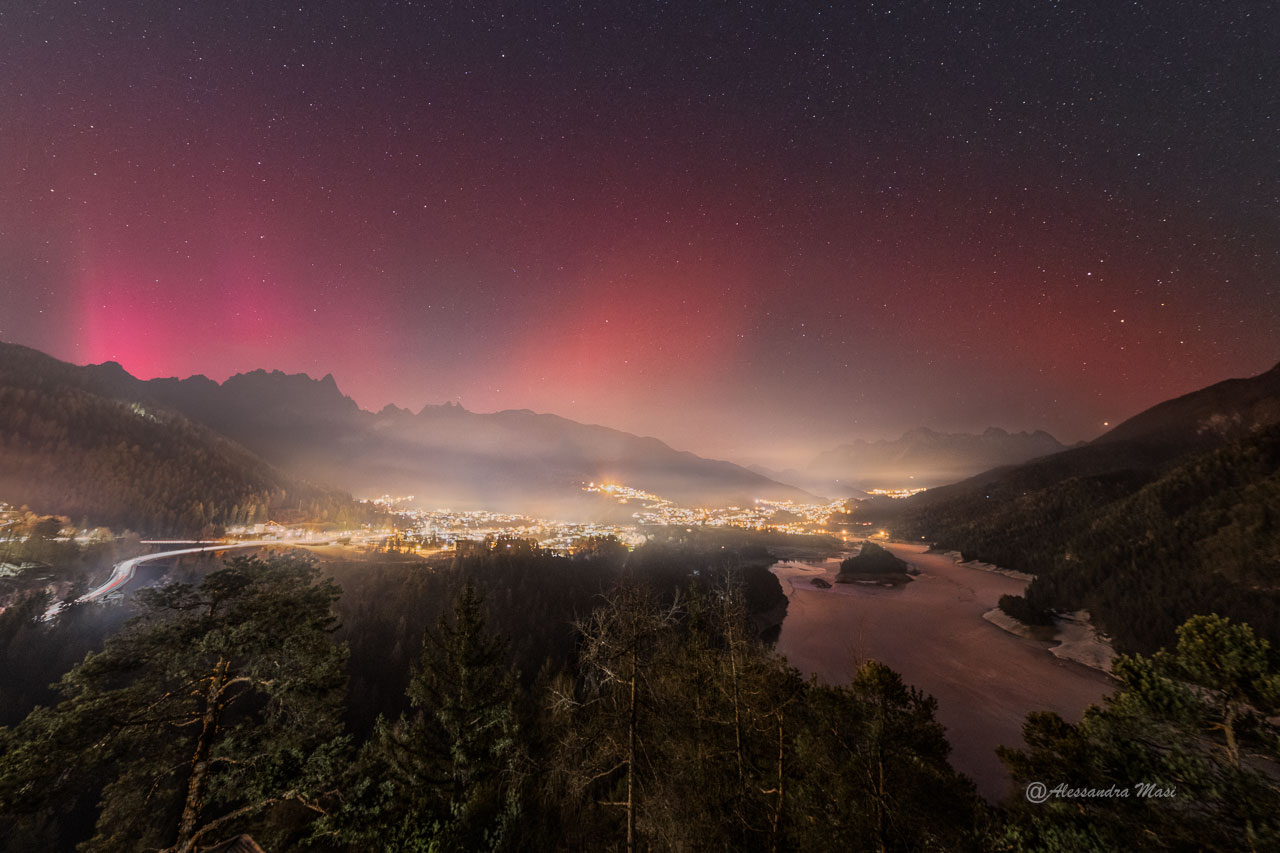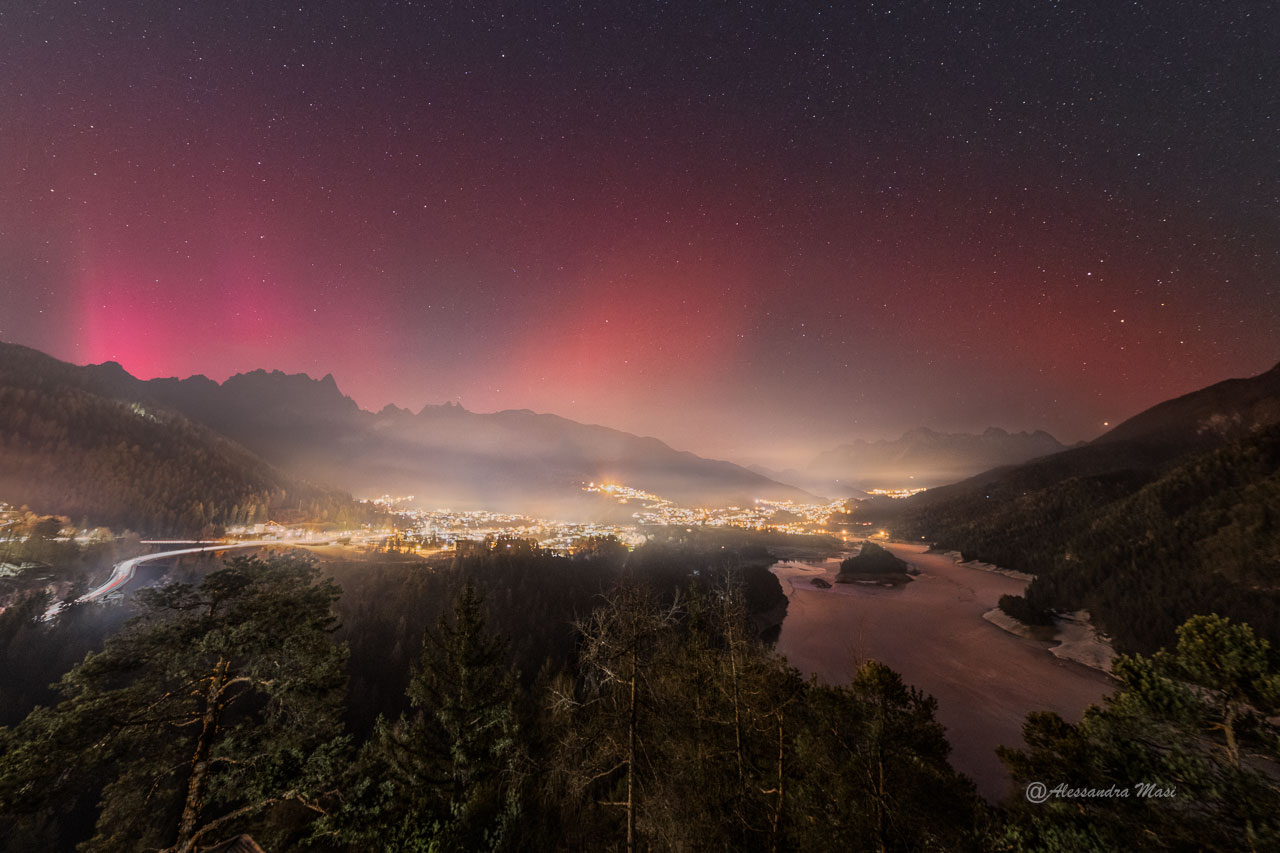
It was a new year, and the sky was doubly red. The new year meant that the Earth had returned to its usual place in its orbit on January 1, a place a few days before its closest approach to the Sun. The first of the two red skyglows, on the left, was a red aurora, complete with vertical rays, caused by a blast from the Sun pushing charged particles into Earth's atmosphere. The second red glow, most prominent on the far right, was possibly a SAR arc caused by a river of charged particles flowing across Earth's atmosphere. Although both appear red, the slight color difference is likely due to the aurora being emitted by both oxygen and nitrogen, whereas the higher SAR arc was possibly emitted more purely by atmospheric oxygen. The featured image was taken on January 1 from near Pieve di Cadore in Italy. Portal Universe: Random APOD Generator
Crédito: NASA, CGRO SSC Era un nuevo año, y el cielo estaba doblemente rojo. El nuevo año significaba que la Tierra había regresado a su lugar habitual en su órbita el 1 de enero, un lugar unos días antes de su acercamiento más cercano al Sol. El primer resplandor rojizo del cielo, a la izquierda, era una aurora roja, completa con rayos verticales, causada por una explosión solar que empujó partículas cargadas a la atmósfera terrestre. El segundo resplandor rojo, más destacado en la parte más a la derecha, podría haber sido un arco SAR causado por un río de partículas cargadas que fluían a través de la atmósfera terrestre. Aunque ambos aparecen rojos, la ligera diferencia de color probablemente se deba a que la aurora es emitida por oxígeno y nitrógeno, mientras que el arco SAR más alto podría haber sido emitido principalmente por oxígeno atmosférico. La imagen destacada fue tomada el 1 de enero cerca de Pieve di Cadore en Italia.