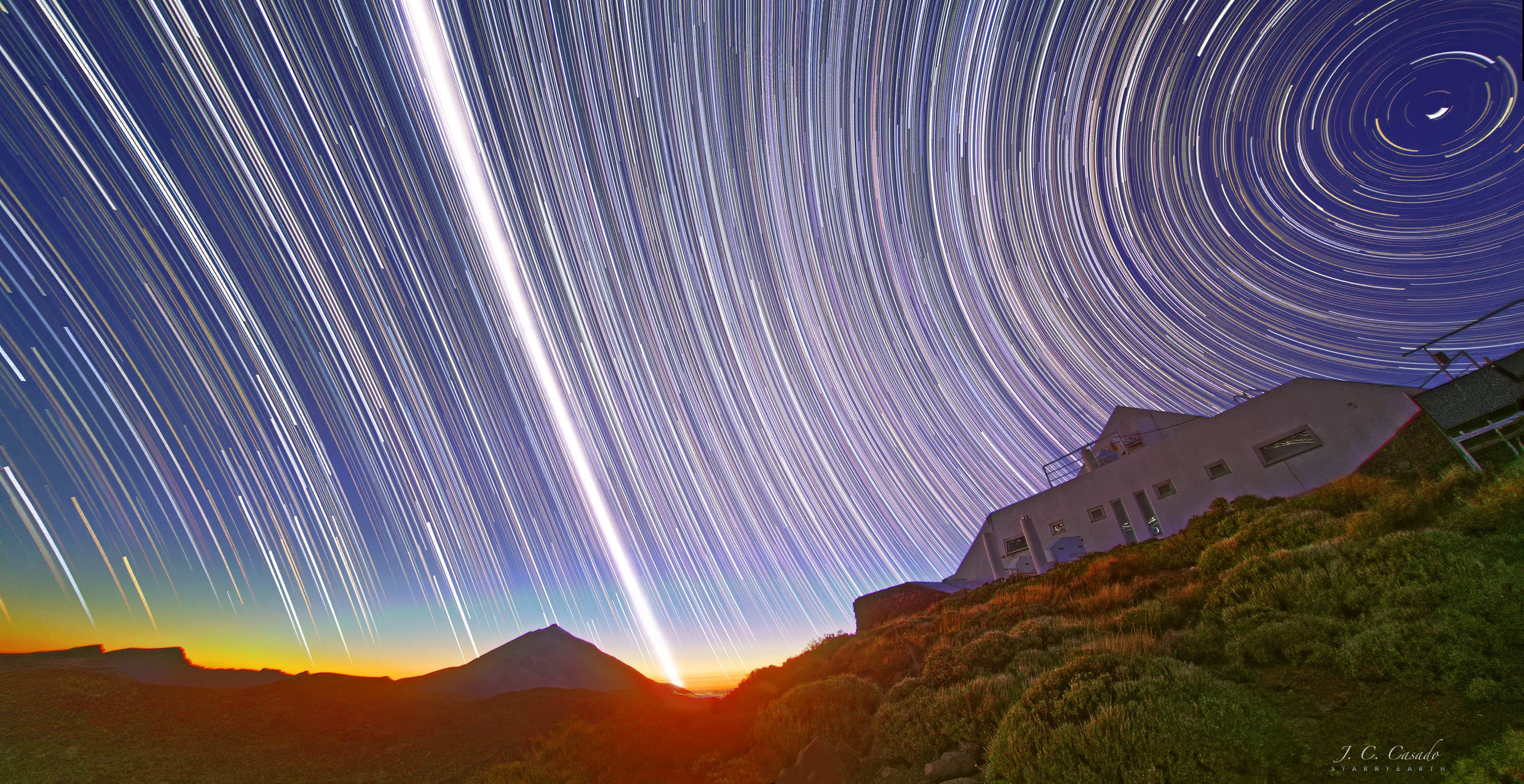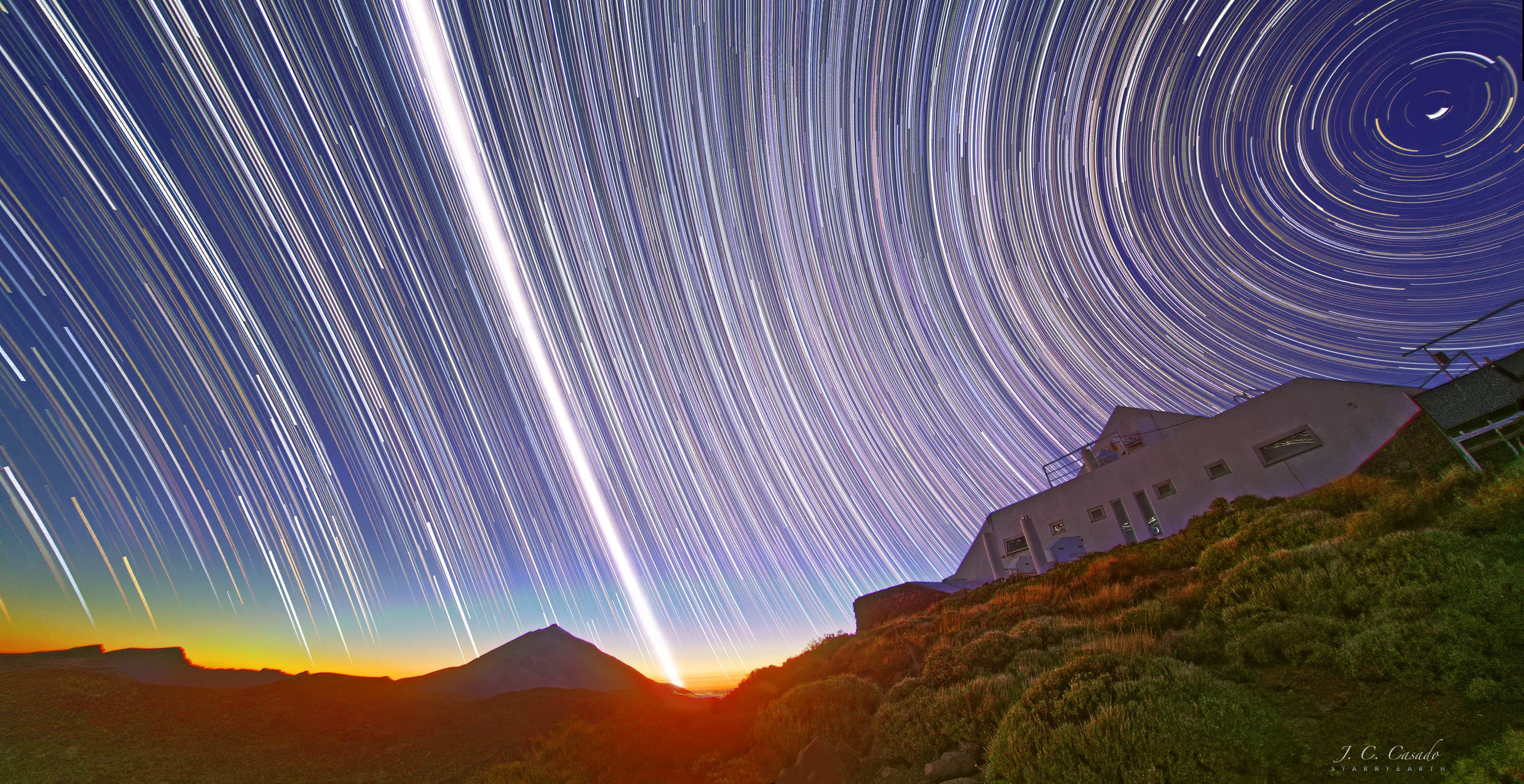
The defining astronomical moment of the equinox today is at 14:46 UTC (March 20). That's when the Sun crosses the celestial equator moving north in its yearly journey through planet Earth's sky, marking the beginning of spring for our fair planet in the northern hemisphere and fall in the southern hemisphere. Then, day and night are nearly equal around the globe. In fact, both day and nighttime exposures from a spring equinox at the Observatorio del Teide in Tenerife, Canary Islands, Spain, are used in this composited skyscape. Over 1,000 images were taken with a fisheye lens and merged in the ambitious equinox project. The apparent motion of the Sun setting along the celestial equator on the equinox date follows the bright linear, diagonal track from the sequence of daytime exposures taken over 6 hours. After sunset, nighttime exposures recorded startrails, with the celestial equator as a linear track and concentric arcs circling the north celestial pole near Polaris at upper right and the south celestial pole beyond the lower left edge (and below the Teide horizon). The foreground includes the distant Teide volcano peak and the observatory's pyramid-shaped solar laboratory building.
El momento astronómico que define el equinoccio de hoy ocurre a las 14:46 UTC (20 de marzo). En ese instante, el Sol cruza el ecuador celeste desplazándose hacia el norte en su recorrido anual por el cielo del planeta Tierra, marcando el inicio de la primavera en el hemisferio norte y del otoño en el hemisferio sur. En esa fecha, el día y la noche tienen una duración casi igual en todo el globo. Esta composición panorámica combina exposiciones diurnas y nocturnas tomadas durante un equinoccio de primavera en el Observatorio del Teide, en Tenerife, Islas Canarias, España. Se capturaron más de 1.000 imágenes con un objetivo ojo de pez y se fusionaron en este ambicioso proyecto equinoccial. El movimiento aparente del Sol poniéndose a lo largo del ecuador celeste en la fecha del equinoccio sigue una trayectoria lineal y diagonal brillante, formada por la secuencia de exposiciones diurnas tomadas durante 6 horas. Tras la puesta de Sol, las exposiciones nocturnas registraron trazas estelares: el ecuador celeste aparece como una línea recta, mientras que se forman arcos concéntricos alrededor del polo norte celeste, próximo a Polaris en la parte superior derecha, y del polo sur celeste, más allá del borde inferior izquierdo (por debajo del horizonte del Teide). En primer plano se distinguen el lejano pico del volcán Teide y el edificio del laboratorio solar de forma piramidal perteneciente al observatorio.