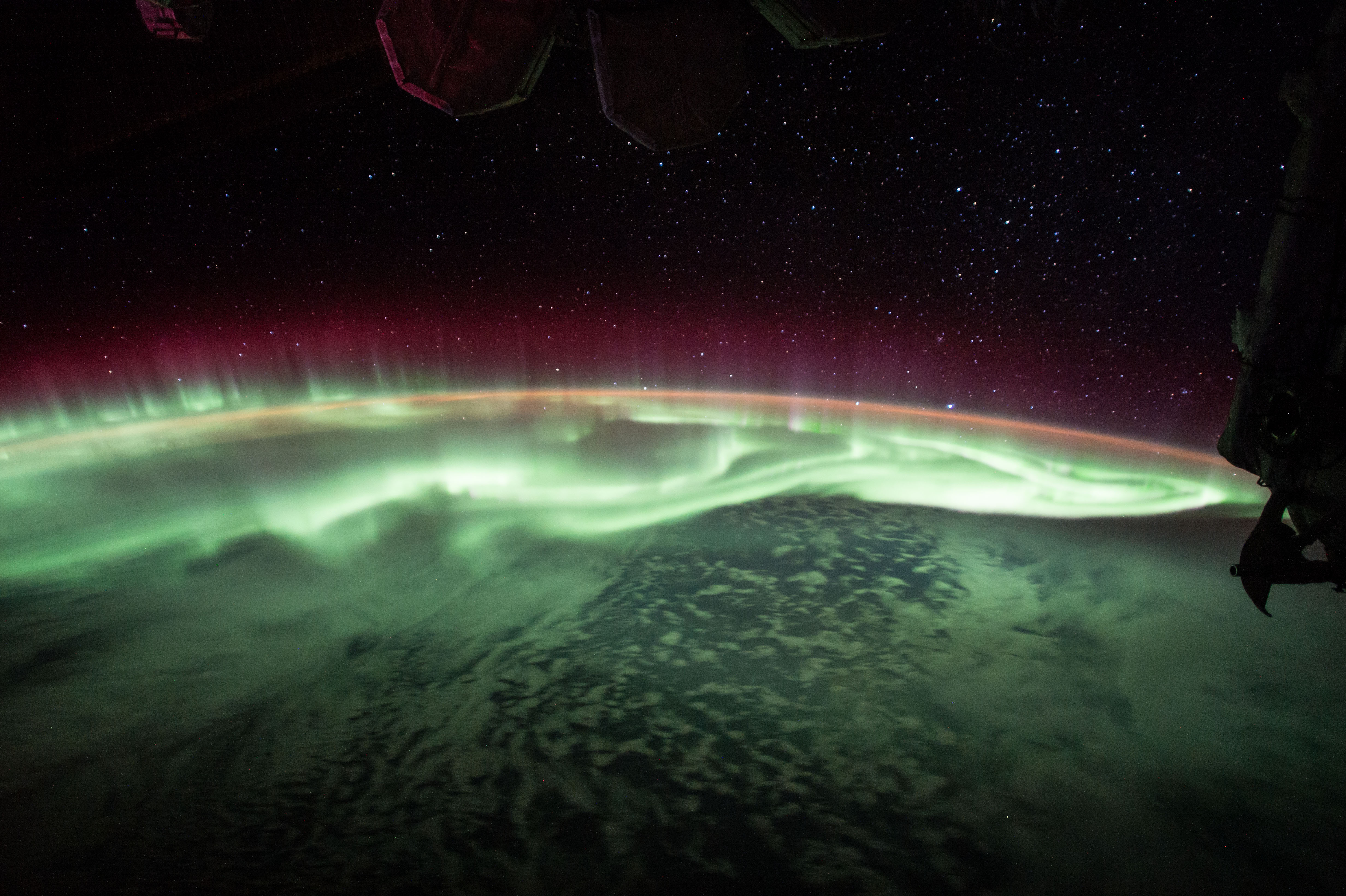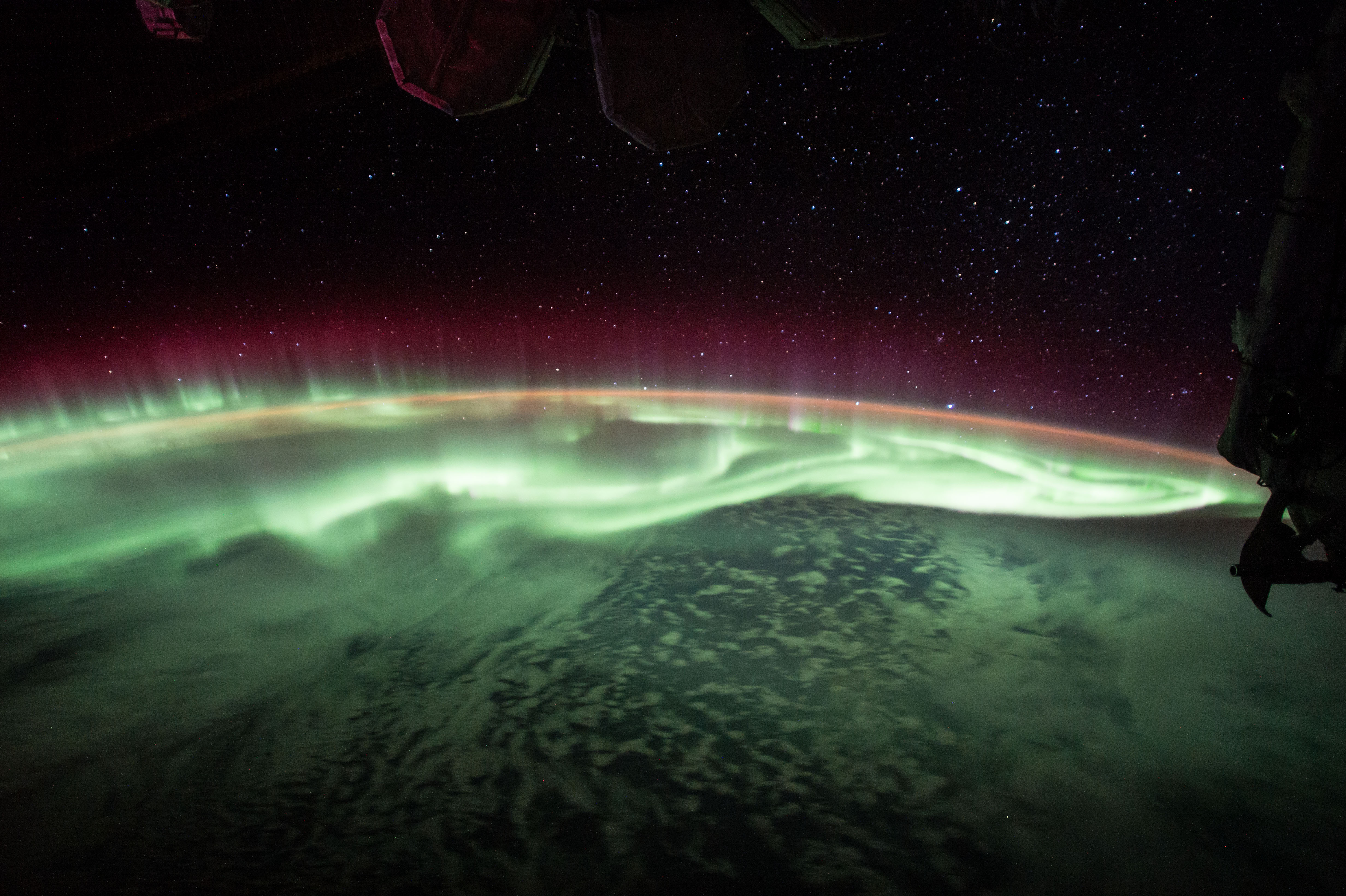
Like salsa verde on your favorite burrito, a green aurora slathers up the sky in this 2017 June 25 snapshot from the International Space Station. About 400 kilometers (250 miles) above Earth, the orbiting station is itself within the upper realm of the auroral displays. Aurorae have the signature colors of excited molecules and atoms at the low densities found at extreme altitudes. Emission from atomic oxygen dominates this view. The tantalizing glow is green at lower altitudes, but rarer reddish bands extend above the space station's horizon. The orbital scene was captured while passing over a point south and east of Australia, with stars above the horizon at the right belonging to the constellation Canis Major, Orion's big dog. Sirius, alpha star of Canis Major, is the brightest star near the Earth's limb.
Como salsa verde sobre tu burrito favorito, una aurora verde cubre el cielo en esta instantánea tomada el 25 de junio de 2017 desde la Estación Espacial Internacional. A unos 400 kilómetros (250 millas) sobre la Tierra, la estación orbital se encuentra dentro del dominio superior de los displays aurorales. Las auroras presentan los colores característicos de moléculas y átomos excitados a las bajas densidades que se encuentran en altitudes extremas. La emisión del oxígeno atómico domina esta vista. El seductor resplandor es verde a altitudes más bajas, pero bandas rojizas más raras se extienden por encima del horizonte de la estación espacial. La escena orbital fue capturada mientras se sobrevolaba un punto al sur y al este de Australia, con estrellas sobre el horizonte a la derecha pertenecientes a la constelación de Canis Major, el gran perro de Orión. Sirio, la estrella alfa de Canis Major, es la estrella más brillante cerca del limbo terrestre.