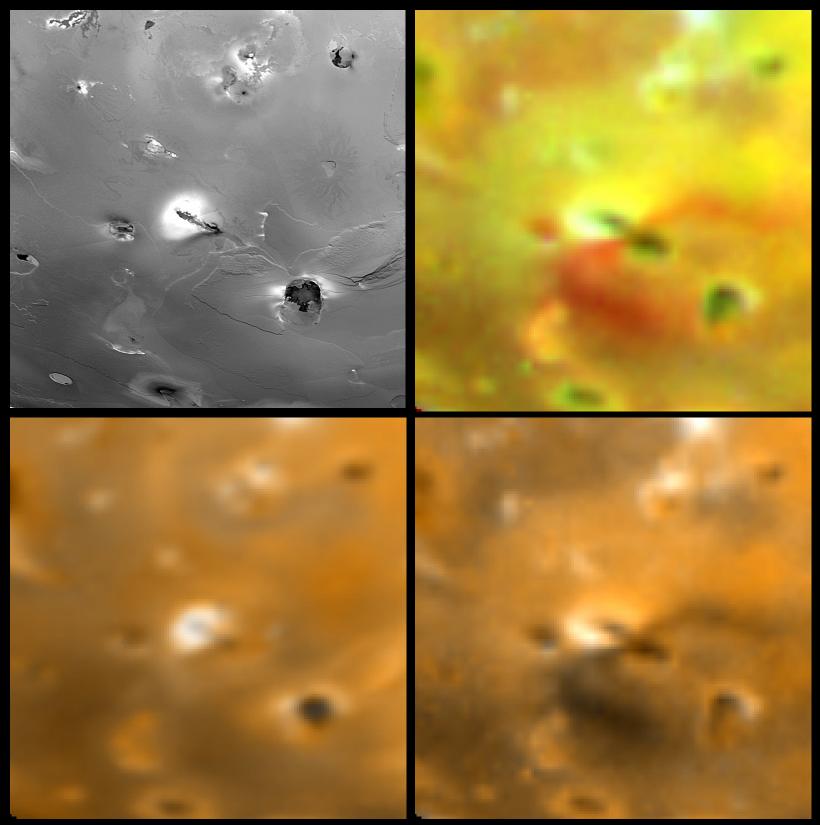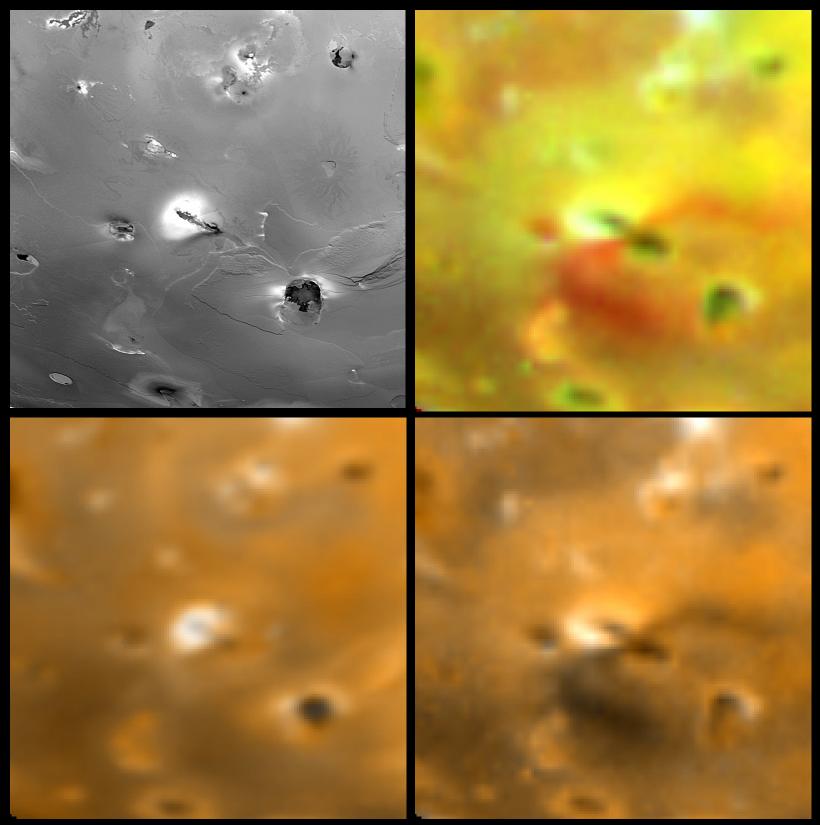
Jupiter's moon Io is turning out to be our Solar System's geologic powerhouse. The churning moon was photographed again just recently on June 27th and again shows signs of violent activity. Shown above are photographs of the volcano Euboea Fluctus taken at different times. The black and white photograph on the upper left was taken by the Voyager 1 spacecraft when it flew by in 1979, the upper right and lower left photographs were taken in 1996 by the Galileo spacecraft, while the lower right photograph is a color image taken by Voyager 2, also in 1979. The upper right Galileo picture has been artifically changed to simulate the color sensitivity of the Voyager 2 mission. The marked difference in the two images is highlighted by new red and yellow deposits. These markings may indicate that Euboea Fluctus erupts in an unusual fashion, possibly caused by an obstruction near the volcanic vent.
La luna Ío de Júpiter está resultando ser el centro geológico más activo de nuestro Sistema Solar. Esta agitada luna fue fotografiada nuevamente el pasado 27 de junio y vuelve a mostrar señales de actividad violenta. Se muestran aquí fotografías del volcán Euboea Fluctus tomadas en diferentes momentos. La fotografía en blanco y negro de la esquina superior izquierda fue tomada por la sonda espacial Voyager 1 durante su sobrevuelo en 1979; las fotografías superior derecha e inferior izquierda fueron tomadas en 1996 por la sonda Galileo, mientras que la fotografía inferior derecha es una imagen en color tomada por Voyager 2, también en 1979. La imagen de Galileo en la esquina superior derecha ha sido modificada artificialmente para simular la sensibilidad de color de la misión Voyager 2. La marcada diferencia entre las dos imágenes queda resaltada por nuevos depósitos de color rojo y amarillo. Estas marcas podrían indicar que Euboea Fluctus entra en erupción de una manera inusual, posiblemente causada por una obstrucción cerca de la chimenea volcánica.