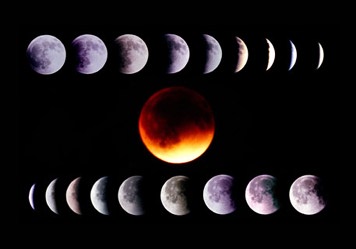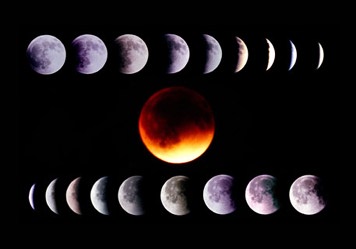
Tonight brings the last total lunar eclipse visible from North America until the year 2000 - with the Moon becoming completely immersed in Earth's shadow. The above time-lapse photograph shows a lunar eclipse that occurred in April 1993. Tonight's eclipse will begin at 8:12 pm Eastern Daylight Time, with totality extending from 10:19 pm to 11:29 pm. In North and South America, the Moon will be just rising at the beginning of the eclipse. In West Europe and Africa, tonight's lunar eclipse will be visible before the dawn of September 27th. The Moon is not expected to become completely dark - usually it has a slight red glow caused by sunlight refracted through the Earth's dusty atmosphere - but every lunar eclipse is slightly different. This year's eclipse will be enhanced by the proximity of bright Saturn just 3 degrees away.
Esta noche se produce el último eclipse total de Luna visible desde América del Norte hasta el año 2000, durante el cual la Luna quedará completamente inmersa en la sombra de la Tierra. La fotografía de lapso de tiempo que se muestra arriba corresponde a un eclipse lunar ocurrido en abril de 1993. El eclipse de esta noche comenzará a las 8:12 pm, hora de verano del este (EDT), con la totalidad extendiéndose desde las 10:19 pm hasta las 11:29 pm. En América del Norte y del Sur, la Luna estará apenas saliendo al inicio del eclipse. En Europa Occidental y África, el eclipse lunar de esta noche será visible antes del amanecer del 27 de septiembre. No se espera que la Luna se oscurezca por completo; por lo general presenta un leve resplandor rojizo producido por la luz solar refractada a través de la atmósfera polvorienta de la Tierra, aunque cada eclipse lunar es ligeramente distinto. El eclipse de este año se verá realzado por la proximidad del brillante Saturno, situado a tan solo 3 grados de distancia.