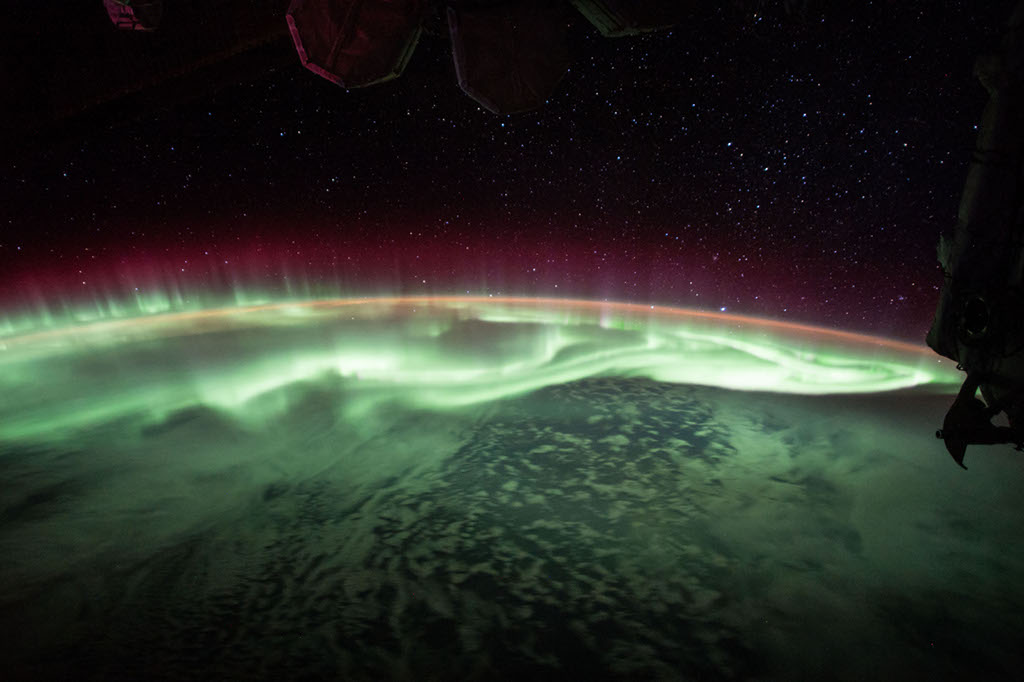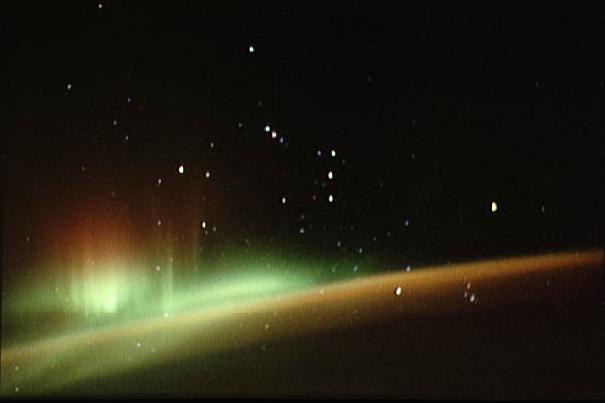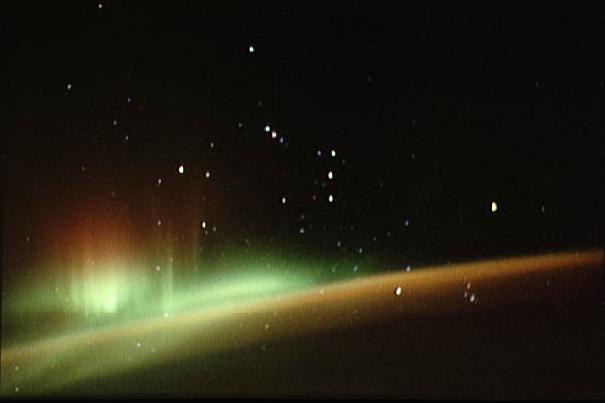
Looking toward the south from low Earth orbit, the crew of the Space Shuttle Endeavor made this stunning time exposure of the Aurora Australis or southern lights in April of 1994. Aurora are visible at high northern latitudes as well, with the northern lights known as Aurora Borealis. They are caused by high energy electrons from the Solar Wind which are funneled into the atmosphere near the poles by the Earth's magnetic field. The reddish colors occur at the highest altitudes (about 200 miles) where the air is least dense. At lower altitudes and greater densities green tends to dominate ranging to a pinkish glow at the lowest. The familiar constellation of Orion the Hunter is clearly visible above the dark horizon in the background. Because of the shuttle's orbital motion, the bright stars in Orion appear slightly elongated.
Mirando hacia el sur desde la órbita baja terrestre, la tripulación del transbordador espacial Endeavour capturó esta impresionante fotografía de larga exposición de la Aurora Australis, o luces del sur, en abril de 1994. Las auroras también son visibles en latitudes altas del hemisferio norte, donde se conocen como Aurora Borealis o luces del norte. Son causadas por electrones de alta energía provenientes del viento solar, que son canalizados hacia la atmósfera cerca de los polos por el campo magnético terrestre. Los colores rojizos se producen a las mayores altitudes (aproximadamente 320 kilómetros), donde el aire es menos denso. A altitudes menores y con mayor densidad atmosférica, el verde tiende a predominar, transitando hacia un resplandor rosado en las cotas más bajas. La familiar constelación de Orión el Cazador es claramente visible sobre el oscuro horizonte al fondo de la imagen. Debido al movimiento orbital del transbordador, las brillantes estrellas de Orión aparecen ligeramente alargadas.