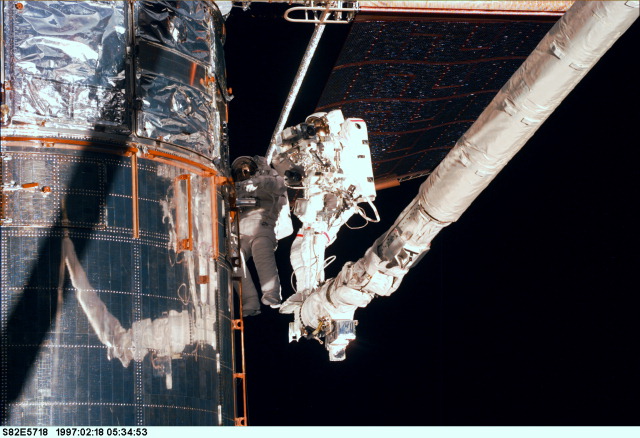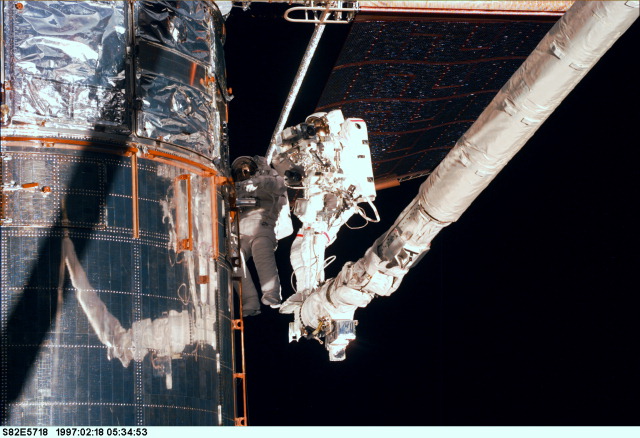
The Hubble Space Telescope's second servicing mission has been completed. Every few years, the telescope is visited by a Space Shuttle to allow astronauts to switch old instruments for new. This time, the Goddard High Resolution Spectrograph and Faint Object Spectrograph were replaced by the Near Infrared Camera and Multi-Object Spectrometer and the Space Telescope Imaging Spectrograph. These new instruments will act like eyes sharing the 2.4-meter telescope mirror with the remaining instruments: the Wide Field Planetary Camera 2 and the Faint Object Camera. The Hubble Space Telescope can take clearer pictures than ground based telescopes because its images are not blurred by the Earth's atmosphere. Pictured in the final phases of a space walk from the second servicing mission, astronauts Mark Lee (right) and Steven Smith work on HST while perched on the Shuttle's remote manipulator arm.
La segunda misión de mantenimiento del Telescopio Espacial Hubble ha sido completada. Cada pocos años, el telescopio es visitado por un transbordador espacial para permitir a los astronautas reemplazar instrumentos antiguos por nuevos. En esta ocasión, el Espectrógrafo de Alta Resolución Goddard y el Espectrógrafo de Objetos Tenues fueron sustituidos por la Cámara de Infrarrojo Cercano y Espectrómetro de Objetos Múltiples, y por el Espectrógrafo de Imagen del Telescopio Espacial. Estos nuevos instrumentos actuarán como ojos que comparten el espejo de 2,4 metros del telescopio junto con los instrumentos restantes: la Cámara de Campo Amplio y Planetaria 2 y la Cámara de Objetos Tenues. El Telescopio Espacial Hubble puede obtener imágenes más nítidas que los telescopios terrestres porque sus imágenes no se ven distorsionadas por la atmósfera terrestre. Fotografiados en las fases finales de una caminata espacial correspondiente a la segunda misión de mantenimiento, los astronautas Mark Lee (derecha) y Steven Smith trabajan sobre el HST mientras están posicionados sobre el brazo manipulador remoto del transbordador.