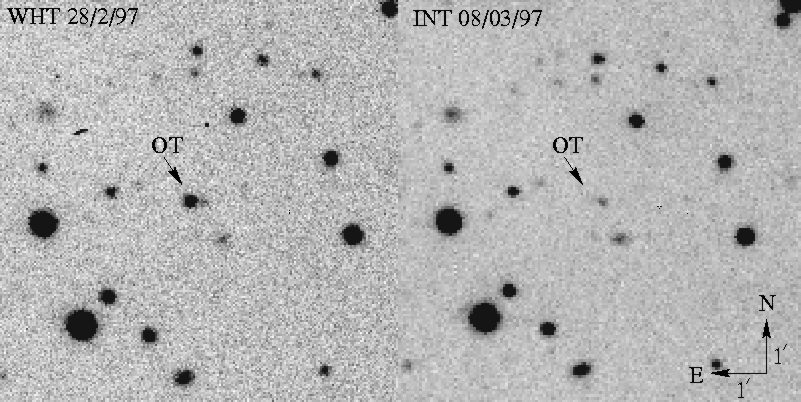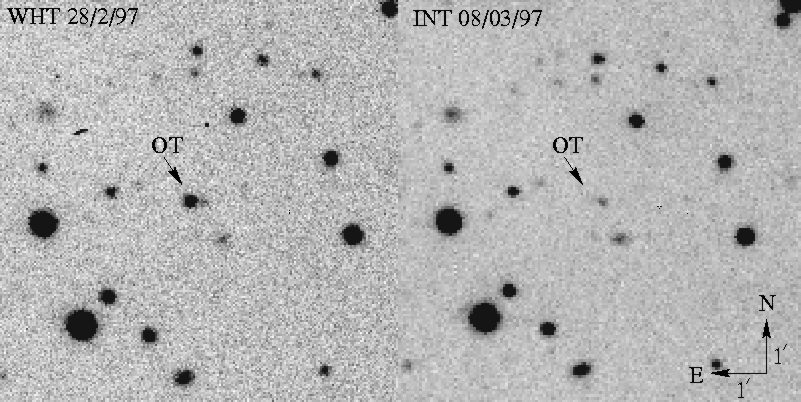
The largest telescopes in the world have scrambled to point toward this faint, fading object. Why? Because it may well be the first active optical counterpart ever found for a gamma-ray burst, and could hold the clue to the distance scale to this most enigmatic class of astronomical objects. During the past two months, multiwavelength observations, claims, and counterclaims have been exchanged at a torrential pace, as astronomers wait impatiently to see what setting houses the fading transient. Above are two pictures of the optical transient (OT), one taken on February 28th, the other about a week later on March 8th. The OT arrows show the source that faded from view during this time. The OT has been examined by large telescopes including the Hubble Space Telescope and Keck, yet researchers are still scrambling to get answers to fundamental questions about its true nature. Does the OT actually move (exhibit proper motion)? Is there a faint galaxy superposed behind the OT or is this extended emission fading too? In the face of intense scrutiny with the world's most capable telescopes, the origin of gamma-ray bursts so far remains mysterious!
Los telescopios más grandes del mundo se han apresurado a apuntar hacia este objeto tenue y en proceso de desvanecimiento. ¿Por qué? Porque bien podría ser la primera contraparte óptica activa jamás encontrada para un estallido de rayos gamma, y podría contener la clave para determinar la escala de distancias de esta clase de objetos astronómicos más enigmática que existe. Durante los últimos dos meses, observaciones en múltiples longitudes de onda, afirmaciones y refutaciones han sido intercambiadas a un ritmo torrencial, mientras los astrónomos esperan con impaciencia para ver en qué entorno se encuentra alojado el transitorio en desvanecimiento. Arriba se muestran dos imágenes del transitorio óptico (OT, por sus siglas en inglés), una tomada el 28 de febrero y la otra aproximadamente una semana después, el 8 de marzo. Las flechas señalan la fuente que desapareció de la vista durante ese período. El OT ha sido examinado por grandes telescopios, incluidos el Telescopio Espacial Hubble y el Keck, pero los investigadores aún se afanan en obtener respuestas a preguntas fundamentales sobre su verdadera naturaleza. ¿Se desplaza realmente el OT (exhibe movimiento propio)? ¿Existe una galaxia tenue superpuesta detrás del OT, o esta emisión extendida también se está desvaneciendo? Ante el intenso escrutinio de los telescopios más capaces del mundo, el origen de los estallidos de rayos gamma sigue siendo hasta ahora misterioso.