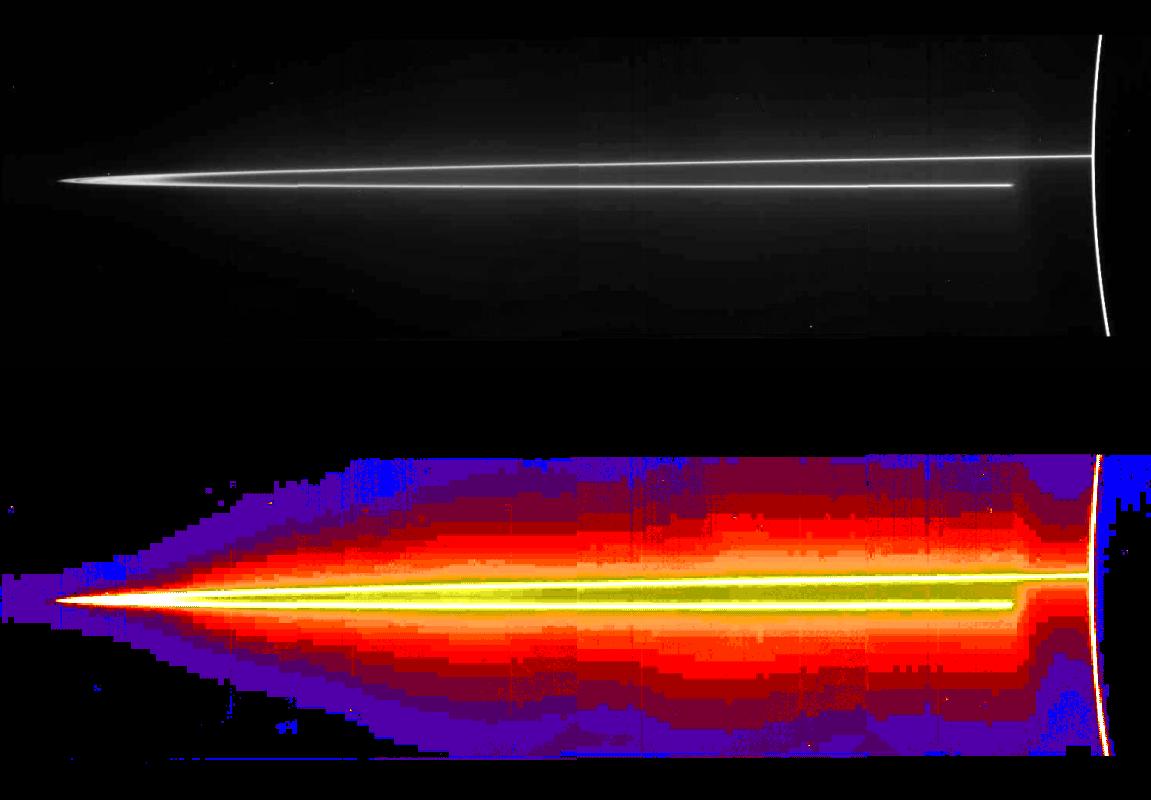
Why do small particles hover around Jupiter's rings? These particles form a previously unknown ring halo, recently discovered by the robot spacecraft Galileo currently orbiting Jupiter. Galileo obtained this image when on the far side of Jupiter - from this orientation scattered sunlight makes the halo ring visible. The amount of scattering indicates that halo particles are very small - perhaps 100 times smaller than the width of a human hair. Particles this small are believed to survive only for years, and so must somehow be replenished to Jupiter's ancient ring system. One possible explanation for this unusual halo is that electromagnetic fields around Jupiter gently push small charged particles out of the ring plane. This false color image has been artificially stretched in the vertical direction to highlight the ring halo.
¿Por qué flotan pequeñas partículas alrededor de los anillos de Júpiter? Estas partículas forman un halo anular previamente desconocido, descubierto recientemente por la nave espacial robótica Galileo, que actualmente orbita Júpiter. Galileo obtuvo esta imagen desde el lado opuesto de Júpiter; desde esta orientación, la luz solar dispersada hace visible el halo del anillo. La cantidad de dispersión indica que las partículas del halo son muy pequeñas, quizás 100 veces más pequeñas que el grosor de un cabello humano. Se cree que partículas de este tamaño sobreviven solo durante años, por lo que de alguna manera deben reponerse en el antiguo sistema de anillos de Júpiter. Una posible explicación para este inusual halo es que los campos electromagnéticos alrededor de Júpiter empujan suavemente las pequeñas partículas cargadas fuera del plano del anillo. Esta imagen en falso color ha sido artificialmente extendida en la dirección vertical para resaltar el halo del anillo.