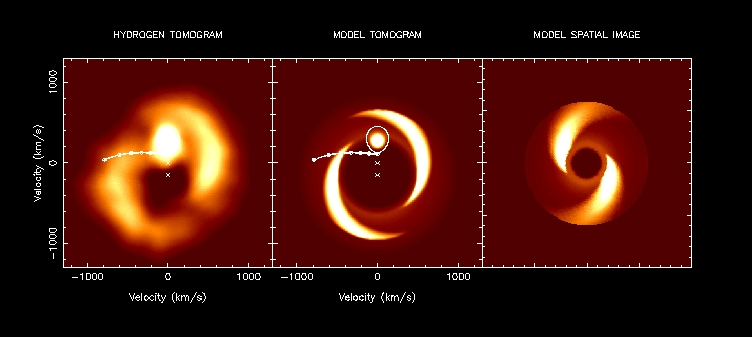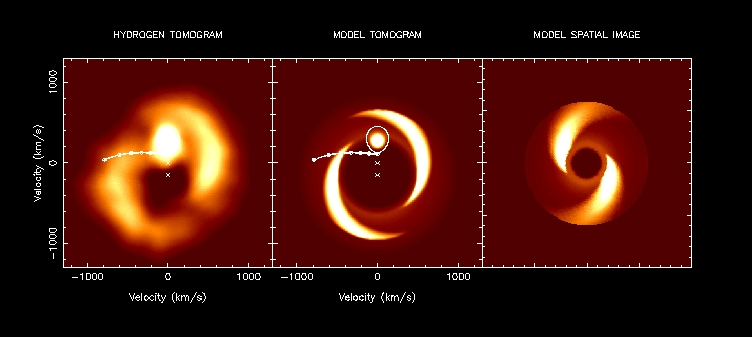
Spiral arms aren't just for galaxies. A hot disk of gas surrounding a compact white dwarf star in the constellation of Pegasus has recently been revealed to be imprinted with this dramatic pattern. The white dwarf is part of the interacting binary star system IP Pegasi and the disk of gas is an accretion disk formed of material lost from a companion star and falling toward the white dwarf. The disk itself is smaller than the Sun's diameter, so the spiral pattern can not be imaged directly by telescopes. Instead, the spiraling disk of gas is mapped over a series of observations using a spectroscopic technique known as doppler tomography. The left panel above shows a tomogram, the directly measured gas velocity map for the system. The relative brightness corresponds to the intensity of light emitted by Hydrogen gas moving at the indicated velocity. The position at the center of this panel represents the velocity of the binary system's center of mass. In the middle panel, a simple model velocity field consistent with the measurements is shown. At the right, the calculated position map of the IP Pegasi accretion disk reveals a striking two armed trailing spiral pattern.
Los brazos en espiral no son exclusivos de las galaxias. Recientemente se ha descubierto que un disco caliente de gas que rodea a una enana blanca compacta en la constelación de Pegaso presenta este llamativo patrón. La enana blanca forma parte del sistema binario interactuante IP Pegasi, y el disco de gas es un disco de acreción formado por material desprendido de una estrella compañera que cae hacia la enana blanca. El disco en sí es más pequeño que el diámetro del Sol, por lo que el patrón en espiral no puede ser observado directamente por los telescopios. En su lugar, el disco espiral de gas se mapea a lo largo de una serie de observaciones mediante una técnica espectroscópica conocida como tomografía Doppler. El panel izquierdo muestra un tomograma, es decir, el mapa de velocidades del gas medido directamente para el sistema. El brillo relativo corresponde a la intensidad de la luz emitida por el hidrógeno gaseoso que se desplaza a la velocidad indicada. La posición en el centro de este panel representa la velocidad del centro de masa del sistema binario. En el panel central se muestra un modelo simple del campo de velocidades compatible con las mediciones. A la derecha, el mapa de posiciones calculado del disco de acreción de IP Pegasi revela un llamativo patrón de espiral de dos brazos en sentido directo de arrastre.