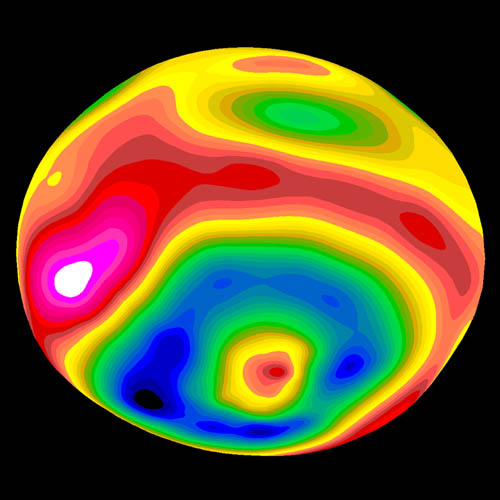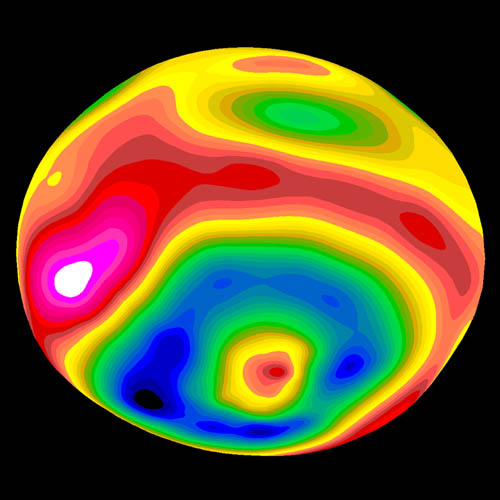
Vesta is a huge rock 500 kilometers across that orbits out past Mars. Last week, the above map of Vesta created using the Hubble Space Telescope was released showing a rugged surface highlighted by a single crater spanning nearly the entire length of the asteroid. The large crater dominates the lower part of the false-color conglomerate image: blue indicates low terrain, while red indicates raised terrain. Evidence indicates that Vesta underwent a tremendous splintering collision about a billion years ago. In October 1960, a small chunk of this rock believed to have originated on Vesta fell to Earth and was recovered in Australia.
Vesta es una enorme roca de 500 kilómetros de diámetro que orbita más allá de Marte. La semana pasada se publicó el mapa de Vesta mostrado arriba, creado con el Telescopio Espacial Hubble, que revela una superficie accidentada destacada por un cráter que abarca casi toda la longitud del asteroide. El gran cráter domina la parte inferior de la imagen compuesta en falso color: el azul indica terreno bajo, mientras que el rojo indica terreno elevado. Las evidencias indican que Vesta sufrió una tremenda colisión fragmentadora hace aproximadamente mil millones de años. En octubre de 1960, un pequeño fragmento de esta roca que se cree tuvo su origen en Vesta cayó a la Tierra y fue recuperado en Australia.