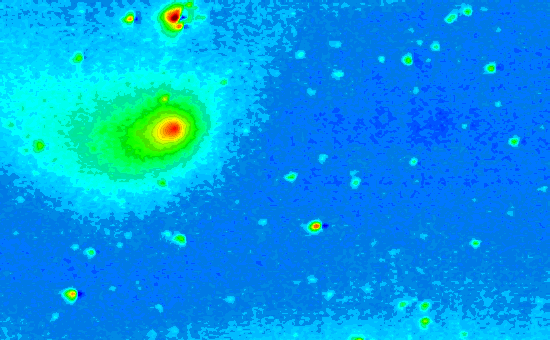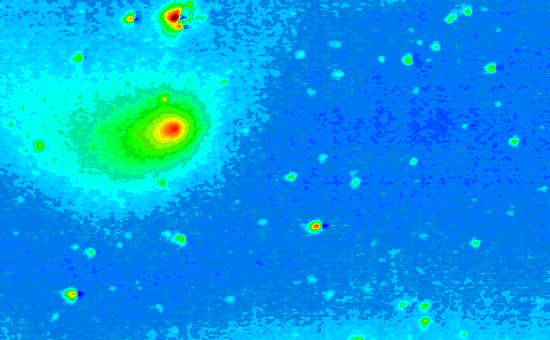
Hale-Bopp, the Comet of the Century, is leaving the inner Solar System. Outbound at about 12 miles per second it is presently nearing the main asteroid belt between Mars and Jupiter. This false-color image represents a recent view from low Earth orbit showing the comet surrounded by its shrinking coma against a background of stars. It was constructed from a fraction of the data taken aboard the Space Shuttle Discovery in August by a small innovative telescopic camera known as the Southwest Ultraviolet Imaging System or SWUIS. SWUIS (sounds like "swiss") images will be particularly interesting to astronomers who wish to continue to follow the Great Comet's interaction with the Solar Wind. The once bright Hale-Bopp has faded below 4th magnitude but is still visible to Earthbound observers south of 35 degrees north latitude.
Hale-Bopp, el Cometa del Siglo, está abandonando el Sistema Solar interior. Desplazándose hacia el exterior a aproximadamente 19 kilómetros por segundo, se encuentra actualmente aproximándose al cinturón de asteroides principal, entre Marte y Júpiter. Esta imagen en falso color representa una vista reciente desde la órbita terrestre baja, mostrando al cometa rodeado por su coma —que continúa reduciéndose— sobre un fondo de estrellas. Fue construida a partir de una fracción de los datos capturados a bordo del Transbordador Espacial Discovery en agosto, mediante una pequeña e innovadora cámara telescópica conocida como el Sistema de Imágenes Ultravioleta del Suroeste, o SWUIS (por sus siglas en inglés). Las imágenes de SWUIS (cuya pronunciación recuerda a la palabra inglesa «swiss») resultarán de especial interés para los astrónomos que deseen continuar siguiendo la interacción del Gran Cometa con el viento solar. El otrora brillante Hale-Bopp ha disminuido su brillo por debajo de la magnitud 4, pero aún es visible para los observadores terrestres ubicados al sur de los 35 grados de latitud norte.