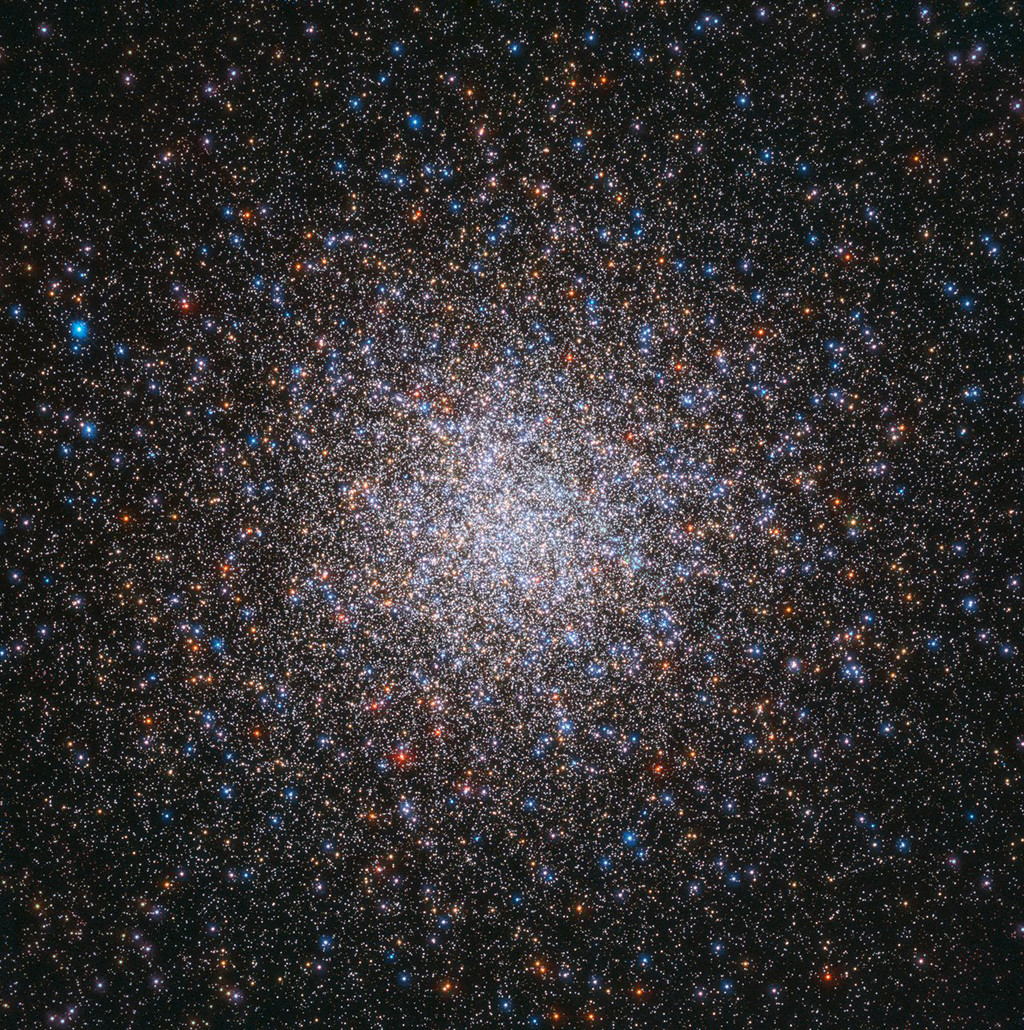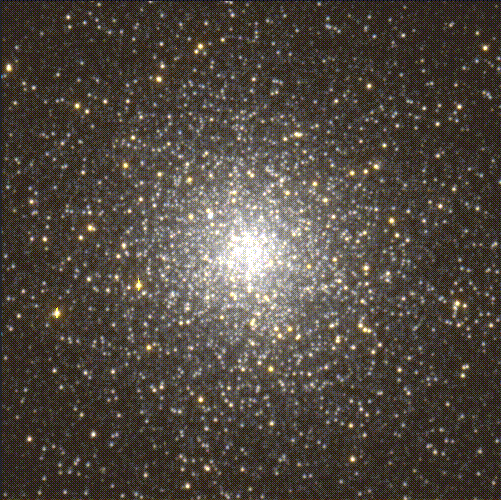
Stars come in bunches. Of the over 200 globular star clusters that orbit the center of our Milky Way Galaxy, 47 Tucanae is the second brightest globular cluster (behind Omega Centauri). Known to some affectionately as 47 Tuc or NGC 104, it is only visible from the Southern Hemisphere. Light takes about 20,000 years to reach us from 47 Tuc which can be seen near the SMC in the constellation of Tucana. Red Giant stars are particularly easy to see in the above photograph. The dynamics of stars near the center of 47 Tuc are not well understood, particularly why there are so few binary systems there.
Las estrellas se agrupan en conjuntos. De los más de 200 cúmulos globulares que orbitan el centro de nuestra galaxia Vía Láctea, 47 Tucanae es el segundo cúmulo globular más brillante (después de Omega Centauri). Conocido afectuosamente por algunos como 47 Tuc o NGC 104, solo es visible desde el hemisferio sur. La luz tarda aproximadamente 20,000 años en llegar hasta nosotros desde 47 Tuc, el cual puede observarse cerca de la Nube de Magallanes Menor (SMC) en la constelación de Tucana. Las estrellas gigantes rojas son particularmente fáciles de distinguir en la fotografía anterior. La dinámica de las estrellas cercanas al centro de 47 Tuc no se comprende del todo bien, en particular por qué existen tan pocos sistemas binarios en esa región.