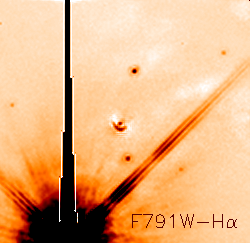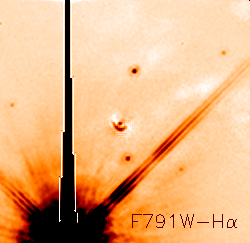
Unusual appendages around bright stars are commonplace, but never seem to be mentioned. What are they? First, a telescope brings starlight falling over a large area to a small area. To get at this small area, however, one must go inside a reflecting telescope, and this can only be done with support rods, which are right in the view of the telescope. The wave nature of light causes it to deflect when passing near these rods. Light scatters away from the original destination point ending up elsewhere and appearing as "diffraction spikes." These annoying spikes steal precious light from the central image and hide light from fainter, more interesting stars. Above, astronomers are more interested in the half-circled point near the image center, than the cool-looking diffraction spikes from the bright star at the bottom. Apparently, that half-circle is a new stellar system forming in the Lagoon Nebula.
Los apéndices inusuales alrededor de las estrellas brillantes son comunes, pero rara vez se mencionan. ¿Qué son? En primer lugar, un telescopio concentra la luz estelar que cae sobre una gran área en una pequeña área. Para acceder a esta pequeña área, sin embargo, es necesario llegar al interior de un telescopio reflector, y esto solo puede hacerse mediante varillas de soporte que quedan justo en el campo visual del telescopio. La naturaleza ondulatoria de la luz hace que se desvíe al pasar cerca de estas varillas. La luz se dispersa alejándose del punto de destino original y aparece en otras zonas, dando lugar a los llamados "picos de difracción". Estos molestos picos roban luz preciosa a la imagen central y ocultan la luz de estrellas más tenues y de mayor interés científico. En la imagen superior, los astrónomos están más interesados en el punto semicircular situado cerca del centro de la imagen que en los llamativos picos de difracción de la estrella brillante ubicada en la parte inferior. Al parecer, ese semicírculo corresponde a un nuevo sistema estelar en formación en la Nebulosa de la Laguna.