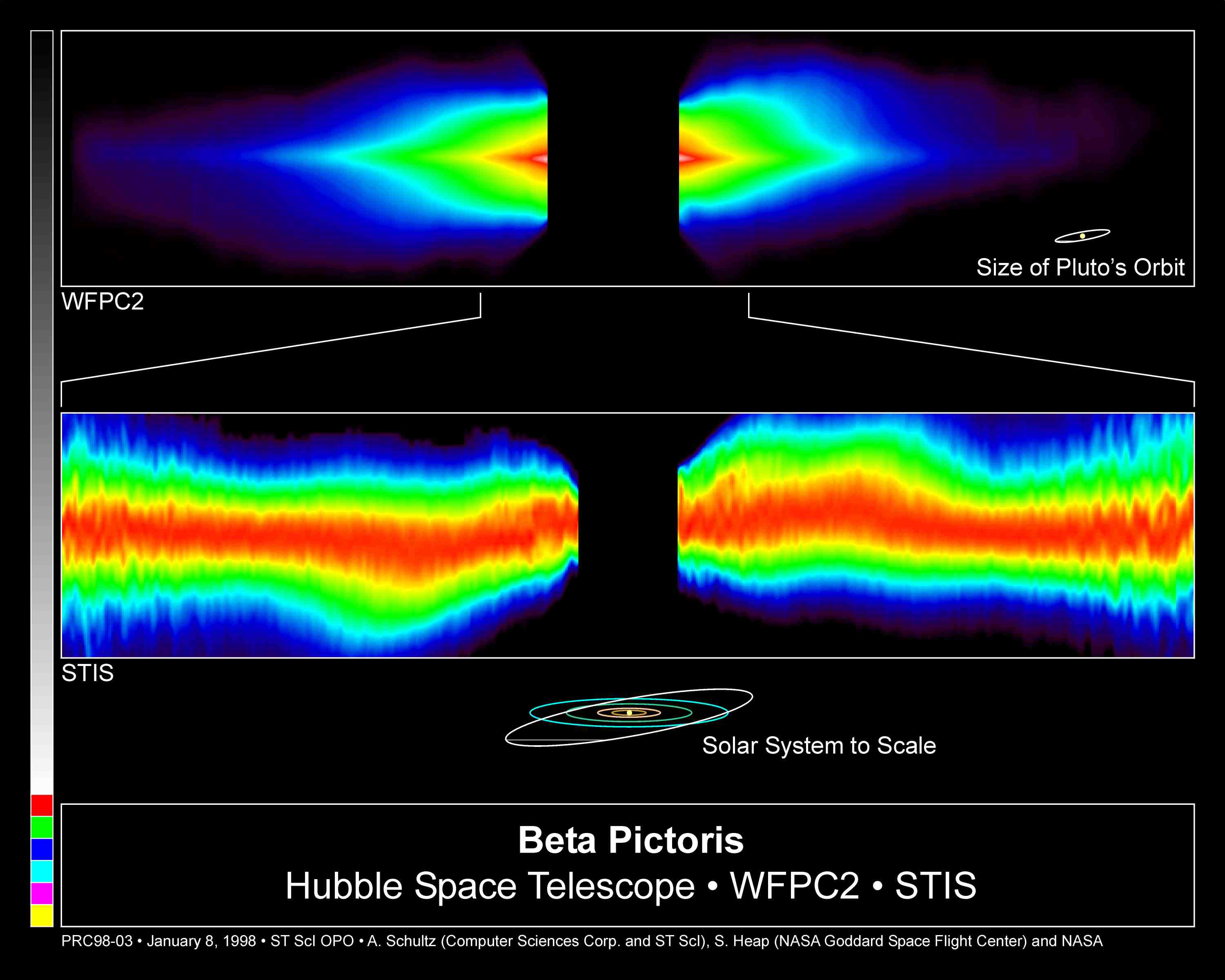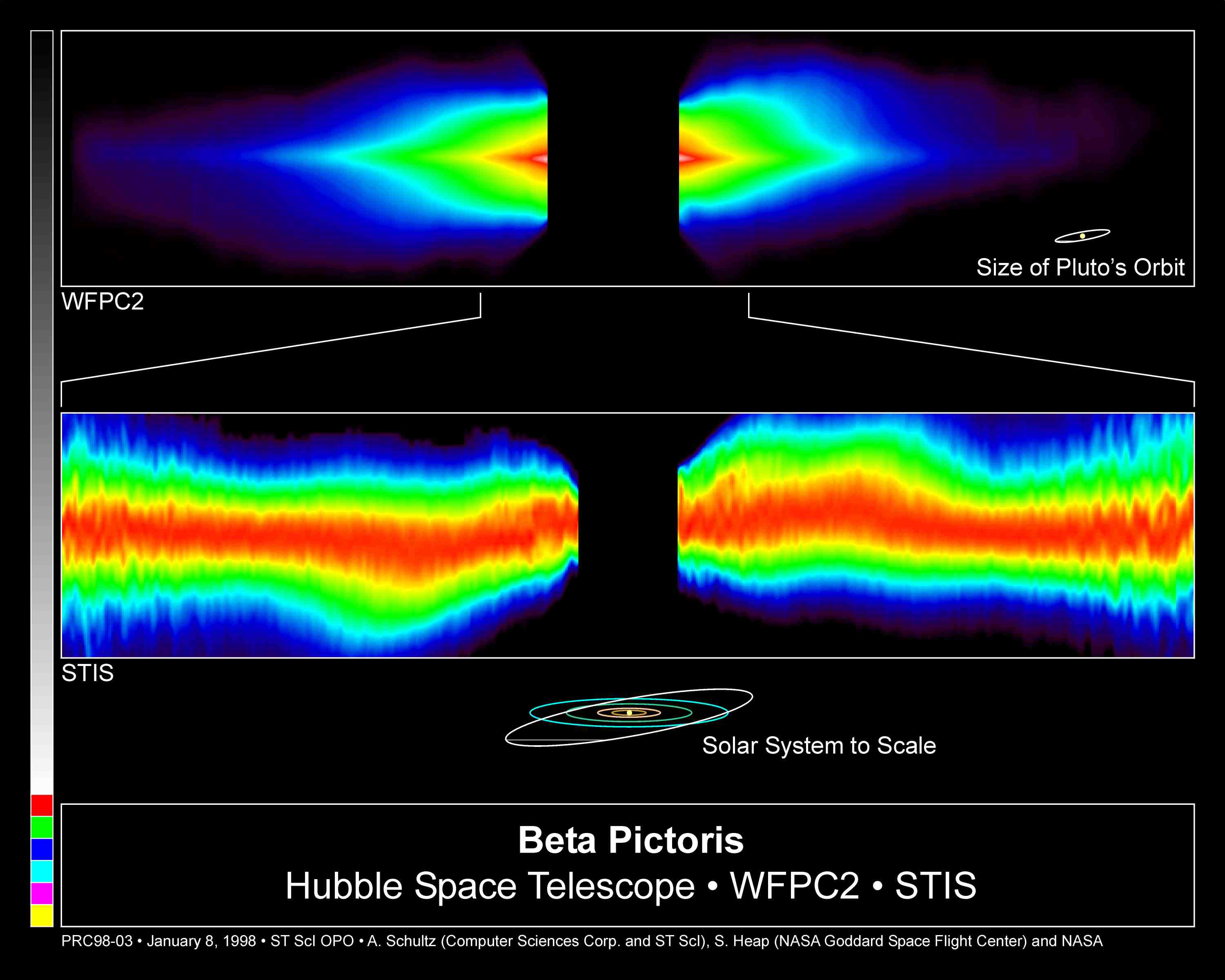
What did our Solar System look like as the planets were forming? Since the 1980s, astronomers have been pointing toward Beta Pictoris, a young, sun-like star a mere 50 light-years distant, as a likely example. Beta Pic is surrounded by a disk of dust which we view nearly edge-on. The dust disk shines by reflected starlight and has been examined with ever increasing detail to search for signs of planetary formation. The trick is to follow the disk as close in to the star as possible, without being overwhelmed by the direct starlight. To make this Hubble Space Telescope image, a coronagraph was used to block the direct starlight and achieve the closest view yet. The false color picture shows the inner section of the dusty disk to within nearly 1.5 billion miles of the star itself, about the scale of the orbit of Uranus. The obvious warp is indirect evidence that a planet now orbits this young sun, slightly inclined to the disk. The planet's gravitational pull would produce the visible distortion.
¿Qué aspecto tenía nuestro Sistema Solar cuando los planetas se estaban formando? Desde la década de 1980, los astrónomos han señalado a Beta Pictoris, una estrella joven similar al Sol situada a apenas 50 años luz de distancia, como un probable ejemplo. Beta Pic está rodeada por un disco de polvo que observamos casi de canto. El disco de polvo brilla por la luz estelar reflejada y ha sido estudiado con un nivel de detalle cada vez mayor en busca de indicios de formación planetaria. El desafío consiste en seguir el disco lo más cerca posible de la estrella, sin quedar abrumados por la luz estelar directa. Para obtener esta imagen del Telescopio Espacial Hubble, se utilizó un coronógrafo para bloquear la luz estelar directa y lograr la vista más próxima obtenida hasta ahora. La imagen en falso color muestra la sección interior del disco de polvo hasta aproximadamente 2.400 millones de kilómetros de la estrella, una escala comparable a la de la órbita de Urano. La evidente deformación constituye evidencia indirecta de que un planeta orbita actualmente alrededor de este joven sol, ligeramente inclinado respecto al disco. La atracción gravitacional del planeta produciría la distorsión visible.