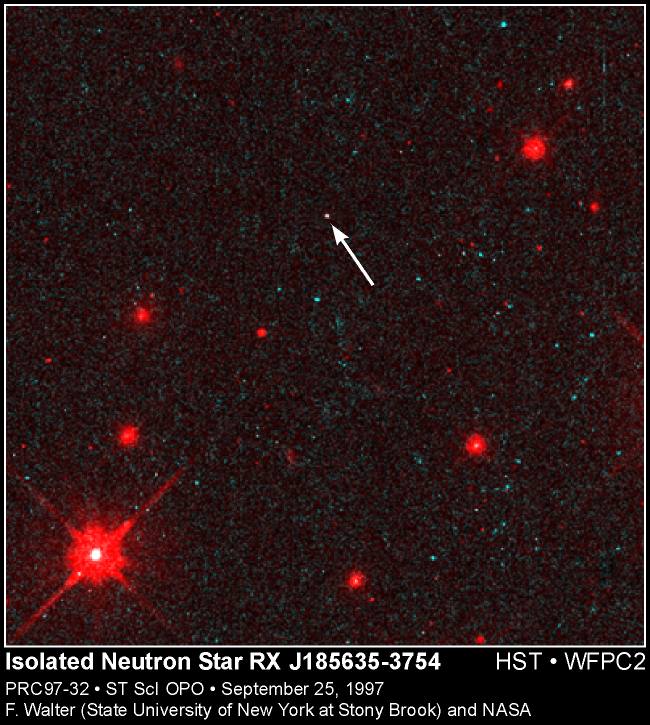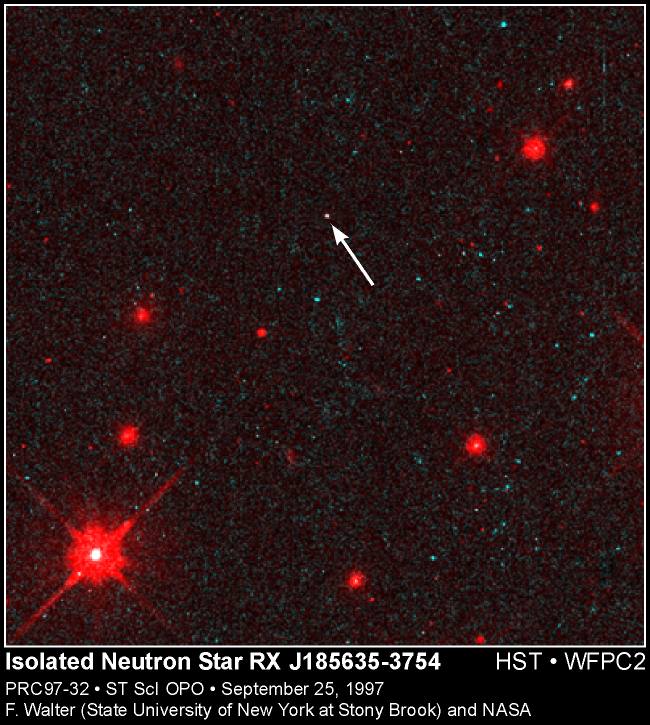
How massive can a star get without imploding into a black hole? These limits are being tested by the discovery of a lone neutron star in space. Observations by the Hubble Space Telescope have been combined with previous observations by the X-ray ROSAT observatory and ultraviolet EUVE observatory for the isolated star at the location of the arrow. Astronomers are able to directly infer the star's size from measurements of its unblended brightness, temperature, and an upper limit on the distance. Assuming that the object is a neutron star of typical mass, some previous theories of neutron star structure would have predicted an implosion that would have created a black hole. That this neutron star even exists therefore allows a window to the extreme conditions that exist in the interiors of neutron stars.
¿Qué tan masiva puede ser una estrella antes de implotar y convertirse en un agujero negro? Estos límites están siendo puestos a prueba por el descubrimiento de una estrella de neutrones aislada en el espacio. Las observaciones del Telescopio Espacial Hubble han sido combinadas con observaciones previas del observatorio de rayos X ROSAT y del observatorio ultravioleta EUVE para estudiar esta estrella aislada ubicada en la posición indicada por la flecha. Los astrónomos son capaces de inferir directamente el tamaño de la estrella a partir de mediciones de su brillo sin contaminación de fuentes cercanas, su temperatura y un límite superior sobre su distancia. Suponiendo que el objeto es una estrella de neutrones de masa típica, algunas teorías previas sobre la estructura de las estrellas de neutrones habrían predicho una implosión que habría dado lugar a un agujero negro. El hecho de que esta estrella de neutrones exista permite, por tanto, asomarse a las condiciones extremas que prevalecen en los interiores de las estrellas de neutrones.