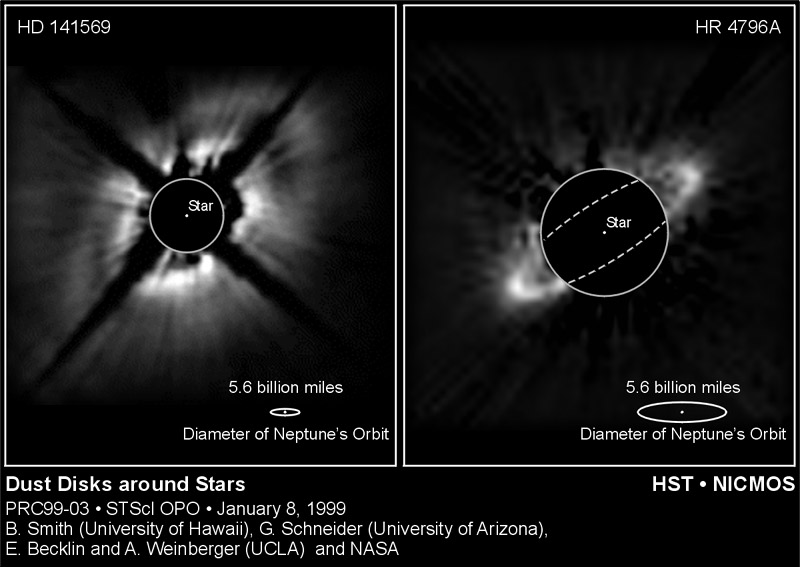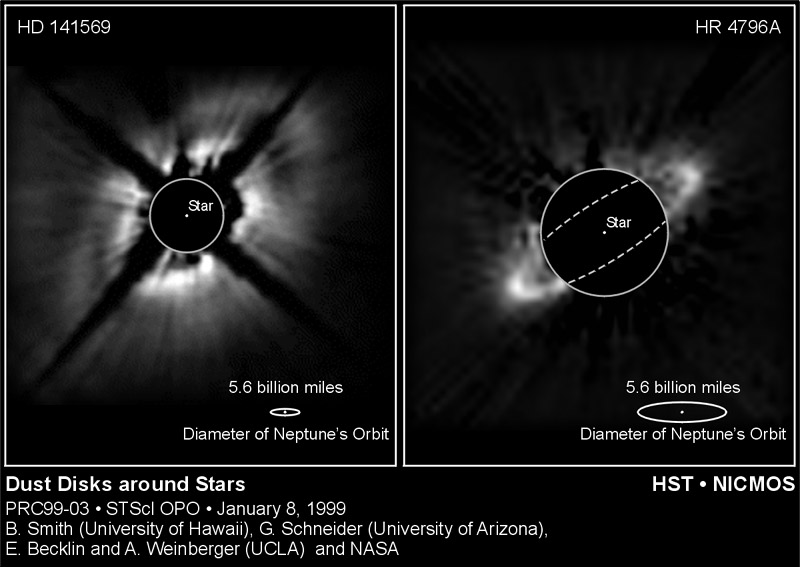
These near-infrared Hubble images of dust surrounding young stars offer the latest tantalizing evidence for planets beyond our Solar System. At left, the dark gap seen in the dust disk is reminiscent of a similar large gap in Saturn's rings believed to be sculpted by orbiting moons. By analogy, the gap in the dust disk of HD 141569 may be a larger scale result of unseen orbiting planets. At right is a relatively thin stellar dust ring suggestive of planetary rings held in place by orbiting moons. On a much larger scale this ring around the star HR 4796A could also indicate the presence of orbiting planet-sized bodies too faint to be directly visible. For a distance comparison, the orbit of Neptune is drawn at the lower right of each picture. The overwhelmingly bright starlight at the center has been blocked out to reveal the dim dust features.
Estas imágenes del Hubble en el infrarrojo cercano de polvo que rodea estrellas jóvenes ofrecen las últimas evidencias tentadoras de planetas más allá de nuestro Sistema Solar. A la izquierda, la brecha oscura visible en el disco de polvo recuerda a una brecha similar de gran tamaño en los anillos de Saturno, que se cree fue esculpida por lunas en órbita. Por analogía, la brecha en el disco de polvo de HD 141569 podría ser el resultado, a mayor escala, de planetas en órbita que no se observan directamente. A la derecha se muestra un anillo de polvo estelar relativamente delgado, sugerente de los anillos planetarios mantenidos en su lugar por lunas en órbita. A una escala mucho mayor, este anillo alrededor de la estrella HR 4796A podría indicar también la presencia de cuerpos del tamaño de planetas en órbita, demasiado tenues para ser visibles directamente. Como referencia de distancia, la órbita de Neptuno aparece dibujada en la parte inferior derecha de cada imagen. La brillante luz estelar del centro, de intensidad abrumadora, ha sido bloqueada para revelar los tenues rasgos del polvo circunestelar.