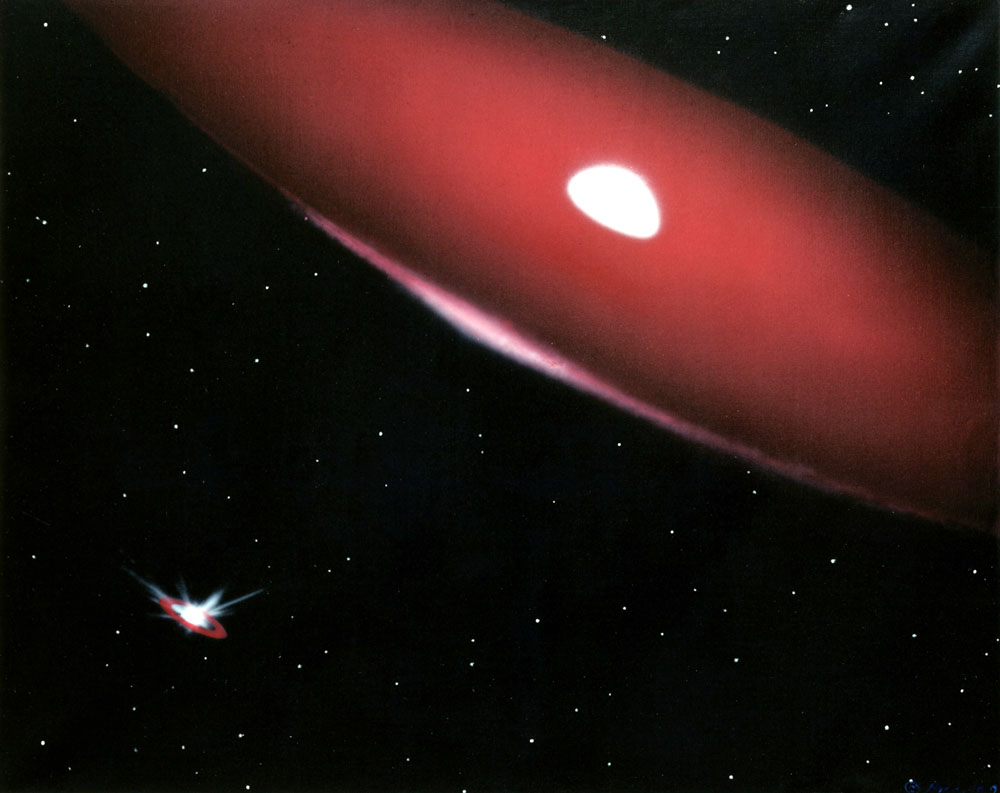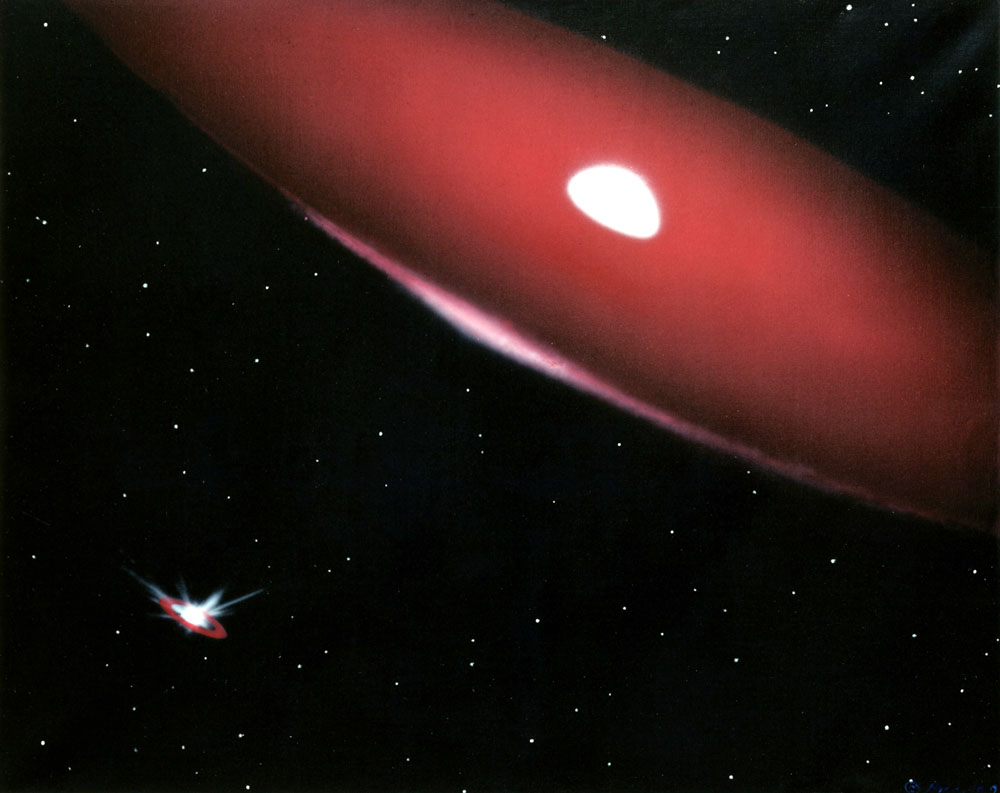
It's clear who is the biggest star in this binary system. Based on recent results, this artist's vision of the double star Phi Persei, 720 light years away, shows a bright, rapidly rotating massive star surrounded by a disk of gas. A small companion star orbits 100 million miles away. The bigger star is presently about 9 times more massive than the small one ... but it wasn't always this way. Ten million years ago the small companion was actually the most massive star in the system and because of its greater mass evolved into a giant star more quickly. After losing its swollen outer layers to the now massive star, all that remains is a stripped down, intensely hot core of about 1 solar mass. In another ten million years, the roles may reverse as the now massive star swells into its own giant phase "returning" mass to its companion. Will these stars end their lives as white dwarfs or supernovae? Astronomers consider the ultimate fate of such mass-exchanging, interacting binary systems an open question and a challenge for present theories of stellar evolution.
Está claro quién es la estrella más grande de este sistema binario. Basada en resultados recientes, esta representación artística de la estrella doble Phi Persei, a 720 años luz de distancia, muestra una estrella masiva, brillante y de rotación rápida rodeada por un disco de gas. Una pequeña estrella compañera orbita a 100 millones de millas de distancia. La estrella más grande es actualmente unas 9 veces más masiva que la pequeña... pero no siempre fue así. Hace diez millones de años, la compañera pequeña era en realidad la estrella más masiva del sistema y, debido a su mayor masa, evolucionó hacia una fase de gigante más rápidamente. Tras perder sus capas externas hinchadas en favor de la ahora masiva estrella, todo lo que queda es un núcleo desnudo e intensamente caliente de aproximadamente 1 masa solar. En otros diez millones de años, los papeles podrían invertirse cuando la ahora masiva estrella se expanda hacia su propia fase de gigante, "devolviendo" masa a su compañera. ¿Terminarán estas estrellas sus vidas como enanas blancas o como supernovas? Los astrónomos consideran el destino final de tales sistemas binarios interactuantes con intercambio de masa una pregunta abierta y un desafío para las teorías actuales de evolución estelar.