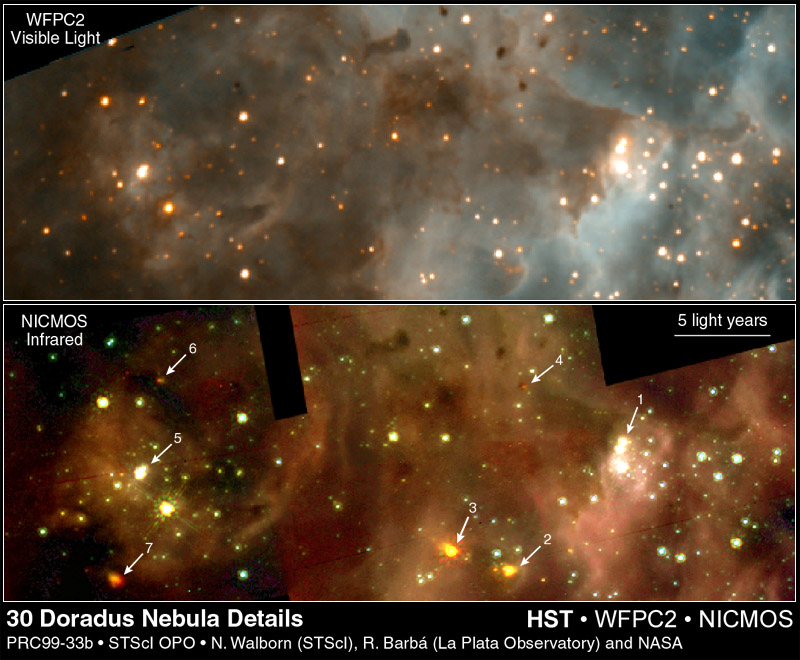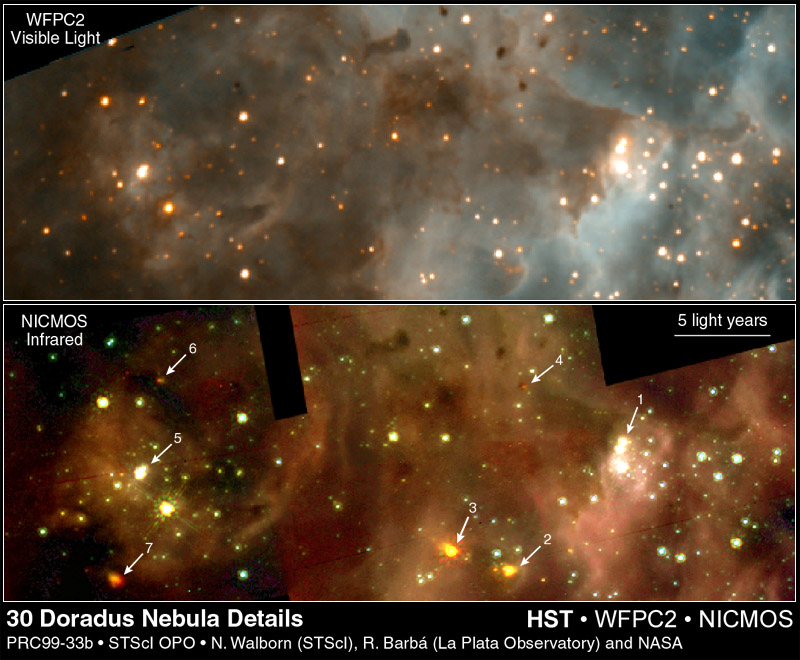
Compare these matched Hubble Space Telescope views (visible-light on top; infrared on bottom) of a region in the star-forming 30 Doradus Nebula. Find the numbered arrows in the infrared image which identify newborn massive stars. For example, arrows 1 and 5 both point to compact clusters of bright young stars. Formed within collapsing gas and dust clouds, the winds and radiation from these hot stars have cleared away the remaining obscuring material making the clusters easily apparent in both visible and infrared images. But still shrouded in dust and readily seen only in the penetrating infrared view are newborn stars and star systems indicated by arrows 2, 3, and 4. Perhaps even more remarkable are the infrared bright spots indicated by arrows 6 and 7. Exactly in a line on opposite sides of the bright cluster at arrow 5, they may actually be caused by symmetric jets of material produced by one of the young cluster stars. These luminous spots are each about 5 light-years from the cluster and would correspond to points at which the energetic jet material impacts the surrounding dust clouds.
Compare estas vistas pareadas del Telescopio Espacial Hubble (luz visible en la parte superior; infrarrojo en la parte inferior) de una región en la nebulosa de formación estelar 30 Doradus. Localice las flechas numeradas en la imagen infrarroja, que identifican estrellas masivas recién nacidas. Por ejemplo, las flechas 1 y 5 señalan cúmulos compactos de jóvenes estrellas brillantes. Formados dentro de nubes de gas y polvo en colapso, los vientos y la radiación provenientes de estas estrellas calientes han despejado el material oscurecedor restante, haciendo que los cúmulos sean fácilmente visibles tanto en imágenes de luz visible como en imágenes infrarrojas. Sin embargo, aún envueltas en polvo y visibles únicamente gracias a la penetrante vista infrarroja, se encuentran las estrellas y sistemas estelares recién nacidos indicados por las flechas 2, 3 y 4. Quizás aún más notables son los puntos brillantes en el infrarrojo señalados por las flechas 6 y 7. Alineados exactamente en lados opuestos del cúmulo brillante de la flecha 5, podrían ser causados por chorros simétricos de material producidos por una de las estrellas jóvenes del cúmulo. Estos puntos luminosos se encuentran cada uno a aproximadamente 5 años-luz del cúmulo y corresponderían a los puntos en los que el material energético del chorro impacta las nubes de polvo circundantes.