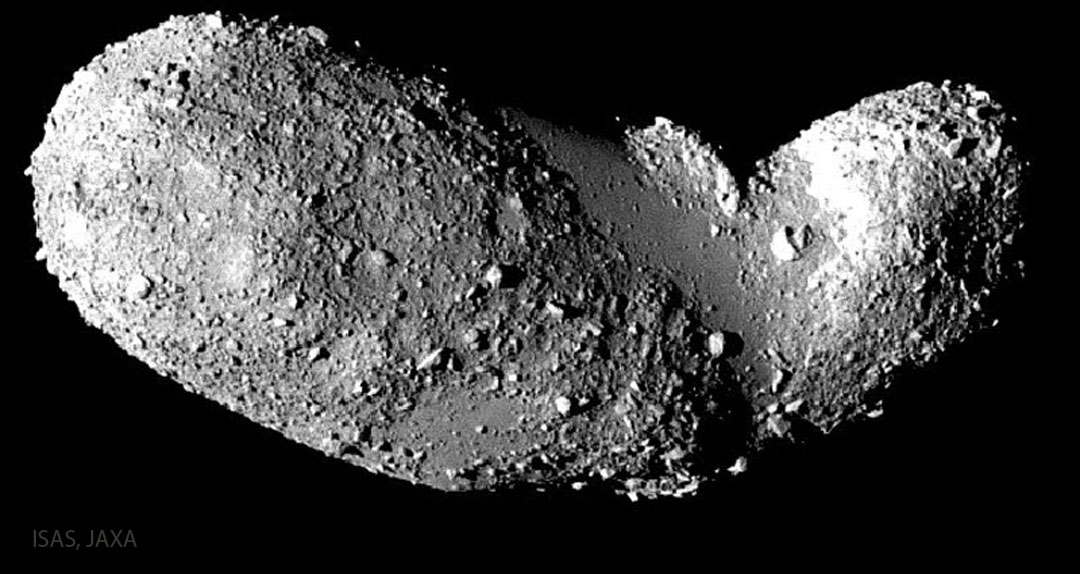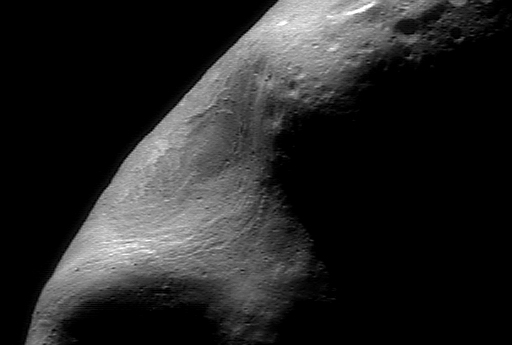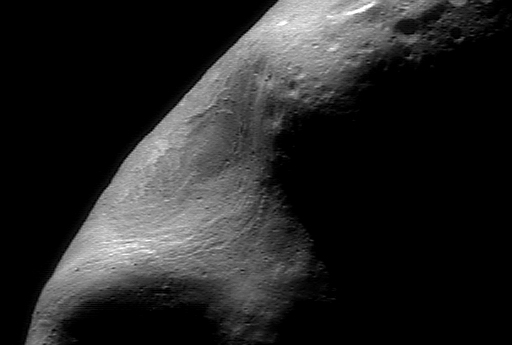
Asteroid 433 Eros is posing several riddles. NASA's robot spacecraft NEAR began orbiting the 30-kilometer space rock last week, and new pictures are now being beamed back to Earth regularly. As usual in science, when you arrive at a place you've never been before, you see things you don't immediately understand. Scientists are contemplating, for example, the cause of the above-pictured giant gouge in the middle of Eros. Intriguing internal features include groves oriented parallel to the asteroid's length and the relative paucity of craters. These indicate that the gouge formed well after the asteroid itself. One question answered by the shape and density is that, unlike asteroid 253 Mathilde, Eros is not a pile of rocks but one big rock. Astronomers are hopeful that data taken over the coming year might indicate the nature and origin of the baffling bright patches.
El asteroide 433 Eros plantea varios enigmas. La nave espacial robótica NEAR de la NASA comenzó a orbitar esta roca espacial de 30 kilómetros la semana pasada, y nuevas imágenes están siendo transmitidas regularmente a la Tierra. Como ocurre habitualmente en la ciencia, cuando se llega a un lugar al que nunca se ha estado antes, se observan cosas que no se comprenden de inmediato. Los científicos están contemplando, por ejemplo, la causa de la gigantesca hendidura que se aprecia en la imagen central de Eros. Entre los intrigantes rasgos internos se incluyen surcos orientados en paralelo a la longitud del asteroide y una relativa escasez de cráteres. Estos indicios sugieren que la hendidura se formó mucho después que el propio asteroide. Una pregunta respondida por la forma y la densidad es que, a diferencia del asteroide 253 Mathilde, Eros no es un montón de rocas sino una gran roca sólida. Los astrónomos confían en que los datos recopilados durante el próximo año puedan revelar la naturaleza y el origen de los desconcertantes parches brillantes.